Cavalry saddles up for relic survey
An all-female team from Horgos, in Northwest China, crosses mountains and grasslands to safeguard heritage.









In the vast, rugged terrain of Northwest China's Xinjiang Uygur autonomous region, an all-female team has been traversing mountains and grasslands on horseback to ensure the nation's cultural heritage is precisely documented and preserved.
The four-member team hails from Horgos city in Ili Kazak autonomous prefecture, with an average age over 43.
Xinjiang has long been a crucial hub where Eastern and Western civilizations met and mingled.
As the fourth national cultural relics survey, launched in November 2023 and set to conclude in June 2026, continues its mission, this dedicated team is contributing its expertise and passion to the monumental task.
Team leader Zhang Huiling, who has 31 years of experience in cultural relics preservation, also took part in the third survey more than a decade ago.
She recalls the significant challenges of that time.
"Back then, we relied on manual measurement and hand drawing. Ensuring accuracy was the biggest challenge," Zhang says. "Now, with advanced technological tools, our mapping and surveying work has become much more efficient and precise."
The scope of the current survey is extensive. To reach remote and inaccessible sites, the team often has to ditch their vehicles, trek on foot or ride horses through harsh terrain and in unpredictable weather.
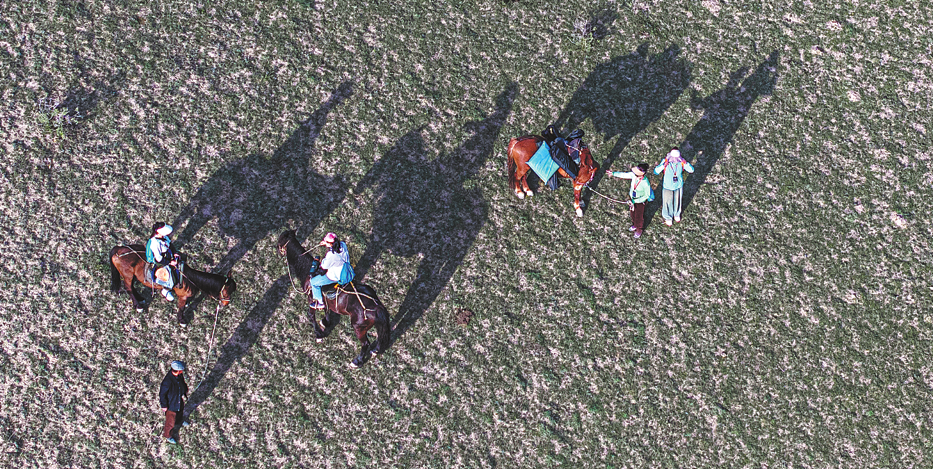
Horgos, which means "a place where camel caravans pass" in the Mongolian language, has been a key post on the northern route of the ancient Silk Road since the Tang Dynasty (618-907). It stands as a living evidence of multicultural exchange, witnessing centuries of vibrant trade and interaction among various cultures.
That legacy continues today. One of their assignments was the recording and registration of Horgos' fifth-generation National Gate, a symbolic modern structure. The first-generation National Gate was built in the 1960s to strengthen border management.
Their work often takes them to sites of profound historical significance.
These include the remains of Qing Dynasty (1644-1911) boundary stones, which served as important symbols of national sovereignty and unity, and ancient tomb complexes, all of which offer invaluable insights into the region's rich past.
Through their dedication, they are not just documenting history but actively preserving the tangible memory of the diverse cultures that have shaped Xinjiang, ensuring that this precious heritage is accurately mapped and remembered for generations to come.
Archaeological findings in recent years have shed light on the origins of Chinese civilization in this vast region and its role in forming a united nation.
By the end of last year, Xinjiang boasted 9,545 verified and registered immovable cultural relics, among which six were on the World Heritage List and 133 key cultural relic sites under national-level protection, according to official statistics.





- China's Global Governance Initiative receives positive feedback at forum
- China's Xizang sees steady tourism growth in 2025
- First-of-its-kind pearl auction held utilizing Hainan FTP
- Agarwood exhibition steeps Shanghai museum in fragrance
- The Fujian Coast Guard conducts regular law enforcement patrol in the waters near Jinmen
- IP protection for new fields to improve