World's tallest bridge seen as new high in infrastructure









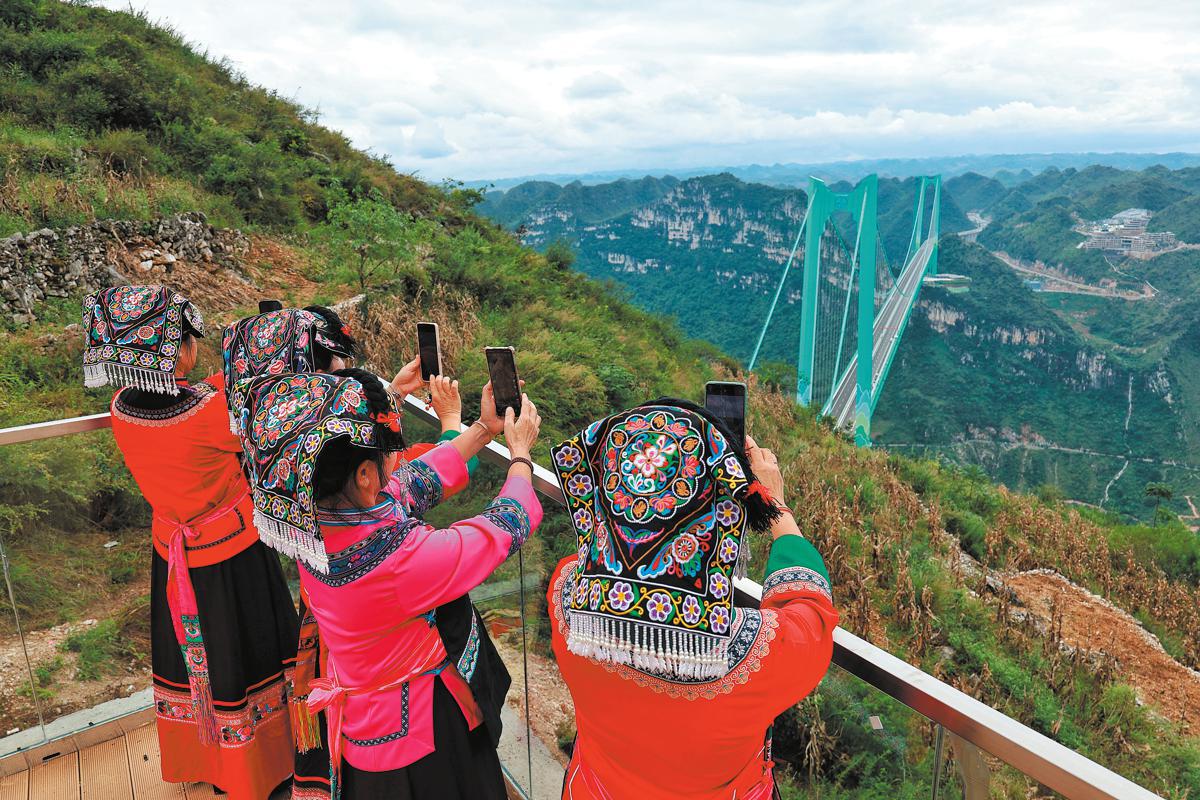
The Huajiang Grand Canyon Bridge in Guizhou province, the world's tallest, opened to traffic on Sunday, turning what was once a two-hour drive across the gorge into a trip of barely two minutes. It's a symbol of China's progress in improving infrastructure in rural areas.
Rising 625 meters above the Beipan River, the bridge is a key project of an expressway linking the Liuzhi special district of Liupanshui city with Anlong county. With a main span measuring 1,420 meters, it anchors a new expressway that winds through one of China's most mountainous provinces, where geography has long made traveling a challenge.
Guizhou has earned a reputation as a province of bridges. According to the provincial transportation department, more than 32,000 bridges have been built or are under construction, and nearly half of the world's 100 tallest bridges rise from its valleys. The Huajiang bridge is now its most striking landmark, embodying both practical needs and engineering ambition of the region.
Building at such a height tested the limits of design and construction. Engineers faced unpredictable weather, sheer cliffs and wind gusts topping 100 kilometers per hour. To meet those challenges, the team relied on a series of new technologies.
Han Hongju, chief engineer of the Guizhou Communications Investment Group, said the company introduced an intelligent cable-hoisting system guided by the Beidou Navigation Satellite System. It allowed workers to position steel trusses — the structures that support the deck — with centimeter-level accuracy.
"The job once required 40 to 50 workers to watch the process physically and communicate by radio," Han said. "Now, one or two people in a control room can input coordinates and limit positioning errors within 10 centimeters."
Liang Junyuan, a project manager who oversaw manufacturing and splice work, said that the China Railway Baoji Bridge Group used a virtual preassembly technique, likened to "building blocks in the cloud", to install 93 truss segments in just 73 days.
Liang said the team adopted a streamlined design and a central stabilizing plate to counter wind of more than 100 km per hour, reducing wind loads by about 30 percent.
Choosing the site itself required careful study. Engineers considered several options within five to 10 km upstream and downstream, balancing cost, safety and environmental protection.
"Those objective conditions determined the bridge's height and span," said Yang Jian, chief engineer at the Guizhou Transportation Planning Survey & Design Academy Co, the survey and design company for the bridge. "It turns an impassable gorge into a passage and helps spur development for residents living nearby."
Beyond the engineering, the bridge is already reshaping local tourism and the economy. Authorities and developers are preparing attractions such as bungee jumping, a cafe atop the bridge tower, and an integrated tourism area designed to channel income into surrounding communities.
In Huajiang village, directly below the bridge, signs of vitalization are visible. Once part of the ancient Tea Horse Road linking Guizhou with Yunnan province, the formerly quiet village has seen a surge of visitors.
"Thanks to the unique upward view of the bridge, visitor numbers have multiplied," said Zhang Delin, Party secretary of Pingjie township. "Tourists from across the country and even artists are coming to see this magnificent project."
According to him, once-barren fields and outward migration are giving way to a revival. An increasing number of young people have returned in recent years to start businesses around the bridge.
One of them is Lin Guoquan, 35, who used to be a migrant worker and now runs a guesthouse in the village. His property offers a view of the bridge from its bedrooms. "We've been fully booked for days, and everyone wants to see the opening," Lin said.
On the opposite bank, Huajiang township in Guanling county is widening roads and building viewing platforms and other tourist facilities to handle crowds.
Local officials estimate that 1,000 to 2,000 people were visiting daily even before the bridge opened, with no admission fee required.
Contact the writers at liuboqian@chinadaily.com.cn


- Taipei Confucius Temple holds annual ceremony marking Confucius' birth
- Former agricultural minister sentenced for bribery
- Grassland justice delivered on horseback
- China braces for holiday travel surge
- Refined legal services streamline border trade
- Fujian coast guard conducts routine patrol in waters near Kinmen