


Dual carbon goals spur green business into action
Nation's entrepreneurs answer call to reduce emissions and protect environment










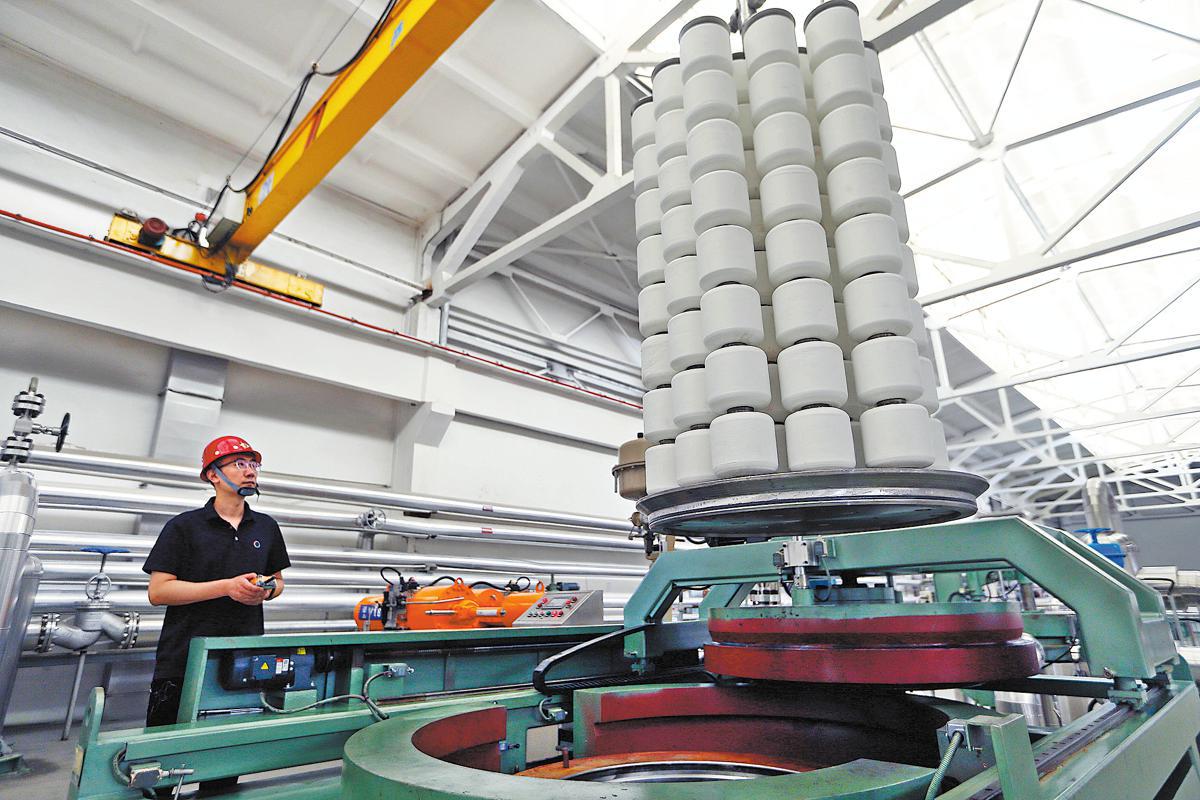
Manufacturing with recycled materials is challenging, as it involves a comprehensive production chain that includes waste recycling, materials development, product design and marketing, Fang said, adding that completing a full product cycle takes over seven months.
"The cost of converting recycled waste into usable materials results in higher prices for our products," she said. "While the investment is substantial, the returns are slow. Without self-belief, it is very difficult to persevere."
Given the company's reliance on recycled waste, Fang advocates for more diligent waste sorting efforts.
Kong Zhicong, founder and CEO of Weirong New Material Technology (Shenzhen) Co in Shenzhen, Guangdong province, is a comparative latecomer to the low-carbon sector. However, he is tapping into innovative solutions to address plastic pollution and contribute to the dual carbon goals by making edible tableware.
His company's edible tableware has appeared in parks, offices and hotels, replacing single-use plastic tableware.
Kong said the products embody the concept of "from farm to fork, from fork to farm". "The materials are 100 percent agricultural products, such as rice powder, fiber and cassava, with zero artificial additives, making the products edible for both humans and animals," he said.
The food-based tableware can be recycled two to three times and can even serve as animal feed after use. It requires no industrial composting and can decompose completely under household composting conditions in approximately 14 days, leaving no residue or pollution, according to the company.
This shortened degradation cycle reduces the end-of-life processing costs associated with traditional disposable tableware, allowing for more effective land use and decreasing the environmental impact and pollution caused by solid waste, Kong said.
The entrepreneur conceived the idea of producing edible tableware while studying biomedical engineering in the United States. "I learned that microplastics have entered humans' brains and hearts, potentially leading to diseases," he said.
"I believe that products related to food should be safe to put in the mouth and degradable once discarded," he said.
Kong first launched the business in the US in 2017. In 2020, he returned to China and established operations in Shenzhen. "Our edible technology requires a concentrated and efficient industrial chain, and China offers that advantage," he said.
In 2020, when China proposed its dual carbon goals, Kong's company received policy support and positive market feedback. "Public awareness increased after the launch of the dual carbon goals, facilitating the promotion of our recyclable and degradable products," he said, adding that younger generations are particularly interested in these environmentally friendly products.
Since last year, China's hotel industry in tier-one cities — usually referring to Beijing, Shanghai and Guangzhou and Shenzhen in Guangdong — has been implementing carbon quota management, incorporating hotel carbon emissions into the government's overall carbon management framework.
Kong's company reported that intent orders have risen since the start of the year, totaling about $5 million.
"As a brand-new product category, promoting and educating people about the recyclable concept takes time. We will continue to use various scenarios to amplify its influence and reduce costs by scaling up production," he said.

Contact the writers at houliqiang@chinadaily.com.cn





