



STEM institute might attract more to science









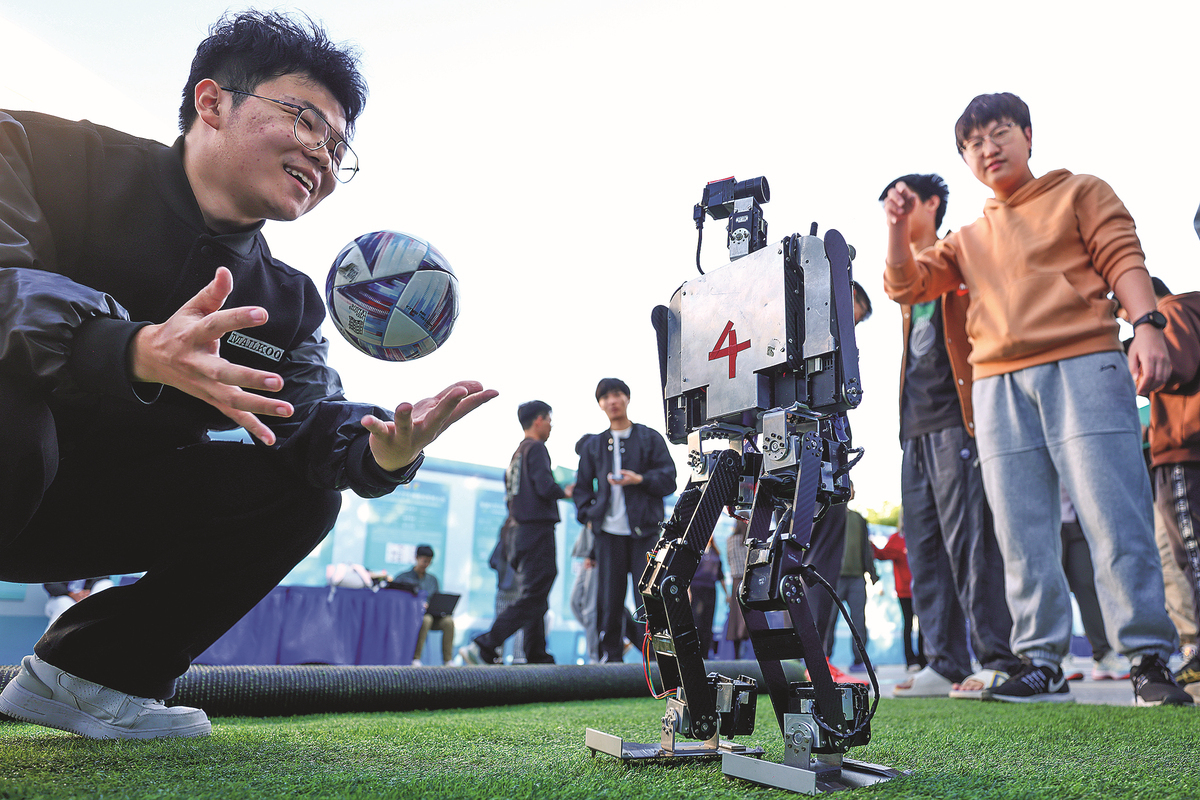
Editor's note: UNESCO inaugurated its International Institute for STEM Education in Shanghai on Sunday. It is the first Category 1 institute of its kind in China. What does this mean for China's education reforms and for global cooperation in STEM? China Daily asked Xiong Bingqi, director of the 21st Century Education Research Institute, and Chu Zhaohui, a senior researcher at the China National Academy of Educational Sciences. Below are excerpts from the interviews. The views don't necessarily represent those of China Daily.
UNESCO's decision to set up the International Institute for STEM Education in Shanghai marks more than the opening of a new institute. It underscores both Shanghai's pioneering role in education reform and China's growing influence in shaping the future of science and education. As the 10th UNESCO Category 1 hub in the world, it highlights China's expanding role in global education governance.
STEM — science, technology, engineering and mathematics — has always been part of Chinese classrooms. Most students study math, science and technology-related subjects. But STEM education goes beyond rote learning, encouraging curiosity, problem-solving and creativity, preparing students to thrive in the 21st century.
"All-round education" has been discussed in China since the 1980s, but due to exam pressure students memorize math formulas without necessarily having real mathematical understanding. In physics and chemistry, labs are sometimes replaced by lectures because exams do not test hands-on ability. Lectures impart knowledge but sometimes ignore nurturing the scientific spirit.
Shanghai has moved against this trend by investing in practice stations, innovation bases and its "future scientists" program, which trains selected students at advanced levels. Museums and labs have become spaces for inquiry. Such initiatives made Shanghai a natural choice for UNESCO's global STEM institute.
China's good performances at the Math Olympiad show how training doesn't necessarily stimulate a lifelong passion for math-related studies. Students have won medals abroad but none has become a Fields Medalist. On the other hand, STEM education promotes individuality and encourages diverse interests. One Shanghai kindergarten, for instance, launched a "four seasons discovery" project where children used tablets and cameras to study seasonal changes. Such experiences cultivate curiosity that exams don't instill.
This approach aligns with China's broader education reforms, which seek to move from "one-score-fits-all" assessments to a multidimensional evaluation. It also connects with career choices. In 2020, China launched a plan to attract top students into math, physics, chemistry and biology. Yet many hesitated to join because these majors are perceived to be less practical in the job market. Students avoiding science has become a concern.
STEM education can help reverse this trend by offering meaningful early exposure to help students envision a future in these fields. At the high school affiliated to Fudan University, up to 20 percent of students now choose engineering majors — well above the national average. With better guidance, more students might see science not as a burden but as a calling.
The opening of the Shanghai institute recognizes China's progress and could become a catalyst for change. It signals a rebalancing of education governance, as the world's largest pool of STEM graduates and fastest-improving systems are here. It also offers momentum for South-South cooperation, enabling developing nations in Africa and Asia to share resources and innovations.
For China, it is an opportunity to accelerate reforms that emphasize well-rounded learning, individuality and career readiness. For the world, it is an invitation to learn from China's experiences and to share solutions.





