Breaking traditional barriers










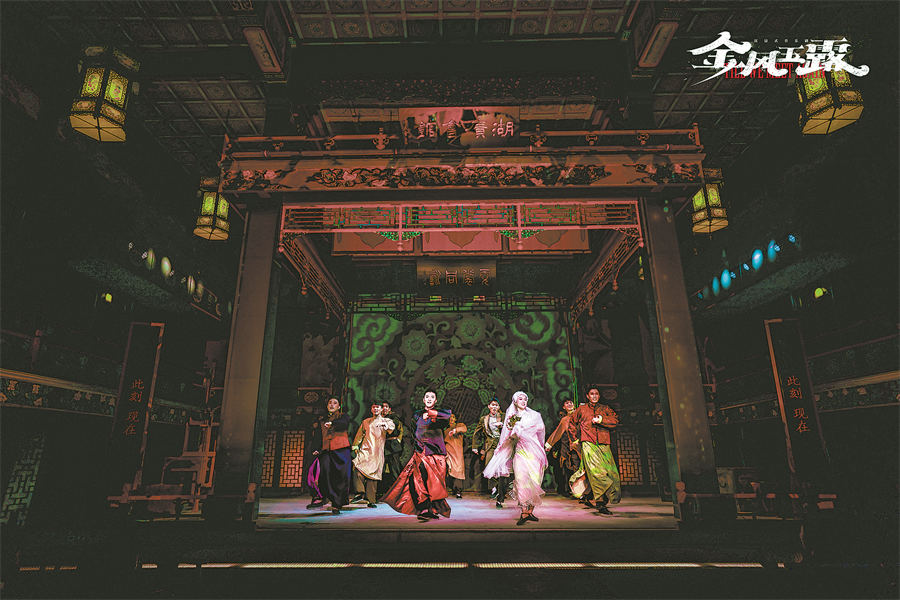
The production also pays homage to the distinctive performing styles of Peking Opera's greatest masters, including the Mei school and the Tan school. The cast's performances showcase the rich diversity within the tradition. For example, Zhang Jianfeng, known for his Xi school style, brings a depth and emotional resonance to his performance, while Ma Botong, with his Tan school training, offers sharp, commanding vocals that echo the energy of heroic figures. In contrast, Qiu Shi's Yu school delivery evokes rustic simplicity and graceful dignity.
Among the dan (female) roles, Dou Xiaoxuan's interpretation of the Mei school is regal and dignified, while Wang Qian's performance, with the Zhang school's fluidity and charm, exudes a youthful, playful energy. Zhang Zixi, representing the Cheng school, is captivating, delivering a poignant and subtle performance that evokes sorrow and tenderness.
"Though the basic melodies remain consistent, each school brings a unique flavor to the performance," says Li. "It's a conversation between tradition and innovation. Every performance, every voice, adds a new layer to tradition."
Li's approach hasn't gone unnoticed by younger audiences. Yan Zhenqing has drawn praise from those who may not have normally engaged with Peking Opera.
"I didn't expect to be so moved by it," wrote an audience member on the social media platform, RedNote. "The visuals were stunning, and the story felt so relevant to today. It was like seeing something old but made new again. I could really connect with it."
Another audience member shared: "I always thought traditional Chinese opera was too formal and old-fashioned. But after seeing this production, I realized it's a living art form, and it speaks to my generation, too."
Li, who was introduced to traditional Chinese opera by her family in Linfen, Shanxi province, has been part of the Jingju Theater Company of Beijing since graduating from the National Academy of Chinese Theatre Arts in 2011. When she first began working with the company, the theater had not hired a new director in years. The company was collaborating with famous directors, but Li's breakthrough came when the company's president asked her a pivotal question: "What can you bring to the table to compete with these big-name directors?"