


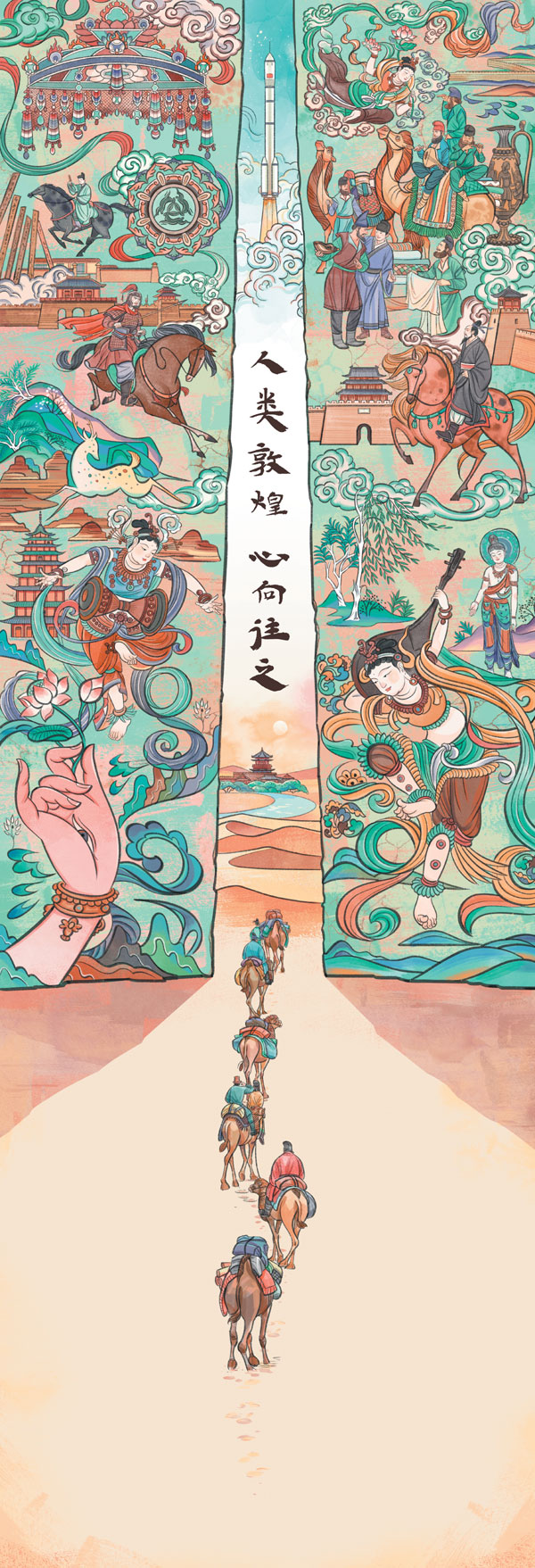
In the Gobi Desert of Northwest China, there is a place that appeals to all hearts: Dunhuang. Those who have visited often express a desire to return.
The renowned scholar Ji Xianlin once said there are four major cultural systems in the world: China, India, Greece, and Islam. There is no fifth. And there is only one place where these four cultural systems converge: Dunhuang and the Xinjiang Uygur autonomous region. There is no other.
A trip to Dunhuang can be a journey through history, a pilgrimage for art, or a retreat for the soul. Every visitor leaves with memories to treasure.
Silk Road
During the reign of Emperor Wu in the Western Han Dynasty (206 BC-AD 24), envoy Zhang Qian was sent on missions to the western regions twice. He pioneered a land route that started from Chang'an (today's Xi'an), passed through the Hexi Corridor and Dunhuang, crossed the Tianshan Mountains, and continued to Central Asia, West Asia, and eventually the Mediterranean coast. This trade and cultural corridor linking East and West was later named the ancient Silk Road. From then on, the deep integration of technology, culture, art, and religion among the diverse nations along this route influenced the entire globe.
On this vital route, two essential thoroughfares for merchants and envoys traveling to and from the western regions - the Yangguan and Yumen passes - served as thriving hubs. These two passes faced each other across the desert, jointly guarding the western end of the Hexi Corridor. Silk and tea were transported westward, while grapes, alfalfa, and fine horses were introduced eastward. Notably, the route through Yangguan Pass was relatively flat, had more water sources, and was less obstructed by desert sands, making it easier to traverse. It was thus metaphorically referred to by ancient people as the "bright and smooth path". Gradually, the term "Yangguan Avenue" became widely used in Chinese folk vocabulary.
The Xuanquan Posthouse, a World Cultural Heritage Site in Dunhuang, was first opened to the public on May 1. Originally a crucial postal and courier station on the Silk Road over 2,100 years ago, it aided the delivery of official documents and hosted traveling envoys and officials. More than 70,000 relics, including bamboo or wooden slips, silk books, paper documents, crops, farming tools, and domestic animal bones, were unearthed from the site. Like keys unlocking the door to history, these artifacts showcase the daily lives of people from that era, offering a glimpse into the bustling activity and intricate details of Silk Road exchanges.
The Sogdians emerged as the dominant commercial force along the ancient Silk Road from the fourth to eighth centuries with their distinctive organizational models and trade wisdom. Relying on family ties and homeland connections, they formed tightly coordinated caravans. They used Sassanian silver coins for transactions and established way stations in key cities like Dunhuang and Liangzhou. In Dunhuang's markets, Sassanian silver coins were exchanged for Chinese products, creating a vibrant trading scene on the ancient Silk Road.





