


Digging for true war stories










Chinese people then fought back. Under the leadership of the Communist Party of China, they gradually formed the army and fought as guerrillas deep in the mountains where winter often lingers for more than five months a year with a temperature as low as — 40 C.
Wearing poor clothing, armed with rudimentary weapons, and lacking permanent bases for 14 years, the soldiers endured extreme weather conditions and starvation but persisted in their brave efforts to tie down hundreds of thousands of enemies, preventing them from advancing into other areas of the country.
When the war ended in 1945, only about 700 soldiers from this army had survived, a number which had reached more than 30,000 in 1937, according to Sun Taizhi, an official from Jilin province's Party history research office.
Amid the 80th anniversary of the victory in the War of Resistance, people are telling more accurate stories of this heroic army, using the latest archaeological evidence.
Over the years, though many stories about the army have been told, people have found few traces of their battles. As guerrillas, they could hardly establish stable base areas. Moreover, the already identified bases were in shambles. With time, people cannot find obvious traces aboveground, says Meng, a researcher at the Jilin Provincial Institute of Cultural Relics and Archaeology.
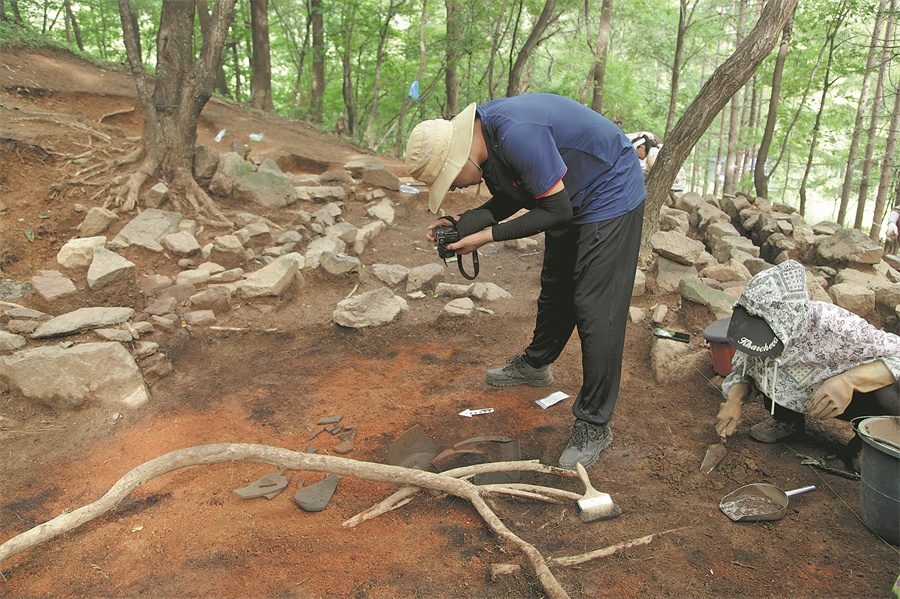
That's where archaeological studies come into play. Archaeologists led by Meng have studied the Hongshilazi site since 2021, which was used as an early base area against Japanese aggression in Northeast China.
The archaeologists have discovered more than 3,300 relics in an excavation area of 5,000 square meters, and determined the site's layout and its four major types of relics: barracks, lookout posts, combat fortifications, and training grounds, says Li Ningning, the executive head of the archaeological team.
She says they have also unearthed more than 1,000 pottery, iron, bronze, porcelain, and glass artifacts, which were used as weapons, farming tools, and daily utensils.





