



2 rocket launches carry 12 high-tech satellites









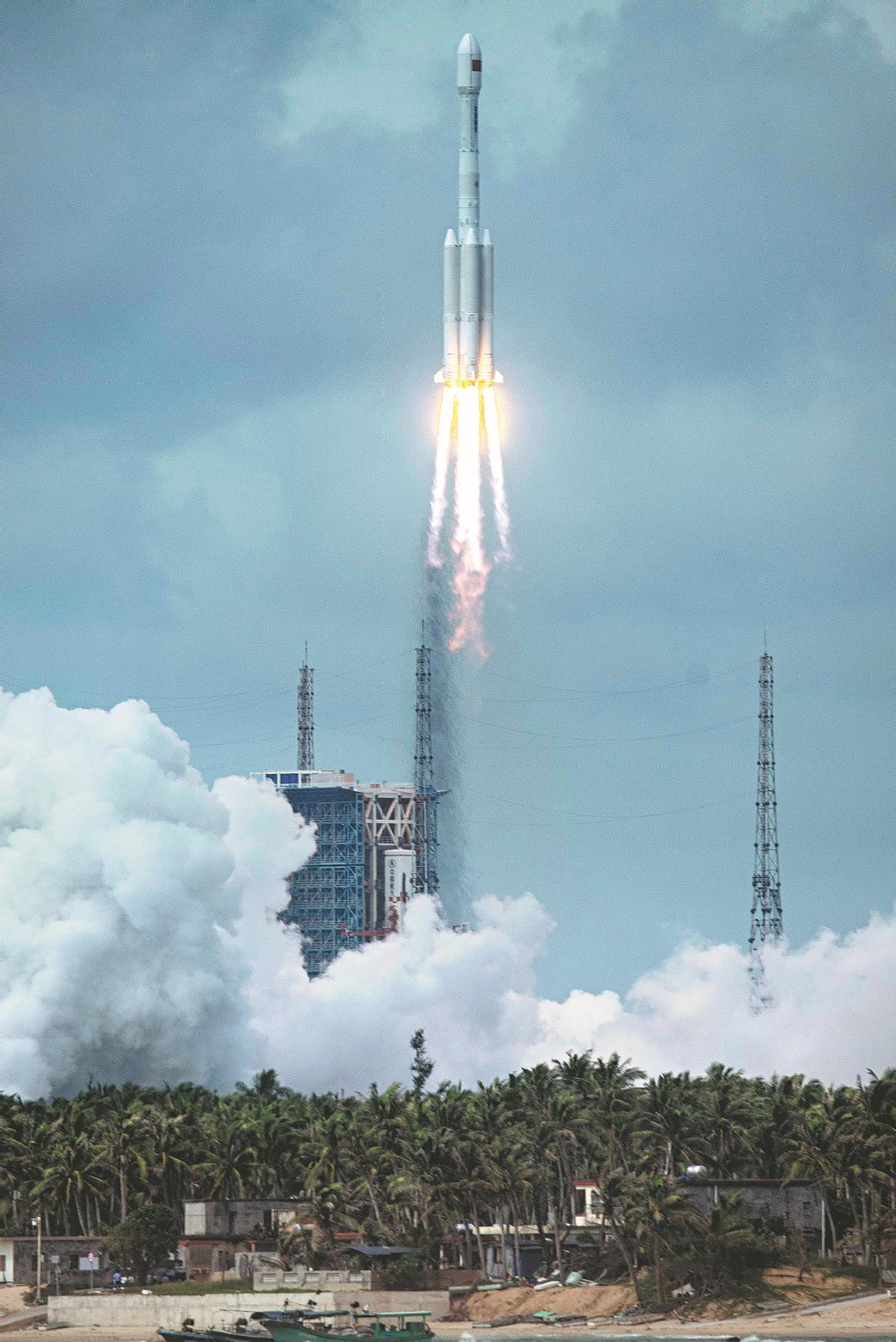
China conducted two rocket launches on Tuesday, sending a total of 12 satellites into space.
A Smart Dragon 3 rocket blasted off at 3:48 am from a launch service ship off the coast of Rizhao, Shandong province, and soon deployed 11 multi-function satellites into their preset positions in a low-Earth orbit about 600 kilometers above the ground. The liftoff marked the rocket model's seventh sea-based launch, China Academy of Launch Vehicle Technology, maker of the Smart Dragon 3 series, said in a news statement released afterwards.
The Smart Dragon 3 is a solid-propellant rocket. The 31-meter-tall spacecraft has a diameter of 2.65 meters and a liftoff weight of 140 metric tons. It is mainly propelled by a high-performance solid-propellant engine holding 71 tons of propellant that creates a thrust of 200 tons.
The rocket has the capacity to send multiple satellites with a combined weight of 1.5 tons to a typical sun-synchronous orbit at an altitude of 500 km.
To date, China has performed 18 sea-based launches using four types of rockets: the Long March 11, the Smart Dragon 3, the Ceres 1 and the Gravity 1.
Developed by Geespace, a private satellite maker in Zhejiang province, the satellites will work with 41 previously deployed Geely satellites to perform a host of tasks that include: collecting data for marine businesses, traffic and transport management, and power generation; conducting tests pertaining to the internet of things and inter-satellite communications; and monitoring environmental pollution, according to Geespace.
A little over six hours later, a Long March 7A rocket blasted off at 10 am from the Wenchang Space Launch Center in Hainan province and transported the Yaogan 45 remote-sensing satellite into its preset orbit.
Built by the Shanghai Academy of Spaceflight Technology — a subsidiary of China Aerospace Science and Technology Corp — the satellite is tasked with facilitating scientific experiments, surveying land resources, monitoring agricultural yields, and supporting disaster prevention and mitigation.
Remote-sensing satellites are usually used to detect and monitor the physical characteristics of objects on land or at sea by measuring reflected and emitted radiation. Data obtained by the Yaogan family, the major series of remote-sensing spacecraft in China, has been widely used by governments, public service sectors and businesses.
The Long March 7A is also a product of the China Academy of Launch Vehicle Technology. It has a liftoff weight of 573 tons and a core-stage diameter of 3.35 meters. It can place a 7-ton spacecraft into geosynchronous transfer orbit.
The latest launch marked the 594th mission of the Long March family and China's 55th rocket launch in 2025.


- Zhejiang to focus on innovation, role as 'strategic pivot'
- Revision to Prison Law helps protect inmate rights, improve rehabilitation
- Book acts as window on China's governance philosophy
- President sends festive greetings to working people
- Exertion, sweat give students 'real rewards'
- Hands-on experience instills steel, empathy in students





