Why factory tours are China's new weekend craze









On the first day Xiaomi's car plant in Beijing opened to visitors this January, more than 4,600 people registered for just 20 available slots. Tech robotics firm Unitree saw its factory tours resold for as much as 3,000 yuan ($420.65) per ticket, yet demand still far outstripped supply.
Many young people in China are now choosing factories over conventional weekend destinations like malls or theme parks. On social media, the trend has earned the playful nickname "Industrial Disneyland", with memes joking, "On weekdays I work overtime in a factory; on weekends I visit another one."
Beyond the humor lies a deeper cultural phenomenon. For families, factories serve as classrooms, giving children a chance to see how things are made and connect textbook knowledge with real-world production.
For young professionals, the tours carry a sense of nostalgia, evoking the industrial backbone that supported their parents' generation while offering a counterpoint to their own screen-centered lives.
And for content creators, factories have become unexpected stages: the rhythmic sounds of machines, the choreography of assembly lines, and the sheer materiality of production provide both aesthetic inspiration and a sense of authenticity that resonates with audiences weary of curated digital experiences.
What makes this wave of industrial tourism particularly noteworthy is the role of youth in shaping it.
For China's younger generation, factories are not merely sites of labor but symbols of national capability and modern ingenuity. Visiting a factory is at once an educational activity, a cultural performance, and a statement of identity. It satisfies curiosity about how everyday products come to life while also offering reassurance that the country's technological foundations remain solid. Enthusiasm for factory tours thus reflects both a personal search for novelty and collective pride in industrial achievement.
Factory tours also reflect broader social transformations. They mark a society more confident in its industrial base, more willing to turn production into culture, and more skilled at weaving industry into everyday leisure.
They reveal a shift in tourism itself: away from passive consumption of spectacles toward participatory, affordable, and experiential activities.
For a generation facing economic pressures and seeking meaningful yet accessible recreation, factories provide a rare combination of education, entertainment, and empowerment.
Globally, "industrial tourism" is not new. France's Citroen opened its workshops to the public in the 1950s, and breweries across Europe still welcome millions annually.
But in China, the momentum carries distinct cultural resonance. Over the past five years, at least 13 major firms — from carmakers to beverage producers — have opened their production lines to visitors. This signals a rebranding: from "Made in China "to "Experienced in China".
The potential is vast. Reports suggest that industrial tourism contributes 10-15 percent of total tourism revenue in developed economies, compared to less than 5 percent in China.
The gap is both a challenge and an opportunity. If more enterprises can balance openness with security, design immersive visitor routes, and embrace transparency as a form of trust-building, then "Industrial Disneyland" may evolve from a niche curiosity into a mainstream pillar of cultural tourism.
Ultimately, what draws young Chinese to the factory floor is not simply the sight of machines at work, but a desire to understand their place in a changing society. The conveyor belts, robotic arms, and furnaces that once stood hidden behind guarded gates now appear as part of a shared cultural landscape.
Transforming them into destinations allows young people to claim a sense of belonging in the nation's industrial story.
For China's younger generation, this is more than weekend entertainment — it is a way of situating their future within the rhythm of production lines and discovering that industry itself can be both a spectacle and a source of pride.
Written by Luo Ying, a 24-year-old graduate student at Peking University, specializing in international journalism and communication. She was awarded second runner-up in the 26th"21st Century Cup" National English Speaking Competition.
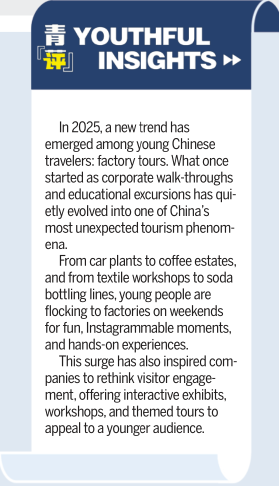
In 2025, a new trend has emerged among young Chinese travelers: factory tours. What once started as corporate walk-throughs and educational excursions has quietly evolved into one of China's most unexpected tourism phenomena.
From car plants to coffee estates, and from textile workshops to soda bottling lines, young people are flocking to factories on weekends for fun, Instagrammable moments, and hands-on experiences.
This surge has also inspired companies to rethink visitor engagement, offering interactive exhibits, workshops, and themed tours to appeal to a younger audience.