Breakthrough made in chemicals production









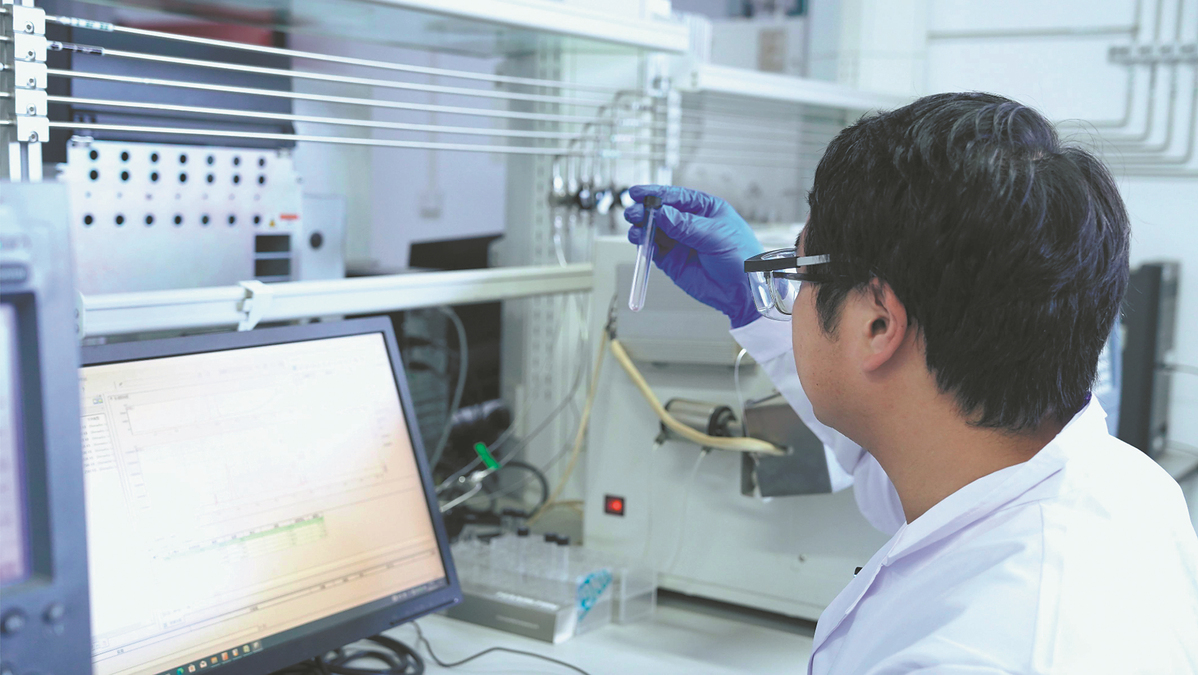
A team of Chinese and Italian scientists has developed a groundbreaking method for splitting hydrogen at room temperature, potentially enhancing the efficiency and quality of producing key chemical products. The study, published in the journal Science on Friday, addresses a long-standing challenge in heterolytic hydrogen dissociation chemistry.
Hydrogenation, a fundamental reaction in the chemical industry, involves hydrogen dissociation, which can occur through homolytic or heterolytic pathways. It is estimated that 25 percent of all the chemical processes include at least one hydrogenation step.
Heterolytic dissociation is crucial for producing fine chemicals, as it generates reactive, polar hydrogen species that selectively reduce polar functional groups. However, this process usually requires high temperatures and pressures, leading to increased energy consumption and safety concerns.
To overcome these challenges, the researchers developed a light-induced strategy to achieve heterolytic hydrogen dissociation at room temperature. Using titanium dioxide supported with gold nanoparticles as a photocatalyst, they found that exposure to ultraviolet light causes electrons to migrate from titanium dioxide to gold nanoparticles.
Concurrently, holes are captured at interfacial defects formed by the gold-oxygen-titanium connection, facilitating heterolytic hydrogen dissociation. The activity scales almost linearly with light intensity, confirming the photocatalytic nature of the process.
The strategy's advantages were demonstrated by reducing inert carbon dioxide with the dissociated hydrogen species. The scientists found that these species could almost fully reduce carbon dioxide at room temperature, producing ethane as the sole product.
By connecting this process with a photocatalytic ethane dehydrogenation device, they could convert carbon dioxide into ethylene with a yield exceeding 99 percent. This process remained stable for over 1,500 hours under ultraviolet light, indicating the catalyst's long-term stability.
Further research showed that light-induced hydrogen dissociation is universal and can be extended to visible-light responsive photocatalysts.
A demonstration using solar energy to convert carbon dioxide achieved an ethane selectivity of up to 90 percent.
"This work offers a promising route to produce high-value chemicals like ethane and ethylene from hydrogen and carbon dioxide under mild conditions, which could lower the energy cost and reduce carbon emissions," said Wang Feng, the study's first corresponding author and a researcher at the Dalian Institute of Chemical Physics of the Chinese Academy of Sciences.
"In the future, we hope the strategy can develop into a scalable, sunlight-driven or photothermal coupled technique to upgrade modern coal-based chemical industries," Wang added.
limenghan@chinadaily.com.cn