How Shanghai became safe harbor for Jews









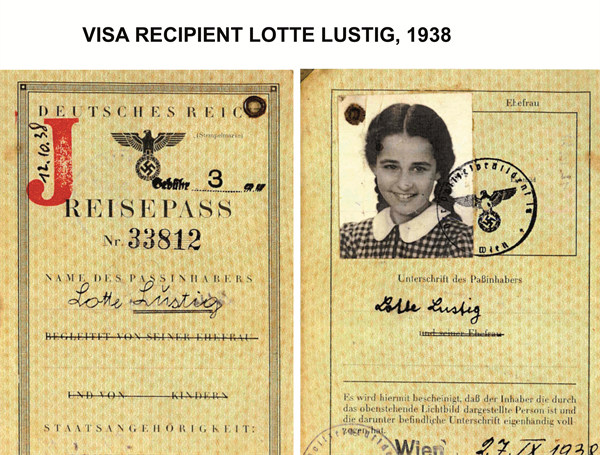
Until July 1937, the Chinese Nationalist government had exercised passport control for entry into Shanghai, but after their retreat to the wartime capital of Chongqing, the harbor was left unattended. Because the other foreign powers in Shanghai did not want to be "inconvenienced", it was the only entry point into China that the Japanese occupiers did not exert control over. Until the end of 1941, when the Japanese took over the entire city, there was no harbor authority to examine passports or entry documents into Shanghai. Anyone could land ashore without passports or papers.
My father took full advantage of this situation and devised an ingenious strategy: issuing entry visas to Shanghai, a destination requiring no visa for entry.
This intentional off-label use of a standard entry visa would provide the "proof of emigration "required by Nazi authorities to allow safe passage out of Nazi-occupied territories and to be released from detention. The visas could also be used to obtain transit visas into otherwise inaccessible countries on the pretext of going to Shanghai. Many Shanghai visa recipients in fact did not go to Shanghai but used these visas to make their way to the Philippines, Cuba, Palestine, England and even the US, the only places they could get to.
At the time, China, and especially Shanghai, was alien to most Europeans. Soon after Hitler's rise to power in 1933, a handful of German Jewish doctors and dentists had answered an advertisement from the foreign concessions for medical professionals and had set up practices in Shanghai. In the subsequent five years, there were no further arrivals until the mass influx of Jewish refugees landing in Shanghai at the end of 1938, after the Anschluss and then Kristallnacht, the Nazi-orchestrated anti-Jewish rampage known as the Night of Broken Glass on Nov 9 and 10 of that year.
Four months after the Anschluss, 17-year-old Eric Goldstaub made the rounds of 50 consulates in Vienna before obtaining 20 visas for himself and his extended family from the Chinese Consulate General. The visas were to a destination — Shanghai — that he had never heard of, in a distant country — China — that he had never dreamed of going to, Eric later recalled.
With the visas, the family bought tickets on an Italian luxury liner from the Lloyd Triestino company, which was war profiteering by ferrying Jewish refugees to Shanghai.
But before they could leave, Eric and his father were arrested on Kristallnacht, along with 30,000 Jewish males from Germany and Austria. Because they were able to produce the Shanghai visas as proof of emigration, they were released and set sail for Shanghai in December. On board the ship, Eric took photographs of fellow Jewish refugee passengers.
More importantly, in 1938 and 1939, the Shanghai visas were instrumental in securing the release of those deported to concentration camps, especially after Kristallnacht. Austrian physician Jakob Rosenfeld was among those deported to Dachau and then to Buchenwald. He was released in 1939 and went to China, where he joined the Chinese New Fourth Army as a medical officer and participated in the revolution.