



Tajik geologist finds home in border region









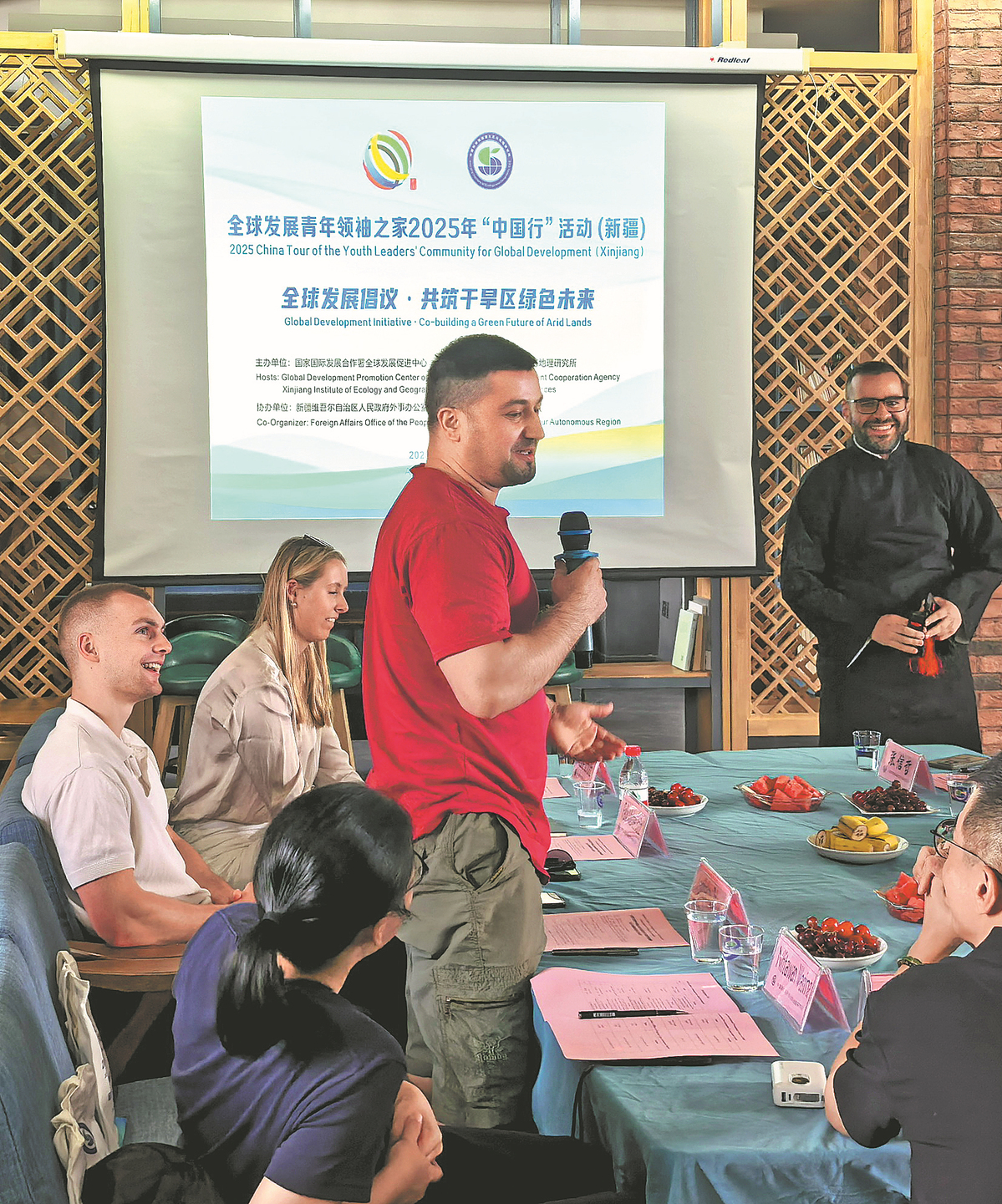
For nearly 10 years, Tajik geologist Dzhovid Yogibekov has made his life in Urumqi, Xinjiang Uygur autonomous region, where his studies have grown into a deep connection with local society.
In 2016, at the suggestion of his professor in Tajikistan, Yogibekov applied to study for a master's degree in geology at the Xinjiang Institute of Ecology and Geography, part of the Chinese Academy of Sciences. It was his first time setting foot in the region.
Xinjiang, which borders Tajikistan, is easily accessible from his home country. Yogibekov said he could reach Tajikistan in just a few hours via the Karasu Port in Kashgar, which makes it more convenient for him to study in the region.
After completing his master's degree, Yogibekov decided to remain in Xinjiang to pursue a doctorate.
"There is no restriction to study, the experiment facilities are well-equipped and the research team is well-organized," he said.
Since 2016, he has witnessed rapid urban growth and technological advances, particularly in the fight against desertification.
"One of the main aspects that surprised me was how fast China is developing and how people are devoting themselves to the popularization of science, technology and the landscaping of desert regions," he said.
He credited these efforts with helping control sandstorms and improve air quality, which in turn has created better living conditions.
Yogibekov noted that international students and teachers are increasingly coming to Xinjiang to share knowledge, further enriching the academic environment.
Outside of research, he took part in tree-planting efforts in Urumqi for three years.
"I was amazed by the way people are afforesting deserts," he said, emphasizing that ecological transformation requires a multidisciplinary approach, including geology.
He pointed to China's "Great Green Wall" — the Three-North Shelterbelt Forest Program designed to slow the Gobi Desert's expansion — as a model that could benefit other countries, including Tajikistan.
Yogibekov's life in Xinjiang has also been shaped by cultural ties. While Tajikistan's Persian-Tajik language and traditions differ from those of Uygur and Han communities, he has connected closely with Xinjiang's ethnic Tajik population.
"Their languages are identical to those of Tajikistan's Pamir region, and their dress and dance styles are exactly the same," he said.
China is making efforts to preserve the cultures of all its ethnic groups, he added.
Yogibekov said he sees himself as a bridge between China and Tajikistan.
"Student exchanges are key to mutual understanding," he said.
Despite differences among countries and ethnicities," human nature is the same," he said, adding that learning local languages and cultures is vital to reducing misunderstandings.


- Zhejiang to focus on innovation, role as 'strategic pivot'
- Revision to Prison Law helps protect inmate rights, improve rehabilitation
- Book acts as window on China's governance philosophy
- President sends festive greetings to working people
- Exertion, sweat give students 'real rewards'
- Hands-on experience instills steel, empathy in students





