China moves ahead with research into brain-computer interfaces









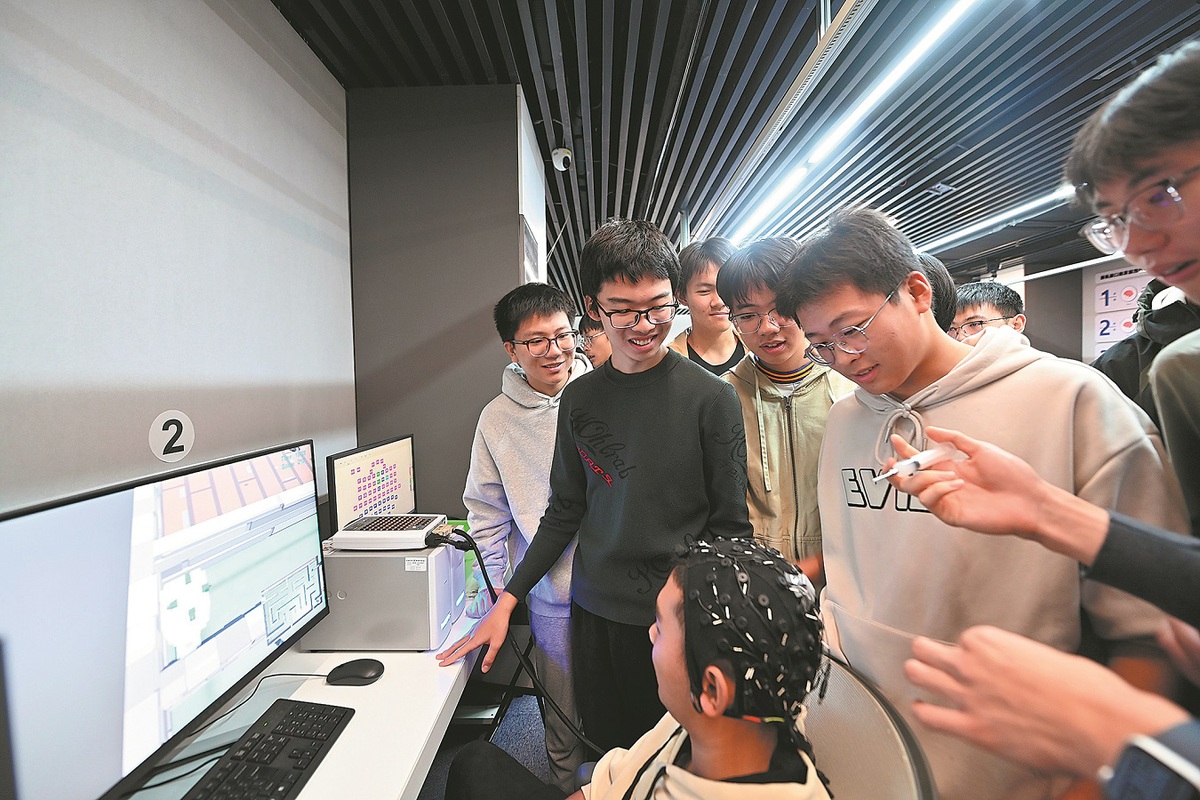
"They hold significant potential in neurorehabilitation but also face surgical risks and ethical challenges, representing the highest technical difficulty and regulatory requirements," he said.
Obtaining high-quality signals requires deep brain access, but the surgery itself can cause damage, he said.
"The goal of scientists in this field is to minimize such damage, and the most direct method is to reduce the size of the implantation window."
Cui Yue, an associate researcher at the Institute of Automation at the CAS, said rigid electrodes cannot accommodate the slight movements of brain tissue during physiological activities and can easily cause nerve drag and damage. In contrast, flexible electrodes, which are made of soft, adaptive materials, can move naturally with brain tissue, reducing damage and scarring, making them more suitable for long-term stable implantation.
Cui's team has reduced the implantation damage to 300 microns and replaced traditional rigid electrodes with flexible electrodes.
However, the extreme softness of flexible electrodes brings implantation challenges. To address this, the Institute of Automation has developed the "CyberSense" flexible micro-electrode implantation robot, pioneering a "sewing machine-style" automatic implantation technology.
"Just like threading a needle, we thread the flexible electrode wire into a fine needle and use the needle tip to precisely deliver the electrode to the designated brain area, then withdraw the needle, leaving only the electrode in place," Cui said.
The efficiency of reading brain signals is critical, directly impacting the accuracy and complexity of BCI tools.
Doctoral student Cao said that many factors affect the reading efficiency, including electrode materials and the number of collection channels.
These are key areas of focus for BCI scientists. Increasing the number of signal collection channels within the same volume of implant devices allows for more complete brain activity information to be restored, laying the foundation for subsequent functional implementation, Cao said.
"Breakthroughs in artificial intelligence technology have contributed greatly to the current development of BCIs," he said. "Even when dealing with the same segment of brain signals, AI now enables us to decode richer neural information than before."
BCIs not only serve clinical medical purposes but also have the potential to expand into everyday life applications in the future, according to Cao, such as providing sleep regulation, emotional monitoring and attention enhancement.
"The current development stage of BCIs is still in its infancy, like a child just learning to walk, but it holds tremendous potential for breakthrough development in the future," he said.
Liu Zixuan contributed to this story.







- China's Global Governance Initiative receives positive feedback at forum
- China's Xizang sees steady tourism growth in 2025
- First-of-its-kind pearl auction held utilizing Hainan FTP
- Agarwood exhibition steeps Shanghai museum in fragrance
- The Fujian Coast Guard conducts regular law enforcement patrol in the waters near Jinmen
- IP protection for new fields to improve