


A force to be reckoned with
New Fourth Army Memorial Hall in Jiangsu pays heartfelt tribute to the martyrs of war of resistance with tales of heroic deeds as it takes the stories on the road, Yang Feiyue reports.










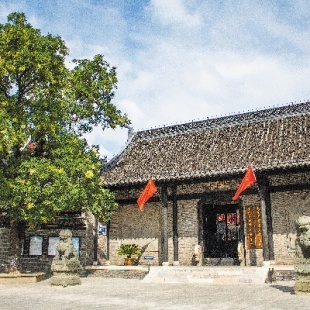
At first glance, the white marble stele at the New Fourth Army Memorial Hall in Yancheng, East China's Jiangsu province, seems unremarkable.
But a closer look at the nearly two-meter-tall monument reveals that it bears a moving tale.
"The great embankment stretches approximately 80 li (40 kilometers), from Huacheng (a low-lying area near Binhai county of Yancheng) in the south to the Huaihe River in the north, with a base width of 21 meters and a crest of three and a half meters," the inscription reads.
"To understand this story, we must first consider the geography of Yancheng, a historic revolutionary base," says Qiu Jinbiao, director of the memorial hall. "Located along the Yellow Sea, the region had long suffered devastating tidal surges and coastal flooding. In August 1939, disaster struck: a catastrophic tsunami pounded northern Yancheng, sweeping away thatched houses, submerging entire villages, and swallowing vast tracts of farmland. More than 13,000 people lost their lives in the waves.
"It was at this desperate moment that the Communist Party of China and the New Fourth Army stepped forward, standing as a bulwark against the fury of the sea," he adds.
After the Chinese People's War of Resistance Against Japanese Aggression (1931-45) broke out in full scale in 1937, the Communist Party of China and the Kuomintang formed their second united front to combat Japanese imperialism.
As part of the agreement, the Red Army and guerrilla forces from eight southern provinces were reorganized into the New Fourth Army, with Ye Ting as its commander.
In January 1938, as the war situation changed, the New Fourth Army's headquarters relocated from Wuhan of Hubei province to Sanyanjing, Nanchang of Jiangxi province. As more officers arrived, it established command, political, and logistics departments. In Nanchang, the New Fourth Army completed the organizational structure of its leadership and consolidated internal structures. At the same time, the army established a wartime service corps that rallied the public with street campaigns to resist the Japanese invasion.
This initiative turned Nanchang into a hub of anti-Japanese activity in southeastern China.
But the army's growing strength alarmed anti-Communist hard-liners within the KMT. In January 1941, the KMT faction launched the notorious Wan'nan Incident (Southern Anhui Incident) to crush the New Fourth Army, inflicting heavy losses.
To counter KMT suppression and continue the fight against Japanese occupation, the CPC reestablished the New Fourth Army in Yancheng on Jan 25, 1941. It was reorganized into seven divisions and one independent brigade, totaling more than 90,000 troops.