



Breeding program gives plum yews new life









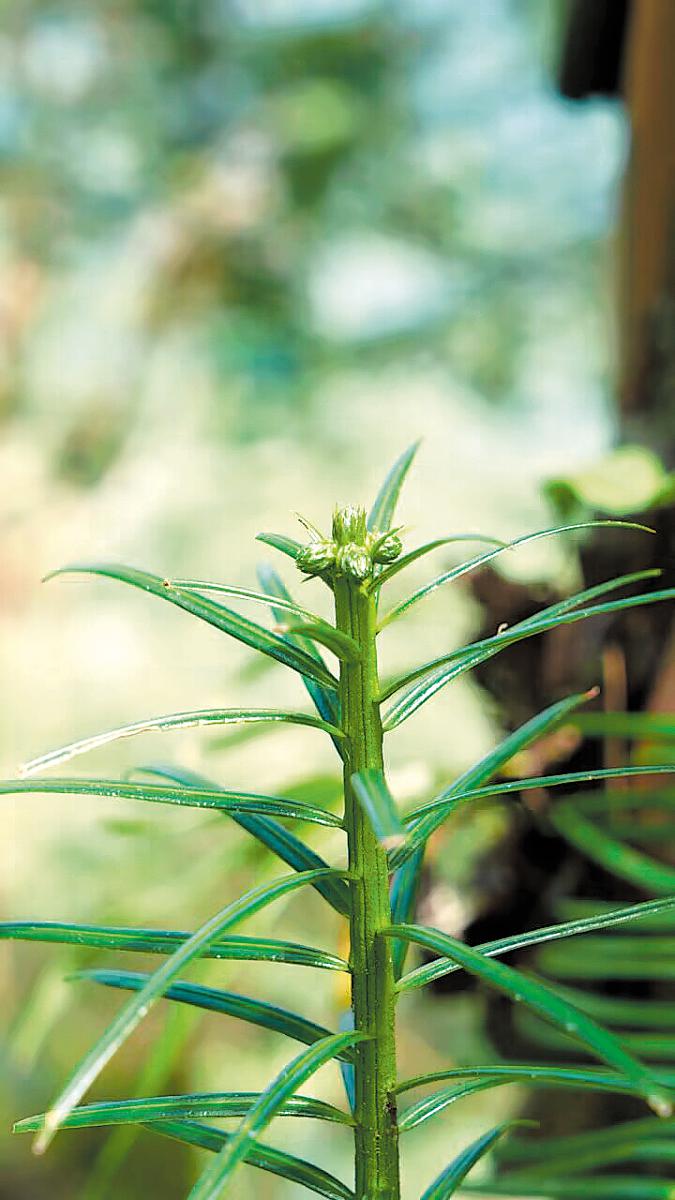
The first batch of artificially bred Gongshan plum yews were reintroduced to the wild at Gaoligong Mountain National Nature Reserve in Southwest China's Yunnan province recently, marking an important stride in the conservation of the endangered species.
"Out of the 109 artificially bred seedlings of Gongshan plum yews, 35 seedlings, which satisfied the criteria for reintroduction into the wild, were transplanted into a location with a native population at the end of last month," said Pian Li, an official from the Gaoligong Mountain National Nature Reserve.
These transplanted seedlings, which have heights exceeding 35 centimeters, have been tested to be free of viruses in case they might bring pathogens to the wild population, he said.
The Gongshan plum yew, also known as Cephalotaxus lanceolata, is an evergreen conifer endemic to the Dulong River valley, and may also be found in Myanmar due to its proximity to the border. It's recognized as a second-class protected species on the National Key Protected Wild Plants List of China and is categorized as endangered on the International Union for Conservation of Nature Red List.
"Cephalotaxus is a genus of relict plants, often referred to as living fossils, representing ancient plant species that have survived through geological changes and environmental shifts. This genus holds significant importance for research in paleogeography and plant evolution," said Sun Jun, a senior engineer at the Kunming Institute of Botany of the Chinese Academy of Sciences.
"There are eight to 11 species in the Cephalotaxus genus, with China having six species, while Yunnan alone has five species," Sun said.
The wood of plants in the Cephalotaxus genus is tough, fine-grained and easy to process, making it an excellent material for construction and furniture. Thus, it might have been exposed to illegal logging, Sun added.
In 2021, the Gongshan plum yew was included on the protection list of plant species with extremely small populations, with Pian's team conducting tailored rescue protection efforts since.
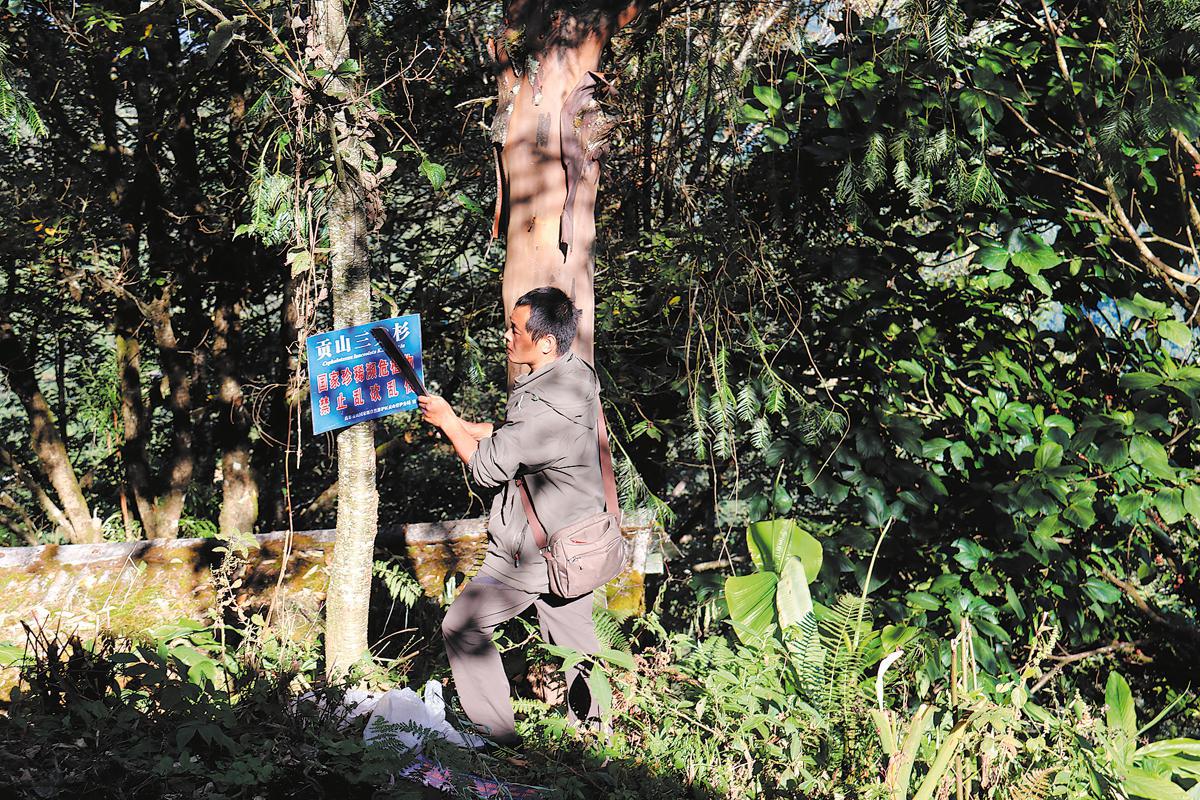
"Since their designation, we have carried out field surveys in the potential distribution area of Gongshan plum yews, and recorded information such as diameter, height, growth condition, as well as latitude, longitude and altitude for each adult tree," said Yang Suhua, a colleague of Pian.
The survey found that due to factors such as limited distribution, restricted habitat and an extremely low natural reproduction rate, the number of Gongshan plum yews has dwindled to only 220 individuals, placing it on the brink of extinction. Among them, only 13 are female trees capable of bearing fruit, revealing the difficulties of natural breeding, Yang said.
In addition to in situ conservation like tagging the identified trees and informing local residents about their rarity, researchers have also conducted breeding experiments.
"The Gongshan plum yew is a gymnosperm — a plant that bears naked seeds like the common pine and hemlock. When collecting the seeds, it was observed that many of them had been damaged by rodent bites and insect infestation," Yang said.
"We collected more than 1,000 seeds, which had a germination rate of around 70 percent. However, only 109 seedlings still survive," he said. "Throughout the breeding process, we also revealed some of their peculiar habits."
The Gongshan plum yew's slow germination process of two years initially left the team feeling disappointed and questioning their breeding efforts. This extended germination period also poses a challenge for the species' wild propagation.
"They typically grow in evergreen broad-leaf forests at elevations ranging from 1,900 to 2,400 meters, while our breeding base is located at 1,400 meters. Therefore, we have set up shade nets above these seedlings to simulate their native habitat," Pian said. He added that apart from the initial seed processing stage, the team tries to minimize interventions in their growth process so that they can better adapt to natural environments in the future.
"We chose to transplant them to the place where their wild population is situated, because the environment there is assumed to be most suitable for their growth," Pian said, adding that the success of artificial breeding will only be achieved if they flower and bear fruit in the future.
Subsequent monitoring and continuous breeding are needed before the species rids itself of being endangered, he added.
Contact the writers at limenghan@chinadaily.com.cn


- Former NDRC deputy director charged with bribery
- How a realtor connects expats to home along Liangma River
- The Datong Code EP.1 | Intangible cultural heritage micro-drama series | PKU presents
- Spring tourism booms across China
- Gansu rolls out centers to settle disputes
- Robots help to protect forests





