Book explores discoveries of relics and takes a deep dive into their symbology, representation and values showcased, Wang Ru reports.
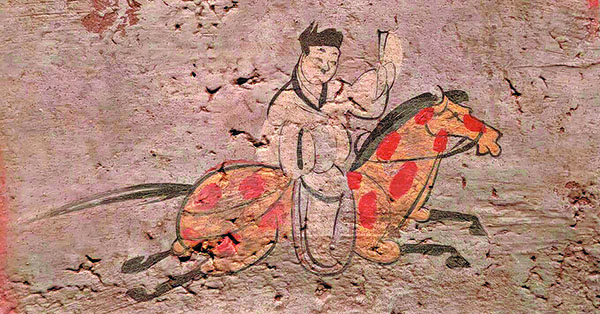
Delivery people have become part of everybody's day-to-day lives. However, from a portrait brick unearthed from a tomb dating back to some time between the Three Kingdoms (220-280) period to the Eastern Jin Dynasty (317-420) in Jiayuguan, Gansu province, visitors can catch a rare glimpse into the images and lives of their counterparts from ancient China.
On the brick, a man is galloping on a horse, his right hand holding the reins while his left hand raising the letter he was transporting. He wears the postman's uniform, and the flesh on his face appears to tremble with the rhythm of the galloping steed.
The man was painted without a mouth, which scholars believe may symbolize the privacy and security of the ancient postal service. On the back of the brick is evidence of the developed postal system of that time.
Historical records indicate that the Western Han Dynasty (206 BC-AD 24) government established more than 80 courier stations on the ancient Silk Road from its capital, Chang'an (now Xi'an, Shaanxi province), to present-day Dunhuang, Gansu. With one station established about every 20 kilometers, men would transport official documents and receive envoys, and some stations continued to function during the period when the brick was made.
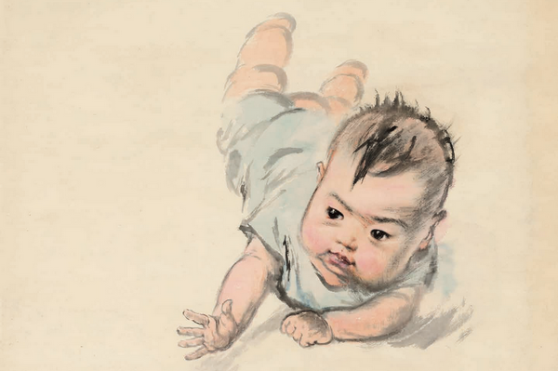
Chinese Faces: Reflections and Memories of the Chinese Nation in Cultural Relics is a new book that explores these stories. It centers on the human faces found on cultural relics discovered across the country from the Paleolithic era to modern times.
The cultural relics introduced in the book were unearthed and discovered to be from different eras, places and ethnic groups. They include pottery figurines, human-shaped ceramic and jade vessels, and human patterns in paintings, murals and stone carvings.
Weng Huainan, the author of the book and the director of the Books and Materials Department of the National Museum of China in Beijing, chose 50 remarkable artifacts from various museums nationwide that he has visited to unveil the diverse faces that represent the emotions and values of the Chinese nation.
Weng says he gained inspiration from writer Shen Congwen (1902-1988), who worked in the same department as Weng at the museum for nearly three decades.
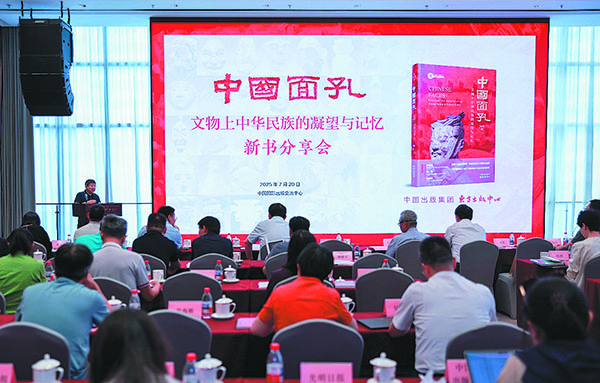
"Shen wrote novels that show the diverse faces of the Chinese people. He also researched ancient Chinese costumes, from which I see the portraits of countless Chinese people. Therefore, I believe the human face is a good perspective from which I can decode cultural relics," said Weng at a book sharing meeting in Beijing in July.