



Digital humans show future of livestreaming e-commerce









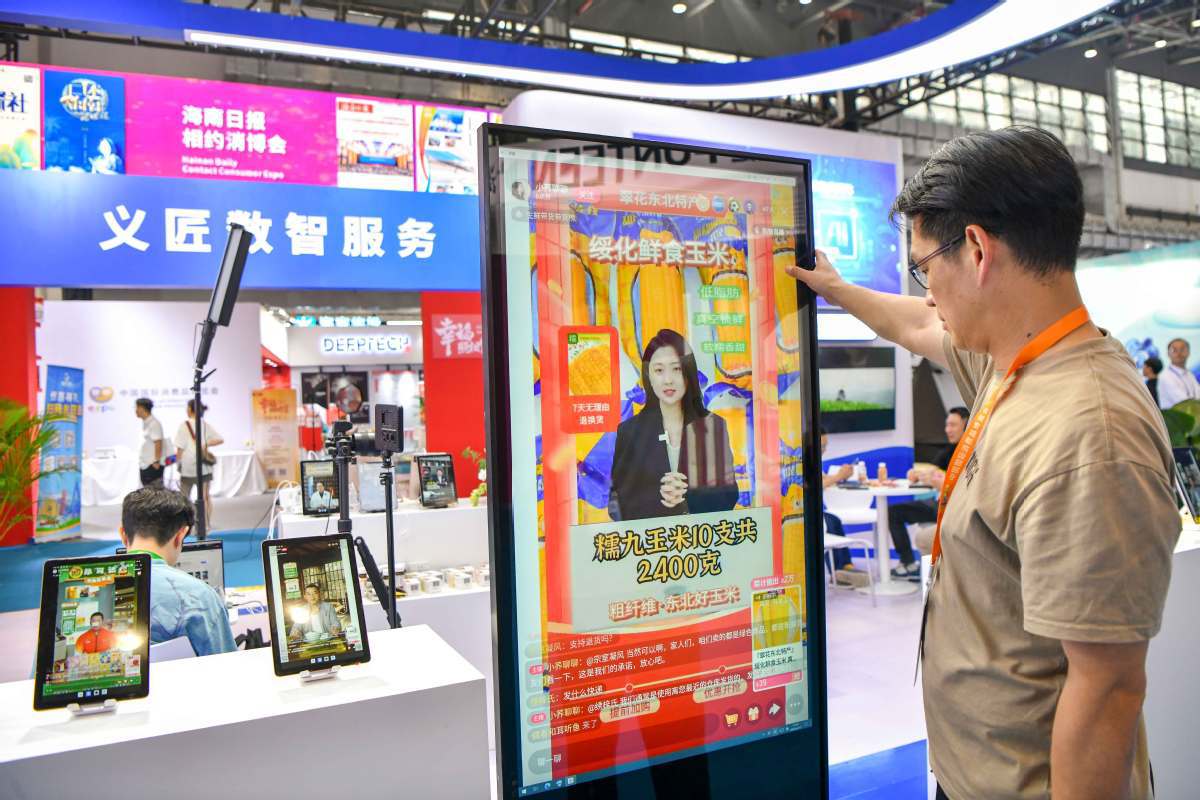
What happens when a livestreaming session is hosted by a digital human who can interact with viewers in real time? Last month, I watched a livestreaming show presided over by the virtual avatar of Luo Yonghao, founder of smartphone maker Smartisan Technology and a key online opinion leader on Chinese social media platforms.
Throughout the live broadcast lasting over six hours, Luo's digital human along with a cohosting avatar garnered more than 13 million views, generating over 55 million yuan ($7.7 million) in gross merchandise value, or GMV.
In key product categories such as consumer electronics and food, order volumes surpassed Luo's real-person livestream debut on the same platform earlier in May.
What impressed me the most was that Luo's digital avatar and the supporting avatar interacted naturally, exhibiting detailed gestures — such as making eye contact and speaking in unison — that mirrored real human hosts, while engaging with viewers in real time.
Powered by Chinese tech heavyweight Baidu Inc's Ernie foundation model, the livestreaming was the first to feature dual digital avatars as cohosts.
Baidu described the new generation of AI digital human as super-intelligent AI agents that closely resemble real people, with coordinated expressions, speech, gestures and behavior. These digital humans are capable of thinking, making decisions and collaborating to complete specific tasks.
AI-powered digital human hosts that bear a close resemblance to real humans in appearance as well as behavior are being increasingly utilized in livestreaming e-commerce to unveil a variety of products and bolster sales.
I noticed that several brands preferred to use virtual anchors to attract digitally savvy and novelty-seeking young consumers, as they cost less than employing real human hosts and don't cause celebrity scandals that could potentially hurt brand image.
A digital human of Liu Qiangdong, Chinese e-commerce giant JD's founder and chairman, appeared in the company's livestreaming rooms in last April to promote a variety of products, including meat, edible oil, eggs, milk, air conditioners and TV sets.
The virtual anchor almost perfectly replicated Liu's expressions, body language, gestures, voice and accent, capturing even the subtlest movement of his fingers. Liu's avatar generated over 20 million views within the first hour and raked in 50 million yuan in sales throughout the entire real-time broadcast session.
The size of China's virtual human market is forecast to reach 270 billion yuan by 2030, according to a report released by QbitAI, an industry services platform focusing on AI and other cutting-edge technologies.
With continuous technological advancements in large language models and multimodal capabilities, the appearance, gestures and actions of digital humans will be more refined and closer to that of real humans, experts said.
However, the virtual human industry is still in its infancy, and the major challenges lie in how to allow virtual anchors to better interact with users and understand their demands more precisely.
The application of virtual hosts in livestreaming e-commerce will likely see speedy growth fueled by user demand, advances in AI technology and policy support, said Zhang Yi, CEO and chief analyst at consultancy iiMedia Research.
Compared to humans, the biggest advantage of digital avatars is that they can significantly cut operating costs of livestreaming for merchants, and work 24 hours a day without coffee and restroom breaks, thus pushing up sales, Zhang said.
Mo Daiqing, a senior analyst at the Internet Economy Institute, a domestic consultancy, said the use of AI-powered virtual hosts in e-commerce livestreaming sessions can bring a feeling of freshness to users, while brand owners can appeal to new consumers via this innovative method.
Virtual livestreamers can play an important role in finishing tedious and repetitive tasks, improving the consumer shopping experience and boosting product sales, thus allowing human hosts to devote more time to creative work, Mo said. "However, they will not totally replace real human hosts, as it is difficult for virtual anchors to fully establish real emotional connections with fans."











