



Opening-up and cooperation country's reply to protectionism









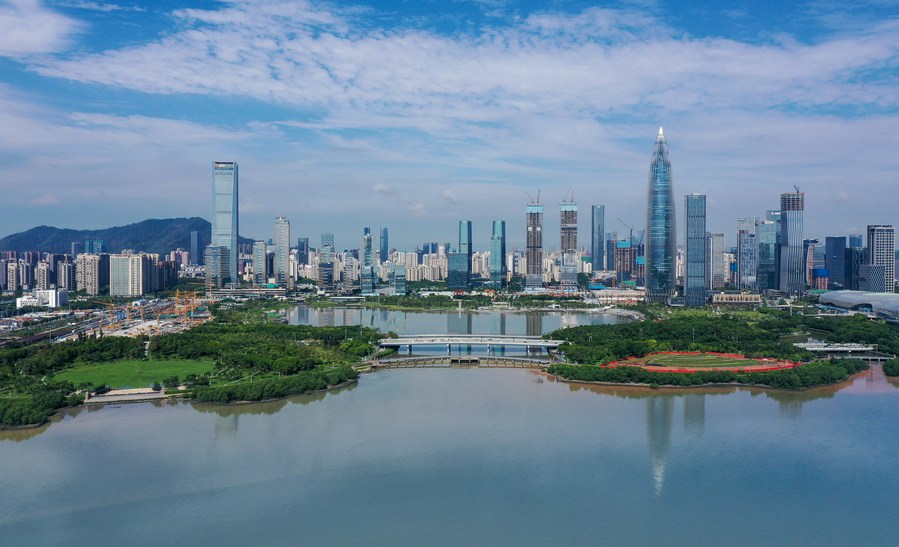
Aerial photo taken on Sept 12, 2020 shows a view of Nanshan district of Shenzhen, South China's Guangdong province. [Photo/Xinhua]
China is reinforcing its longstanding commitment to high-standard opening-up. Even as some countries resort to protectionism, China chooses integration over isolation and cooperation over confrontation. This direction was reaffirmed in a newly published article by Xi Jinping, general secretary of the Communist Party of China Central Committee, in Qiushi, the flagship journal of the CPC Central Committee. The country's dedication is also reflected in the third China International Supply Chain Expo, which is being held in Beijing from Wednesday to Sunday.
Xi's article underscores a foundational principle that China's opening-up will not stop, instead it will open the door wider. This is not mere rhetoric. China sees reform and opening-up as drivers of progress. From trade liberalization to foreign investment facilitation, institutional opening-up to legal guarantees, the country is expanding the depth of and improving the quality of its engagement with the world.
China's high-standard opening-up is a deliberate and systemic effort to integrate with the global economy in ways that are rules-based, market-driven and forward-looking. The article calls for actively aligning with high-standard international economic and trade rules, while promoting market-oriented, law-based and internationalized business conditions.
Nowhere is this more visible than in the area of supply chains. The ongoing expo serves as a timely reminder of China's determination to strengthen global industrial linkages. It brings together businesses from across the world to share insights, forge partnerships and enhance the resilience of global value chains.
About 650 companies from 75 countries, regions and international organizations are participating in the expo, more than in the previous two expos. The continued participation of international enterprises in the expo reflects a growing consensus that stable and resilient global supply chains are a shared imperative across borders and sectors. In today's interconnected economy, industrial competitiveness is no longer defined by products or technologies, but by the robustness and adaptability of the supply chains that support them. For many companies, China's comprehensive industrial ecosystem offers a strategic advantage.
As digital technologies and artificial intelligence accelerate a new wave of industrial transformation, China is seen as a vital node of global innovation and connectivity. The expo itself is emerging as a platform of global public good, an open and inclusive venue where enterprises of all sizes can engage, collaborate and co-create. Participants see the expo as a place where ideas converge, transactions happen and new value is continuously generated.
This is especially critical today, as supply chains are increasingly affected by fragmentation and politicization. Some countries are erecting barriers under the pretext of "national security", promoting "de-risking" strategies that often amount to selective decoupling. China's response, in contrast, is to expand openness while enhancing regulatory capacity and risk management. Development and security are not contradictory; rather, they are mutually reinforcing when guided by sound policy and international cooperation.
China's vast market remains a powerful magnet for global investment. The country is home to the world's largest middle-income group with the second-largest consumer market. Despite global headwinds, foreign companies continue to see long-term opportunities in China not only for production, but also for innovation and consumption. The message to global investors is clear — working with China means working with opportunity.
China's commitment to multilateralism and inclusive globalization is firm. It continues to push for the liberalization and facilitation of trade and investment. It also actively participates in global economic governance and firmly rejects unilateral sanctions and protectionism. China believes in a world where cooperation, not confrontation, defines the rules of economic engagement.





