Solar, wind firms tackle end-of-life recycling issue









Chinese solar and wind power companies are increasingly prioritizing the recycling of aging renewable energy equipment, according to a new report, as the world faces a growing challenge of managing decommissioned infrastructure.
Global renewable energy transition has resulted in a vast installed capacity of wind turbines and solar panels built over the past two decades, said a recently released report by the World Economic Forum in collaboration with Accenture.
This incredible success of transition, led by China — leading the world in green energy deployment and manufacturing — means that a significant portion of these pioneering installations are now naturally reaching the end of their operational life spans, a testament to the scale and speed of the country's green energy build-out, said the report.
This presents a significant opportunity for China to further demonstrate global leadership by establishing a robust and innovative approach to waste management and resource recovery for renewable energy equipment, it said.
Wind turbines typically have a life span of around 20 years and photovoltaic modules 25 to 30 years. Much of the early equipment installed during the initial boom is now approaching retirement.
The necessity of handling this volume of material is driving forward the development of advanced recycling technologies and circular economy practices, paving the way for valuable resources to be recovered and reintegrated into the supply chain, said the report.
The report believes China's dominance in the global renewable energy sector is unparalleled, with renewable energy installations accounting for over half of the global total and continuing to expand rapidly.
Figures released by Accenture reveal that by the end of 2024, the country's installed renewable energy capacity saw a 25 percent year-on-year increase, reaching 1,889 gigawatts, with solar power making up 47 percent and wind power 28 percent.
Projections indicate China could account for nearly 60 percent of global installed renewable energy capacity by 2030, Accenture said.
China, with the largest and most integrated renewable energy industrial chain globally, has led the world in photovoltaic module production for 16 consecutive years, supplying 70 percent of global PV modules and 60 percent of wind turbine equipment.
China's global market share in solar equipment manufacturing is expected to remain between 80 and 90 percent through 2030, it said.
"This shift toward prioritizing recycling is a critical development," said Lin Boqiang, head of the China Institute for Studies in Energy Policy at Xiamen University.
Given China's sheer scale in both deployment and manufacturing, how it handles end-of-life management will set a global precedent, he said.
It moves the industry beyond just installation numbers to a truly sustainable life cycle approach, potentially unlocking significant value from recovered materials and reducing reliance on virgin resources, he added.
The report projects that by 2030, China could generate up to 35 million metric tons of cumulative waste from decommissioned wind and photovoltaic equipment.
Addressing this challenge through circular economy practices is seen as crucial not only for supporting China's ambitious goals of peaking emissions before 2030 and achieving carbon neutrality before 2060, but also for fostering a more sustainable global renewable energy transition, it said.
Leading Chinese companies are already demonstrating practical applications of circularity across the equipment life cycle.
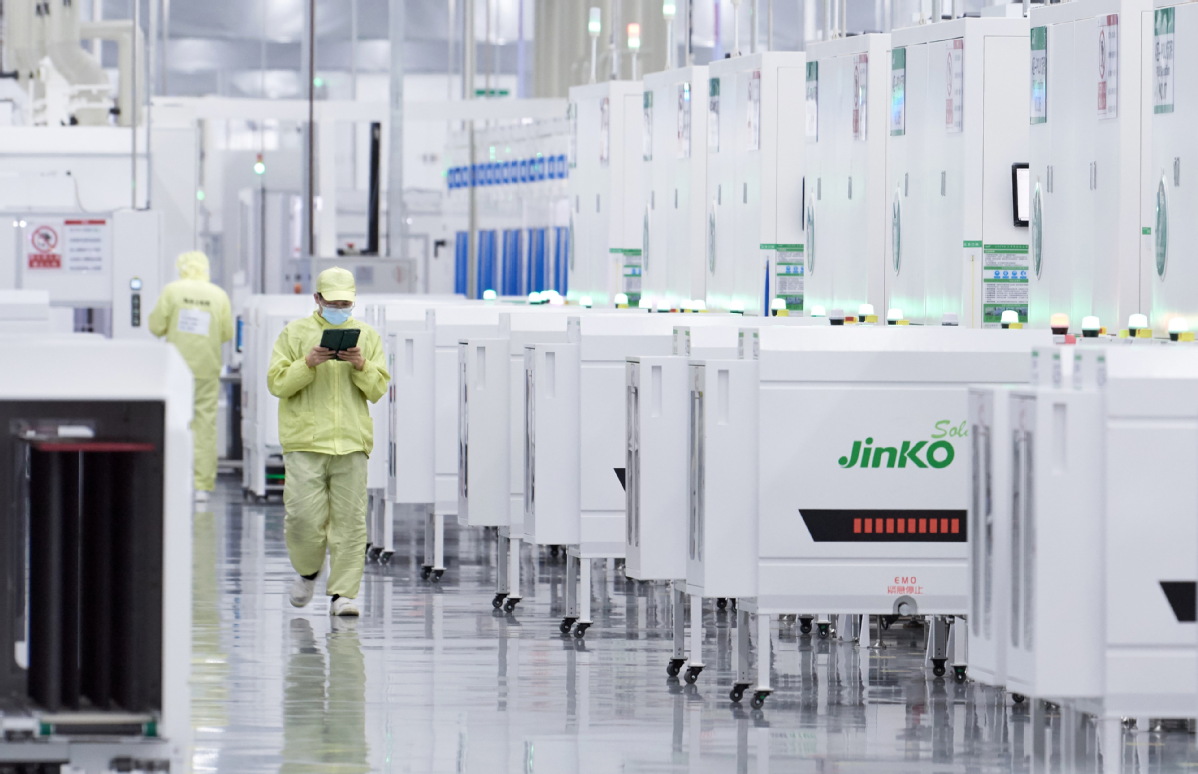
Jinko Solar, one of the world's largest solar module manufacturers, integrates circular practices from research and development to recycling stages.
The company is a pioneer in developing module recycling technology, and has consistently emphasized its full life cycle environmental responsibility.
It started R&D of related technologies since 2018 and current recovery rates for materials such as silver, silicon and copper from recycled modules can now reach as high as 98 percent, said Qian Jing, global vice-president of the company.
The company has been focusing on reducing material thickness and weight, optimizing material usage and developing low-carbon alternative materials. Smart controls and green energy adoption have also minimized waste, said Qian.
For end-of-life management, Jinko is exploring advanced recycling methods, reporting a 99 percent material recovery rate for certain components, she said.
The report underscores that by considering end-of-life aspects during initial planning, companies can facilitate easier decommissioning and recycling while minimizing waste.
Integrating circular actions throughout the renewable energy value chain is presented as essential for managing equipment life cycles sustainably as the sector continues its rapid global scale-up, it said.