



Can AI be a lifeline for legacy manufacturers?









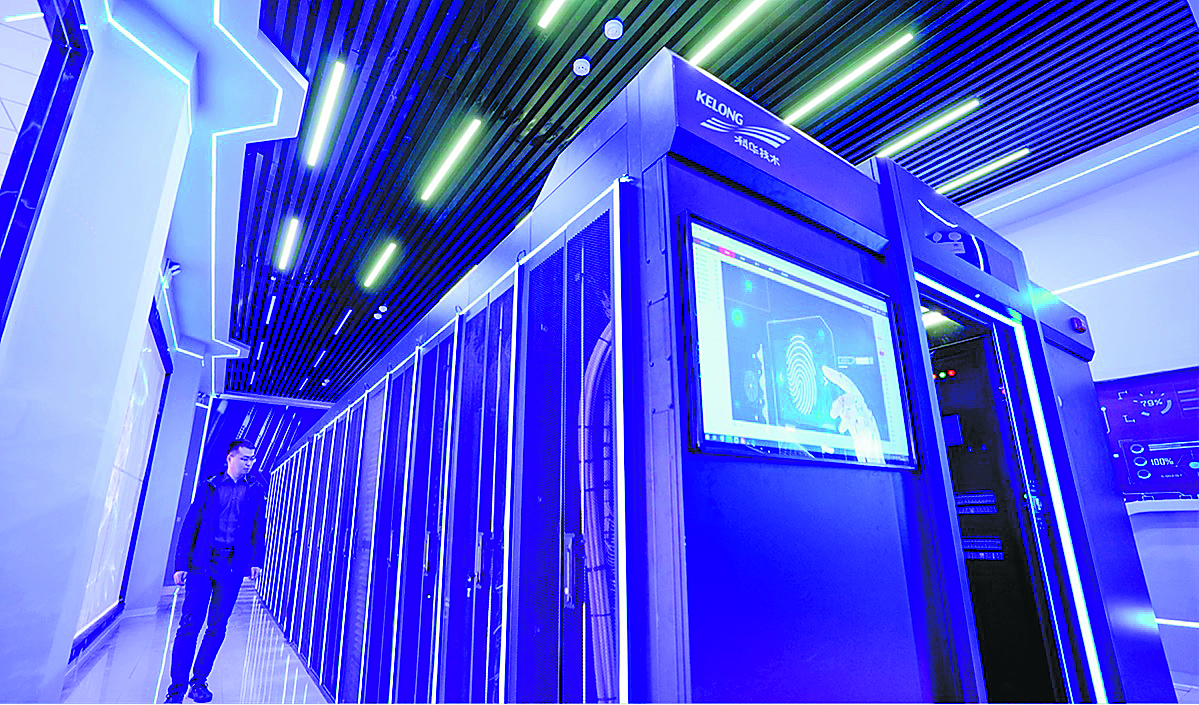
With the global economy undergoing deep restructuring and technological breakthroughs accelerating, China's manufacturing sector is experiencing a structural transformation of historic proportions. By June, manufacturing value-added accounted for 27.3 percent of China's GDP, cementing the country's position as the world's largest manufacturing hub for the 14th consecutive year.
Yet beneath these impressive figures, traditional manufacturers continue to grapple with growing challenges: low production efficiency, rising operational costs, and mounting environmental pressure. With labor and resource costs increasing, many legacy manufacturers are seeing their profit margins shrink, and their long-term sustainability goal diminish.
Against this backdrop, artificial intelligence and the industrial internet are emerging as powerful drivers of change. For many aging industrial giants, the path from "Made in China" to "Created in China" lies in technology adoption. But this journey is not easy; it demands massive investments in automation equipment, software systems, digital infrastructure and workforce training.
Some companies, however, are showing the way forward. By including AI and industrial internet into their core policies, and steadily rolling out digital upgrades, they are transforming high upfront costs into high returns.
Take the Midea Group for instance. Once known as a major home appliance manufacturer, Midea is redefining its tech frontier and business landscape. In 2024, the company reported revenue of 409.1 billion yuan ($56.97 billion), with its commercial and industrial solutions division contributing 104.5 billion yuan, a steadily growing share.
At its factory base in Shunde in Guangdong province, Midea has introduced AI-powered scheduling systems and smart robots, capturing real-time production data through more than 3,000 sensors. And AI algorithms dynamically reconfigure production lines based on order fluctuations. This "Industry 4.0" setup has boosted Midea's supply chain responsiveness by 40 percent and improved inventory turnover efficiency by 25 percent.
Midea has also built its own industrial internet platform, M.IoT, which links every step of the value chain, from raw material sourcing to production, logistics and after-sales. The result: a closed-loop data system that significantly strengthens digital decision-making. Backed by strong R&D and end-to-end digital integration, Midea is developing a competitive edge on the global manufacturing stage.
But not all companies have reaped rewards from digital transformation. Some have fallen into the "tech spending trap", where investments in technology fail to deliver real returns, often due to flawed strategy or poor execution.
Also, consider Zhejiang Furun's failed digital pivot. In 2016, the textile company implemented a "traditional industry + digital economy" policy, acquiring Hangzhou Taiyi Zhishang Technology Co for 1.2 billion yuan and later investing 750 million yuan to build a dual-core model of textiles and digital advertising. Yet as regulatory pressure mounted on China's internet advertising sector, Taiyi Zhishang missed its profit targets by a wide margin. And in 2021, Furun had to write off 240 million yuan in goodwill.
Moreover, its core textile business suffered due to high environmental compliance costs and rising raw material prices, with its profit margins declining from 21 to 5 percent. As a matter of fact, in 2020, the company shut down its printing and dyeing base in Zhuji, Zhejiang province. Instead of finding a new growth engine, fulfilling Furun's digital ambitions became a financial burden.
Furun isn't alone. In March, Lionhead, a 24-year-old cement producer, shocked markets by announcing its entry into the AI sector through the acquisition of Hangzhou Leaper Technology. The move raised a vital question: Can a heavy-asset cement firm really morph into a provider of AI-driven manufacturing solutions? The transition from bricks to algorithms remains uncertain.
Looking ahead, AI and the industrial internet will continue to redefine the road map of China's traditional manufacturers. The promise of smarter, more efficient production is real — but it demands more than flashy high-tech, including a strategic vision, deep technical capacity, and organizational alignment. While some companies have already proven that digital upgrading can yield exponential returns, others remain trapped in a cycle of costly trial and error.
Digital transformation is not just about upgrading machines. It's a full-scale reconfiguration of the value chain. Only by rightly reading the signals and advancing with discipline can manufacturers truly evolve from old-world factories to new-age smart producers, and secure their place in the global industrial future.
Yang Guoliang is a researcher at the Institutes of Science and Development, Chinese Academy of Sciences.
Shang Fangping is a researcher at the Institutes of Science and Development, Chinese Academy of Sciences.
The views don't necessarily represent those of China Daily.
If you have a specific expertise, or would like to share your thought about our stories, then send us your writings at opinion@chinadaily.com.cn, and comment@chinadaily.com.cn.





