Crafting a new era
From intense competition to thoughtful teaching, a new wave of craftsmen is emerging with bold ideas and refined skills.










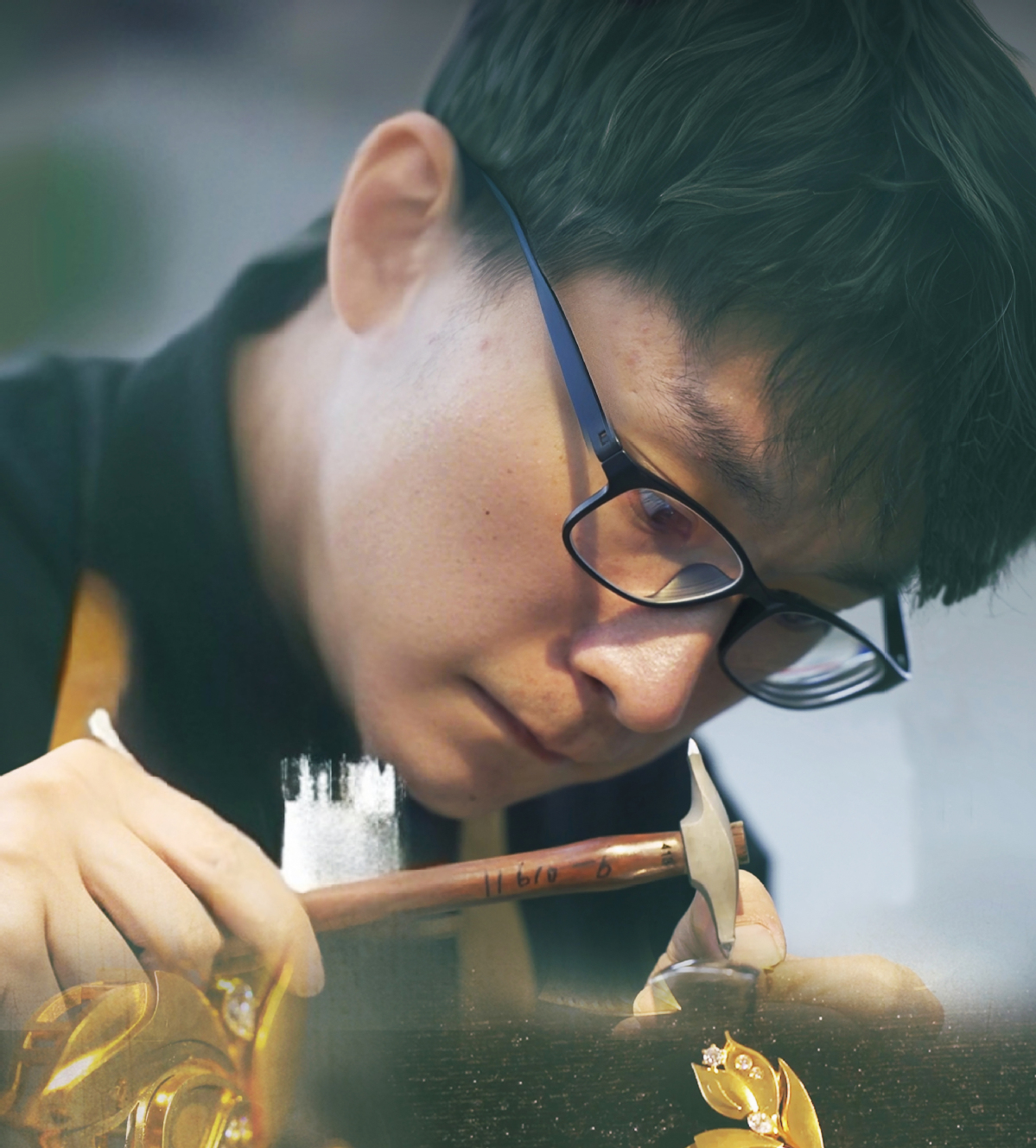
Zhang Yupeng, a 23-year-old from Hengshui, Hebei province, spent years honing his craft before stepping onto the world stage.
"Mental strength is everything," he said, reflecting on the countless hours of practice that built his muscle memory. "Practice makes perfect. Being faster or steadier is the result of countless repetitions off the field."
At the 47th WorldSkills Competition (WSC) held in Lyon, France, last year, Zhang endured four days of grueling challenges, each demanding six hours of intense concentration and steady hands.
On the second day, he focused on crafting the body of a bird-shaped hairpin — a complex, three-dimensional piece with a tight deadline. During a break, Zhang confided in his coaching team, "I'm afraid I might not finish." Yet, despite the pressure, he maintained his composure and by day's end was the only competitor to complete the module.
This pivotal moment set the stage for Zhang to win China's first-ever gold medal in the jewelry-making category.
Beyond medals, Zhang gained fresh perspectives on global design and craftsmanship. Known as the "Olympics of Skills", the WSC brought together top talent from 16 countries, each showcasing distinct strengths.
"Chinese participants often focus on overall design and visual impact, while Japanese and South Korean contestants emphasize precision and detail, usually training with specific pieces," he observed. "Their work tends to be flat or semi-flat, while ours is more three-dimensional and artistic."
Competing alongside some of the world's best, Zhang admitted feeling anxious and even intimidated at first. "But through the competition, I learned a lot and became much more confident," he said.
Learning by doing
Zhang believes that his personal growth and achievements are closely tied to vocational education.
In 2019, he enrolled at the Beijing Arts & Crafts Technician College, which is recognized by the Ministry of Human Resources and Social Security as a training base for the WSC. The school has a rigorous selection process for the event, and Zhang's talent earned him a place in its elite "talent echelon class" — marking the beginning of five years of dedicated training.
To Zhang, vocational education is more than a pathway to employment; it's a way to unlock new possibilities in life.
"Many people are caught up in traditional routes like the college entrance exam," Zhang said. "But vocational education shows us that everyone has unique strengths. By discovering and developing them, we can succeed in our chosen fields. It helps us recognize our potential and continue to grow, explore, and refine our skills."
After returning from the WSC with honors, Zhang shifted from competitor to teacher, taking on the role of training the next generation.
He moved away from standardized, "assembly-line" instruction and developed a more individualized approach, tailoring his teaching to the needs of each student.
"Some students excel in design, while others shine in craftsmanship. I teach to complement their weaknesses," he explained.
Zhang encourages students to "learn by doing", helping them turn their skills into real-world competitiveness. He hopes this hands-on foundation will allow them to pursue diverse career paths — from jewelry branding and independent design to appraisal, or even becoming social media influencers within the jewelry industry.
He also emphasizes cultivating students' innovative awareness and comprehensive abilities.
"I focus on combining craftsmanship with aesthetic thinking," he said. "A good jewelry maker should not only have their own ideas and style but also understand how to connect design with production. That's the only way to turn creative ideas into tangible, valuable works."
Modern artisans
Zhang aspires to become — and to nurture — the "new craftsmen" of today's era.
"Our generation of artisans is exposed to a wealth of information and fresh ideas, which encourages bold experimentation in design, technique, and cross-disciplinary fields," he said, describing what defines the emerging wave of craftsmanship.
Last October, Zhang began an apprenticeship with Yuan Changjun, a Chinese Master of Arts and Crafts, to study filigree inlay — a national intangible cultural heritage.
Traditional filigree inlay involves weaving and layering fine gold and silver threads to create intricate designs, while modern jewelry-making emphasizes metal shaping and gemstone setting.
But Zhang sees no contradiction between the two. Jewelry-making, he said, is about "building the bones", while filigree inlay is about "embroidering the flesh".
Drawing from filigree techniques such as pinching, filling, stacking, and layering, Zhang integrates these methods into contemporary jewelry structures, striving to craft pieces that seamlessly blend ancient charm with contemporary aesthetics.
"My vision of innovation is to create entirely new types of jewelry that have never been seen on the market," he said.
Though jewelry shaped like birds, flowers, fish, and insects is common, traditional designs often rely on piling up gemstones to achieve a luxurious appearance. Zhang aims to reimagine these familiar motifs, using filigree to weave delicate patterns into, say, a bird's wing or a flower's petal, making the forms feel fresh and captivating.
Currently, Zhang has paused work on complete pieces to reflect on his five years of competition experience and to further explore how filigree inlay can be integrated with modern techniques.
"My masterpiece is yet to come," he said. "This period of development may be long or short, but it will undoubtedly emerge from systematic reflection and focused incubation," he said.

guiqian@i21st.cn