Tianwen 2 sends back images of Earth, moon









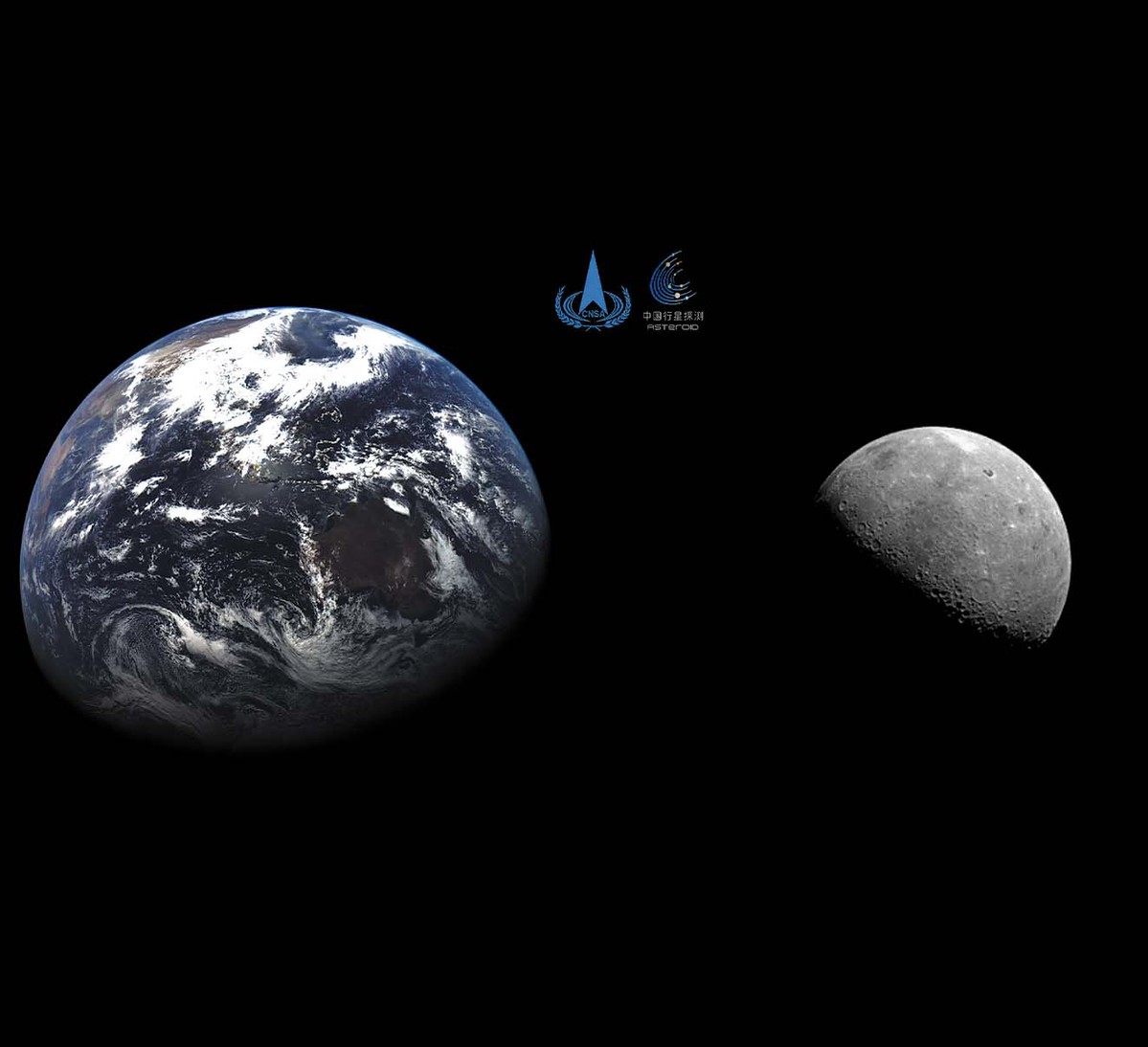
China's Tianwen 2 asteroid sampling spacecraft has been on its interplanetary itinerary for more than 33 days, orbiting at a distance of over 12 million kilometers from Earth, and it is in good working condition, the China National Space Administration said on Tuesday.
The robotic probe is currently traveling on a transfer trajectory toward its destination, a near-Earth asteroid called 2016 HO3, the space administration said in a news release.
The CNSA also released two images, showing Earth and the moon, captured by the spacecraft's narrow-field-of-view navigation sensor when it was about 590,000 km away from Earth.
The Tianwen 2 mission, which is China's first attempt to bring pristine asteroid samples back to Earth, was launched on May 29, when a Long March 3B rocket carrying the robotic probe blasted off from the Xichang Satellite Launch Center in Sichuan province.
The probe's primary objective is to reach 2016 HO3, a small asteroid that is 40 to 100 meters wide, in the summer of 2026. It will study the celestial body up close using a suite of 11 instruments including cameras, spectrometers and radars, before deploying special devices to collect surface substances.
The asteroid, which is also known as 469219 Kamo'oalewa, orbits the sun and, therefore, is a constant companion of Earth. It is too distant to be considered a true satellite of Earth, but is the best and most stable example to date of a quasi-satellite.
After the asteroid samples are collected, the Tianwen 2 probe will fly back to Earth's orbit and send a capsule containing the precious materials to the ground.
The samples will be distributed among scientists, who will examine their physical properties, chemical and mineralogical content and isotopic composition, contributing to studies on the formation and evolution of asteroids and the early solar system.
Delivering the samples to Earth will not be the end of the mission. The Tianwen 2 spacecraft will then enter the second phase of its journey, flying toward a main-belt comet called 311P to conduct a remote-sensing survey and transmit the data back to Earth for scientific research, according to the CNSA.
The whole mission is expected to yield groundbreaking discoveries and expand the understanding of Earth and small celestial bodies inside the solar system, scientists said.





- Tianwen 2 sends back images of Earth, moon
- Laser monitoring system adds extra dimension to 3D printing
- Consumption push promises summer tourism boom
- Snake-like, miniature robots redefine limits of engineering
- 2,000-year-old steel acupuncture needles unearthed in Jiangxi
- New carbon neutrality initiative launched in Beijing