Khoomei: Sounds of harmony
Ancient throat singing tradition thrives amid cultural shifts, Chen Nan and Yuan Hui report










Editor's Note: Using a blend of words and visuals, this series explores unique communities and reveals the heart of China through food, architecture, craftsmanship, landscapes and traditions.
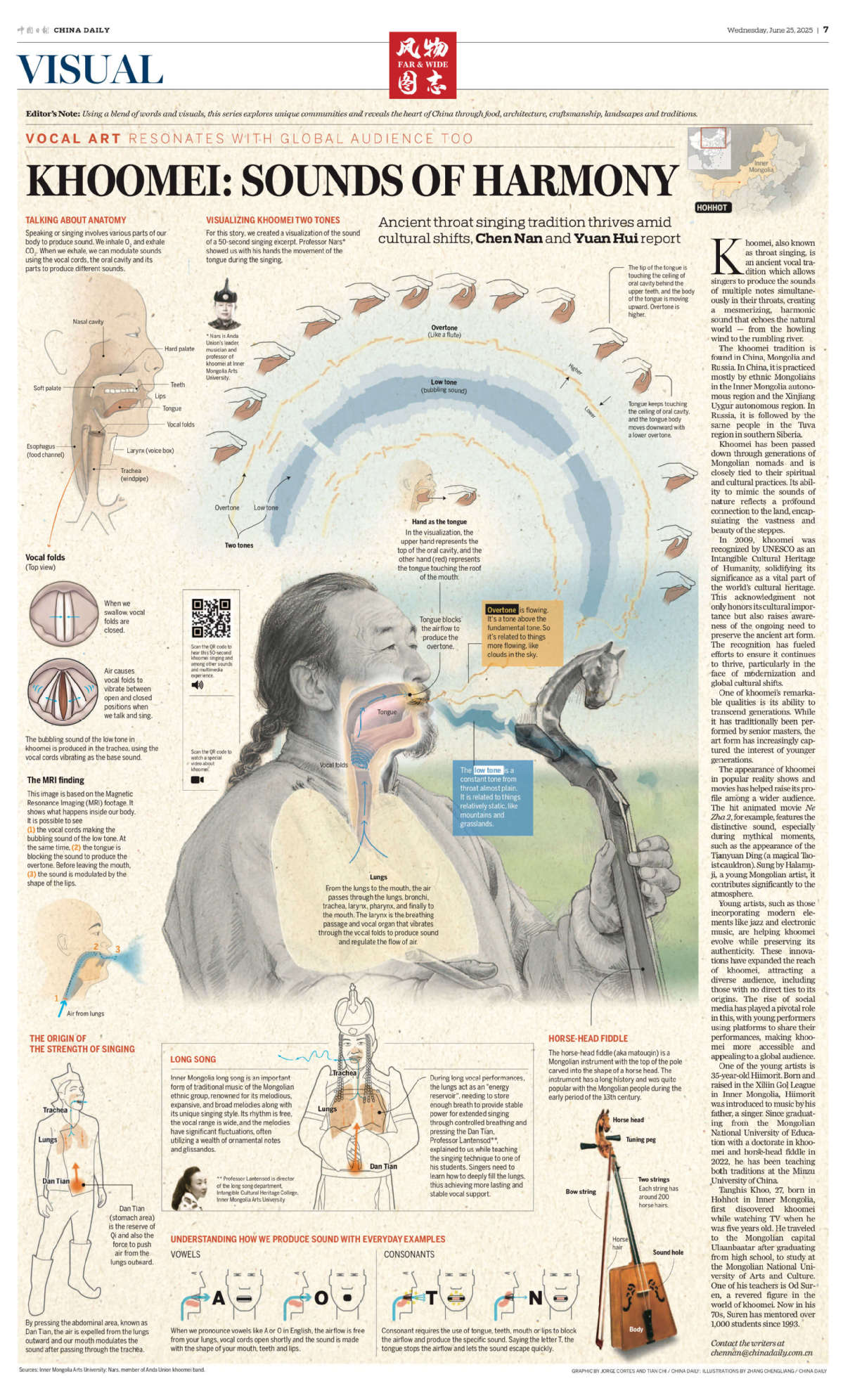
Khoomei, also known as throat singing, is an ancient vocal tradition which allows singers to produce the sounds of multiple notes simultaneously in their throats, creating a mesmerizing, harmonic sound that echoes the natural world — from the howling wind to the rumbling river.
The khoomei tradition is found in China, Mongolia and Russia. In China, it is practiced mostly by ethnic Mongolians in the Inner Mongolia autonomous region and the Xinjiang Uygur autonomous region. In Russia, it is followed by the same people in the Tuva region in southern Siberia.
Khoomei has been passed down through generations of Mongolian nomads and is closely tied to their spiritual and cultural practices. Its ability to mimic the sounds of nature reflects a profound connection to the land, encapsulating the vastness and beauty of the steppes.
In 2009, khoomei was recognized by UNESCO as an Intangible Cultural Heritage of Humanity, solidifying its significance as a vital part of the world's cultural heritage. This acknowledgment not only honors its cultural importance but also raises awareness of the ongoing need to preserve the ancient art form. The recognition has fueled efforts to ensure it continues to thrive, particularly in the face of modernization and global cultural shifts.
One of khoomei's remarkable qualities is its ability to transcend generations. While it has traditionally been performed by senior masters, the art form has increasingly captured the interest of younger generations.
The appearance of khoomei in popular reality shows and movies has helped raise its profile among a wider audience. The hit animated movie Ne Zha 2, for example, features the distinctive sound, especially during mythical moments, such as the appearance of the Tianyuan Ding (a magical Taoist cauldron). Sung by Halamuji, a young Mongolian artist, it contributes significantly to the atmosphere.
Young artists, such as those incorporating modern elements like jazz and electronic music, are helping khoomei evolve while preserving its authenticity. These innovations have expanded the reach of khoomei, attracting a diverse audience, including those with no direct ties to its origins. The rise of social media has played a pivotal role in this, with young performers using platforms to share their performances, making khoomei more accessible and appealing to a global audience.
One of the young artists is 35-year-old Hiimorit. Born and raised in the Xiliin Gol League in Inner Mongolia, Hiimorit was introduced to music by his father, a singer. Since graduating from the Mongolian National University of Education with a doctorate in khoomei and horse-head fiddle in 2022, he has been teaching both traditions at the Minzu University of China.
Tanghis Khoo, 27, born in Hohhot in Inner Mongolia, first discovered khoomei while watching TV when he was five years old. He traveled to the Mongolian capital Ulaanbaatar after graduating from high school, to study at the Mongolian National University of Arts and Culture. One of his teachers is Od Suren, a revered figure in the world of khoomei. Now in his 70s, Suren has mentored over 1,000 students since 1993.
Read more: Khoomei resonates with global audience too
Contact the writers at chennan@chinadaily.com.cn