



Biased subsidy accusations against China distort facts









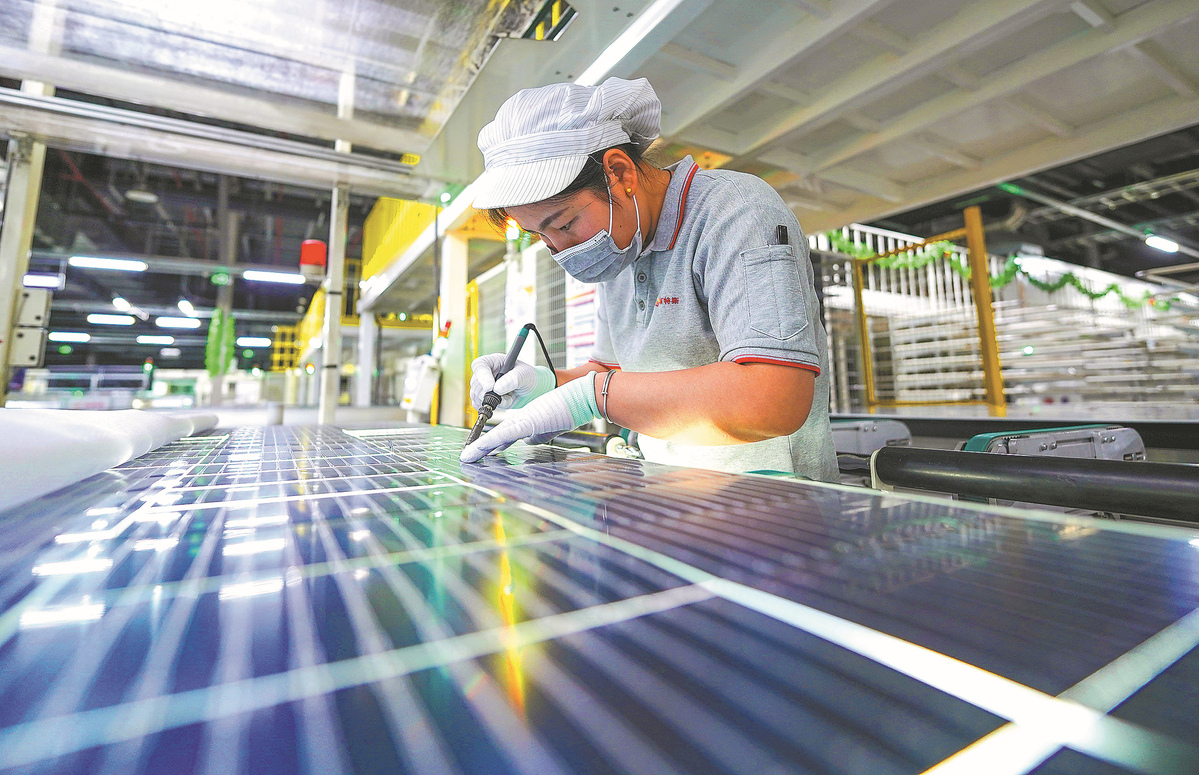
An employee works on a solar panel production line in Suqian, Jiangsu province. CHEN SHAOSHUAI/FOR CHINA DAILY
Certain Western politicians have recently repeated false accusations aimed at China's industrial subsidies and again made baseless "overcapacity" claims. Such narratives, which have been pushed in recent years, clearly distort the facts and reveal typical double standards.
Across the globe, all economies adopt industrial policies to pursue their own development needs and goals. According to incomplete statistics, the European Union, for example, will provide various subsidies totaling 1.44 trillion euros ($1.65 trillion dollars) from 2021 to 2030. By 2024, more than 300 billion euros of subsidies had been distributed. Notably, 387 billion euros in funding has been allocated to the bloc's common agricultural policy for the 2021-2027 period.
It is a clear double standard for one country to point a finger at another while itself resorting to increased subsidies to develop its own industries. Basically, accusations of so-called market distortions and overcapacity are politically motivated moves and clear instances of economic scapegoating. They are just excuses for certain developed countries to adopt protectionist trade practices and to contain and suppress China's industrial progress. They reflect excessive anxiety among nations concerning their own industrial competitiveness and market shares.
The subsidy and overcapacity allegations against China are illogical and untenable. China's manufacturing industry has, in fact, honed its competitiveness through a complete, efficient industrial system, full market competition, a rich labor pool and sustained innovation efforts. Its comparative advantage does not and cannot simply rely on subsidies.
Besides, China's industrial subsidy policy abides strictly by the principles of openness, fairness and compliance -- and is in accordance with WTO rules. China's subsidies are mainly designed for research and development purposes, and to support consumers. They are not linked to exports.
In the world today, both production and consumption are global. The development of international trade is driven by comparative advantages, the international division of labor and cooperation between countries. It is absurd to label a country as having "excess" capacity just because it produces more than its domestic market absorbs.
All economies have the right to development and to determine their own industrial policies based on unique national conditions. Any move to arbitrarily generalize the definition of subsidies or attack the economic development model of another country under the pretext of misapplied subsidies should be resolutely opposed.
To best serve the goal of shared growth, it is desirable to promote open, win-win cooperation, free trade and multilateralism, while double standards and protectionist attitudes must be abandoned. Communication and dialogue based on mutual respect are the best approach to solving trade differences.





