



Stroke-detecting AI company eyes Chinese link-up









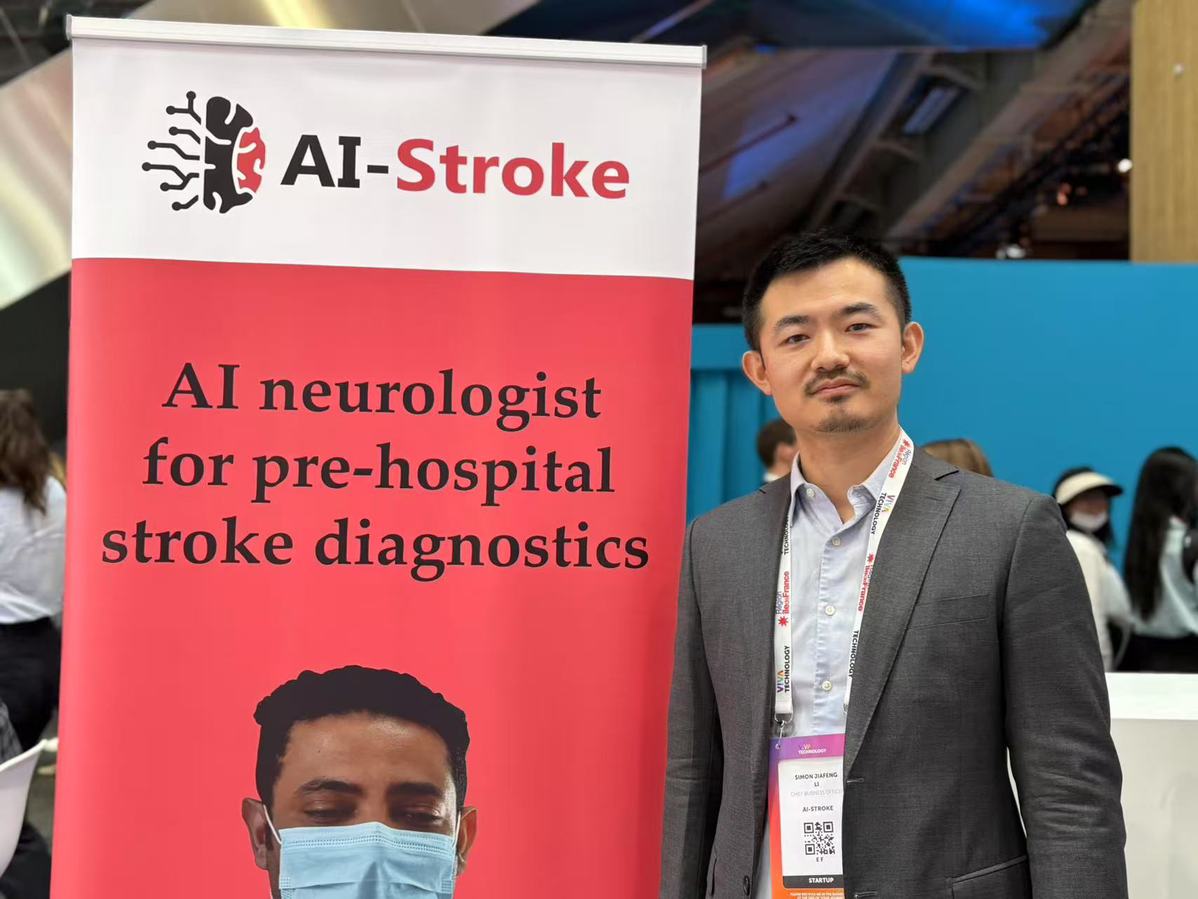
A prime example of France-China cooperation in artificial intelligence, or AI, AI-Stroke is a fast-growing French health-tech startup tackling one of the world's most urgent medical challenges; stroke detection. Founded in 2023, the company is developing AI-based tools that help diagnose strokes in critical early moments — and it sees China as a key partner in its global mission.
At the heart of AI-Stroke's strategy is a deepening collaboration with Chinese medical institutions, researchers, and healthcare investors. China has the highest number of stroke cases globally, making it an essential partner for innovation, testing, and deployment.
AI-Stroke specializes in using AI to detect strokes in their early stages — crucial minutes before patients even reach the hospital. The technology is based on the internationally recognized FAST protocol (Face, Arm, Speech, Time), which AI-Stroke has digitized using computer vision and voice analysis. The software can recognize facial paralysis, arm motor dysfunction, and speech difficulty through a simple mobile app or camera, and make a preliminary diagnosis in under two minutes.
Simon Li, the company's chief business officer, believes China is not just a strategic market, it is a vital partner. "Stroke is really now the number one issue for Chinese citizens' health," Li said. "China has the highest number of stroke cases in the world, especially as the population ages. For us, it's a priority market in terms of both volume and urgency."
China records 3 million new stroke cases each year and is home to over 17 million stroke survivors, according to data presented by AI-Stroke at the VivaTech conference in Paris. Stroke is the leading cause of death and disability in the country, and the burden on the healthcare system is enormous. These numbers make China the most significant global market for any stroke-related medical solution.
Born in China and educated in France and the United States, Li joined the startup to lead its global business development. His background allows him to bridge cultural, regulatory, and commercial gaps between East and West. "The company was started by a French founder who is a serial entrepreneur and engineer," he explained. "Once the technology was ready to commercialize, they realized they needed someone with knowledge of the Chinese market and healthcare system — that's where I came in."
AI-Stroke's ambitions in China are both commercial and collaborative, Li explained. On the commercial side, they see enormous potential in deploying their app across China's ambulance system, where international studies suggest up to one-third of stroke cases go unrecognized during emergency transport. The technology could also assist stroke survivors, who face a 13 percent chance of recurrence within the first year, by enabling home-based monitoring and early detection.
The startup is actively engaging with Chinese healthcare institutions, including top hospitals like Tiantan Hospital in Beijing and Fudan University in Shanghai, to create a localized database and to adapt AI for Chinese demographics. "So far, our AI is trained mostly on European data," Li noted. "We are now working to build datasets of Chinese patients so the solution performs equally well for local users."
Li emphasized that this cooperation is not just about data, it is about expertise. "We want the best Chinese neurologists to guide us," he said. "We also hope to work with Chinese AI engineers and raise capital from local investors. It's a full-circle collaboration."
He also noted that China's supportive policy environment further strengthens the case for expansion. Under the Healthy China 2030 Initiative, stroke prevention and faster diagnosis are defined national priorities. "The government is giving lots of support in terms of how to reduce misdiagnosis, accelerate triage, and enable access to care in rural and lower-resource settings," said Li.
At a time when global competition in AI is intensifying, AI-Stroke sees international cooperation as essential. "AI is a business of data," Li said. "It doesn't help anyone if each country just works alone. If you only train on one demographic, the solution won't generalize well. We want AI that works for everyone — across languages, ethnicities, and systems."
wangmingjie@mail.chinadailyuk.com











