Federal funding cut to California high-speed rail deepens political divide









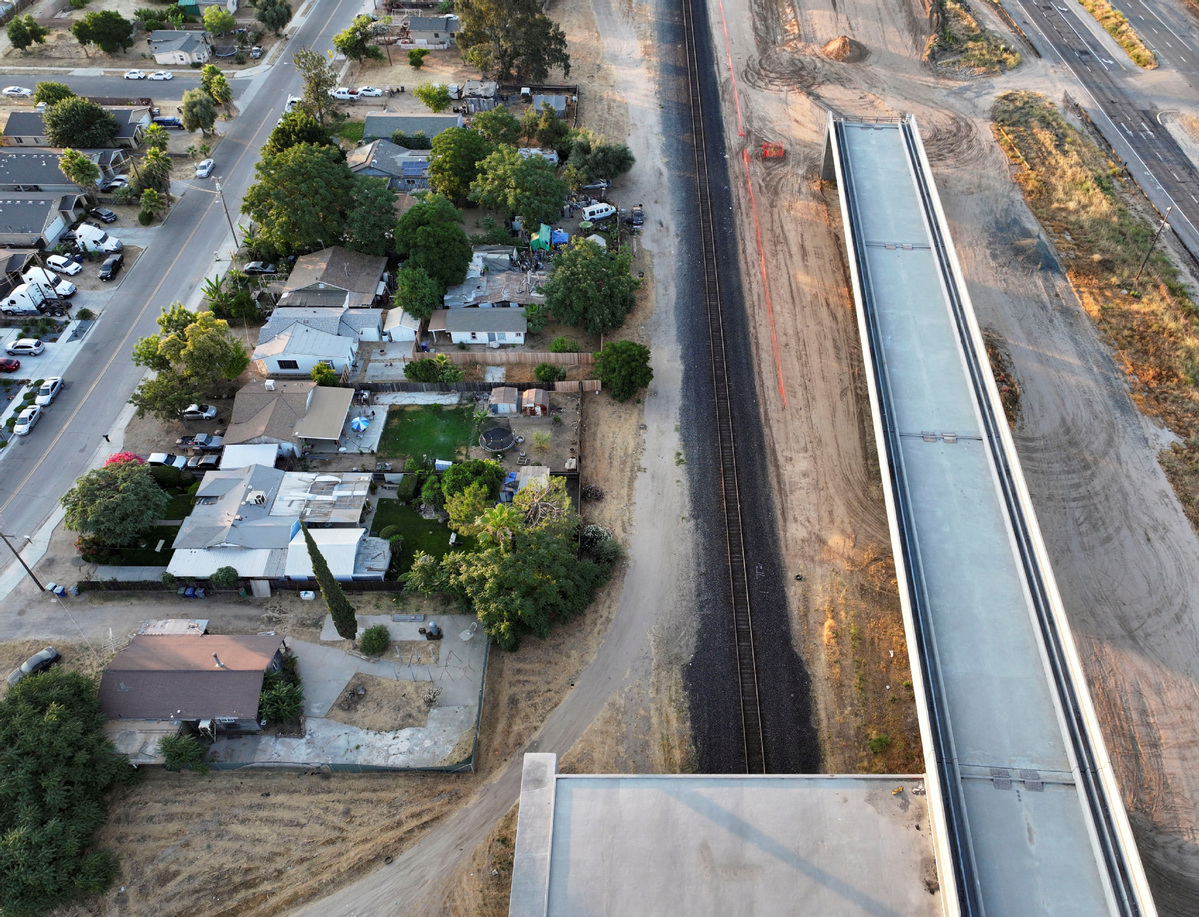
California's high-speed rail project, the largest infrastructure undertaking in the United States, faces a significant setback after the Trump administration announced the termination of $4 billion in federal grants to the already troubled initiative.
The project, which originated in the early 2000s, was designed to position California as a leader in advanced transportation while stimulating the state's economy. However, the original scope has been repeatedly scaled back due to extensive delays and substantial cost overruns.
The Federal Railroad Administration at the US Department of Transportation issued a report last week finding that the high-speed rail project has broken the terms of two federal grants totaling approximately $4 billion. Key findings include missed deadlines, budget shortfalls and inflated ridership projections.
The federal agency has given the California High-Speed Rail Authority (CHSRA), responsible for designing, building and operating the state's high-speed rail system, until July 11 to propose corrective measures before funding termination. California officials have indicated they will pursue legal action once the grant is withdrawn.
"Upon termination of the grant, California can file suit under the Administrative Procedure Act, or APA. The act permits challenges based on various grounds," David Freeman Engstrom, a law professor at Stanford University, told China Daily.
"The most likely claim that California will assert under the APA is that the Federal Railroad Administration acted in an arbitrary and capricious manner, by failing to apply the right factors in terminating funding or by failing to show a rational connection between the facts found and the decision to cut off funds," Engstrom explained.
It marks the second time that California has confronted the Trump administration over high-speed rail funding. In 2019, during President Donald Trump's first term, nearly $1 billion in grants were slashed, prompting California to file a lawsuit.
California Governor Gavin Newsom called the termination "political retribution" and "a direct assault on California", saying the grant was "California's money appropriated by Congress".
The legal battle intensified tensions between California and the Trump administration, but before the case went to trial, Joe Biden became president and restored the grant.
Experts said that any new lawsuit could extend for years, while the funding termination threatens to significantly affect construction progress and potentially result in layoffs.
The high-speed rail project was originally conceived to connect Los Angeles and San Francisco with trains capable of completing the journey in under three hours at speeds exceeding 200 miles (322 km) per hour, according to the CHSRA.
Since California voters approved project bonds in 2008, estimated costs have surged from the initial $33 billion to $128 billion over the past 17 years. The project currently focuses on a 172-mile (277-km) segment from Bakersfield to Merced in the Central Valley, with completion targeted for 2033.
The United States currently operates no high-speed rail networks. Two high-speed rail lines are under construction — the California High Speed Rail and Brightline West, which will link Las Vegas to Southern California.
This contrasts sharply with Europe and Asia, where high-speed trains are popular. China operates the world's largest high-speed railway network, with approximately 48,000 kilometers of operational track by the end of 2024, according to China State Railway Group.
Political considerations have long influenced California's high-speed rail project. During the early 2010s, California officials, including then-governor Jerry Brown, actively pursued Chinese investment and technology for the high-speed rail initiative. However, the political climate became increasingly restrictive toward Chinese involvement in US infrastructure development following Trump's 2017 inauguration.
Ray LaHood, former transportation secretary under President Barack Obama and co-chair of the US High Speed Rail Coalition, attributed the US' failure to develop high-speed rail networks to insufficient federal support and lack of political consensus.
"Opponents of California's high-speed rail program continue to jeer from the sidelines, as the project reports new cost increases. But the real impediment to progress is a long-term lack of federal support for high-speed rail," wrote LaHood in a 2023 article for CalMatters.
The funding cuts have ignited political debate across California and Washington, with arguments largely following partisan lines. Supporters, predominantly Democrats, maintain that the project is essential for the state's future mobility and climate goals, while opponents, primarily Republicans, cite ongoing delays, cost overruns, and the system's reduced scope as evidence of mismanagement.
The longstanding political rivalry between Newsom, a Democrat, and Trump, a Republican, may have influenced the grant-termination decision, Engstrom suggested.
"Governor Gavin Newsom has been one of the most outspoken critics of Trump, going all the way back to the first Trump administration. The two men clearly don't like each other," he said. "But I'm not sure that's anything close to the whole story here. Instead, President Trump is using high-speed rail in California as a powerful political symbol that the liberal establishment can't get things done."
liazhu@chinadailyusa.com