



Reformed gaokao offered in 29 provincial-level regions
Improved system covers 98 percent of all exam takers across country this year









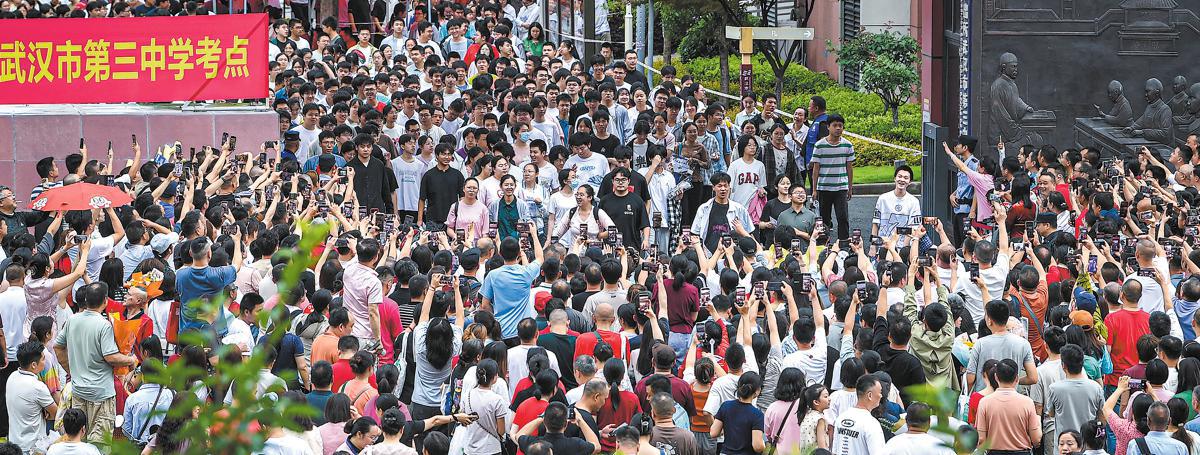
Nearly all candidates in this year's national college entrance examination, or gaokao, participated in a reformed exam that has fully integrated new curriculum standards nationwide, according to the National Education Examinations Authority.
The tests emphasize moral education, foundational knowledge and critical thinking.
Twenty-nine provincial-level regions have adopted the reformed system, covering 98 percent of all candidates. Under the system, there are two versions of the gaokao, which began on Saturday and will end on Tuesday: the "3+1+2" model, now used in 23 provinces, and the earlier"3+3" model, which remains in place in six locations including Beijing, Shanghai and Shandong province.
Under the "3+1+2" format, students take three mandatory exams — Chinese, mathematics and a foreign language. They then choose either physics or history as their primary elective, followed by two of four other subjects: chemistry, biology, political ideology and geography.
Students under the "3+3" format take the same three mandatory exams and choose three electives from the remaining six subjects.
Shanghai and Zhejiang province were the first two provincial-level regions in China to adopt the system in 2017.
A spokesperson from the authority stated that this year's exam is designed to assess students' core competencies, subject literacy and thinking process, aiming to promote all-around student development.
In honor of the 80th anniversary of China's victory in the War of Resistance Against Japanese Aggression (1931-45) and the World Anti-Fascist War, one Chinese-language essay prompt featured historical materials intended to deepen students' sense of national identity and patriotism. An excerpt from the prompt read, "I want to embrace each of you with bloodied hands, because a nation has risen."
Another national essay prompt encouraged students to dream boldly and work diligently to achieve their goals. The spokesperson noted that exam questions emphasized authenticity and originality, requiring students to convey genuine emotions through rhythmic language and vivid details.
Chen Zhiwen, a member of the Chinese Society of Educational Development Strategy, commented that this year's Chinese exam focused on the principle of moral education, inspiring young people to embrace their responsibility to the country.
Test designers also stressed the importance of strengthening assessments of students' basic knowledge.
"The exam content was strictly based on university admission requirements and high school curriculum standards, aiming to reduce rote memorization and mechanical test drilling," the spokesperson said.
Critical thinking was another focus of the test. A reading passage on the Chinese paper used a question-and-answer format about planting trees, asking students to reason why someone might choose a sunny day instead of a rainy one for planting. Wang Ning, a senior professor at Beijing Normal University, said this structure demands that students grasp the logical relationship between the questions.
In math exams, practical scenarios were used to test students' problem-solving skills. One question involved vectors in a sailing competition, while another asked students to analyze the statistical relationship between a disease and ultrasound testing. The spokesperson said the tests encourage students to apply their knowledge in solving real problems, think independently and explore creatively.
The authority also conducted research into classroom teaching and learning conditions to strengthen the connection between testing and teaching. A reading question on the national Chinese paper directly links exam content with textbook material to promote deeper classroom teaching.
zhaoyimeng@chinadaily.com.cn





