Lavender fields and a beloved purple bear









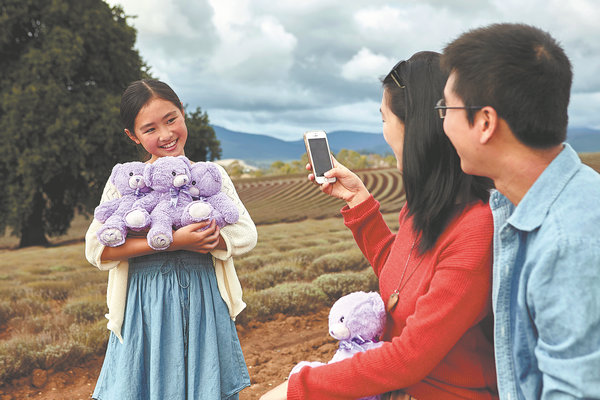
Bobbie the Bear is probably better known in China than it is in Australia.
The scented purple bear, a product of the Bridestowe Lavender Estate in northeastern Tasmania, is one of the island state's most successful stories.
Each year, thousands of tourists from mainland Australia and overseas flock to the 160-hectare property on the upper reaches of the Tamar Valley outside Launceston to walk through the fields of lavender.
The story behind Bobbie the Bear was described by Australia's Startup Daily as "one of the most successful case studies of a foreign brand succeeding in China".
The estate's owner, Robert Ravens, said the bear's phenomenal success in China "even caught us by surprise".
In a telephone interview from Italy, where he was on holiday with his wife, Ravens said the bear was a way of using up excess dried lavender.
The bear became a household name in China more than a decade ago, he said.
"A Chinese celebrity was photographed on social media with Bobbie the Bear ... which sparked a social media frenzy. It seemed like everyone in China wanted one."
Overnight, the company went from producing a few thousand scented teddy bears to hundreds of thousands. Demand never slowed down, Ravens said.
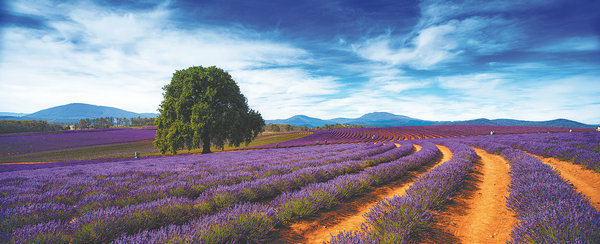
Just over 100 years old, the estate has firmly stamped itself on the Tasmanian tourist map with an estimated 68,000 visitors a year, many of them Chinese.
The property was established by Charles Denny, who emigrated from London in 1921 with the vision of producing quality lavender.
Denny carried with him wild lavender seeds from southern France, hoping to recreate the same high-quality lavender oil in the Eastern Hemisphere, Ravens said. "As well as having good soil, the site was located 40 degrees south of the equator, precisely the same latitude Provence is north of the equator," he said.
"Perhaps more important, it was blessed with a very similar climate, and by 1935, oil produced by the Dennys was deemed to be outstanding by their London connections, who included Yardley relatives — soap makers and perfumers since the early 17th century."
By 1975, the company was one of the world's biggest producers of lavender oil.
The Denny family managed the estate until 1989, when it went into "corporate ownership and began to decline without the family's care", says an article published by the Tasmanian Country magazine in October.
For nearly 20 years, the estate fell into disrepair before Ravens came along.
Having retired from a high-powered corporate position with a Sydney-based chemical company in 2003, Ravens said becoming an entrepreneur was the "last thing on my mind".
"I wanted to find a country property, one which the family could enjoy."
The Bridestowe estate came up in 2006, he said.
"My wife and I decided to have a look. It was run down and grossly undercapitalized. But it had a fascinating history attached to it. It was not cheap, despite the condition it was in."
Negotiations on the purchase began in 2006, and by February 2007, "we had bought it", Ravens said.
"The whole process was rather tortuous, but I saw it as a restoration project more than anything else."
The first few years were not easy, but Ravens and his family persisted and built the business, which is recognized globally and has become an icon of Tasmanian tourism.
With its contoured rows of nearly 700,000 fragrant lavender bushes, the Bridestowe Lavender Estate resembles one giant postcard.
Despite the many ups and downs the estate has been through, Ravens said he does not see himself as the owner, but rather as the custodian.
"We like to say this place is owned by the public."