China Travel Guide: Gansu









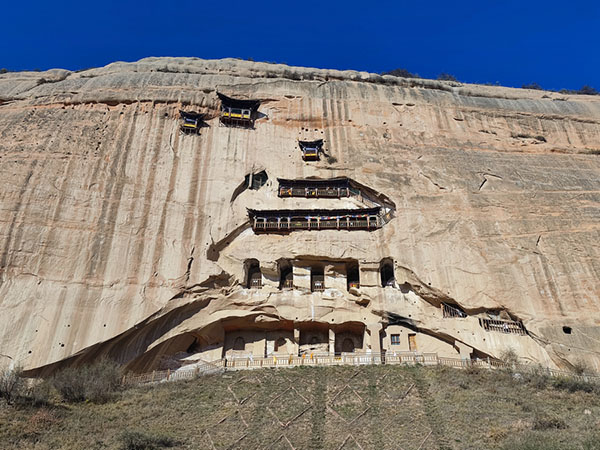
Mati Temple Scenic Area
Located at the northwest bank of the Mati River and at the foot of Linsong Mountain in Zhangye city, Mati Temple is a national 5A tourist attraction, a cultural relic and a famous Buddhist site. It is about 62 kilometers away from downtown Zhangye and earned its name because of a horse footprint found on the top of a grotto.
First built in the northern Liang period (397-460), Mati Temple boasts a wide range of natural, historical and cultural sites, with Yugu, Tibetan and Mongolian ethnic features. It has been widely known for the 21 grottoes distributed in seven floors situated on sharp cliffs.
It is surrounded by rich landforms and has lots of rare wild animals such as white-lip deer, snow leopards and cliff sheep.
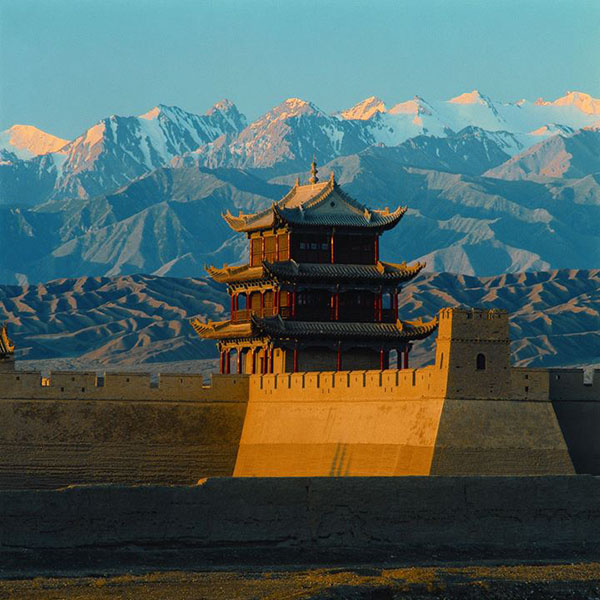
Jiayuguan
Jiayuguan, situated at the center of the Hexi Corridor, a part of the Silk Road in Gansu province, derived its name from the western terminus of the Ming Great Wall at Jiayu Pass.
However, Jiayuguan's reputation stretches further. It is known as the "No 1 Strategic Pass in the World" and "the Steel City of West China", and is the only city to combine the Great Wall of China with Silk Road culture.
Jiayuguan is abundant in both natural beauty and cultural heritage. It has many important natural and historical sites, including the Great Wall's Jiayu Pass, a world-recognized historical site and one of China's top 10 scenic spots, Qiyi Glacier, the closest glacier to any metropolitan area in Asia, tombs from the Wei (AD 220-265) and Jin dynasties, which are protected cultural relics, and the Overhanging Great Wall, known as the "Badaling of the West". The area also has a world-class gliding base and an international driving camp for car enthusiasts.
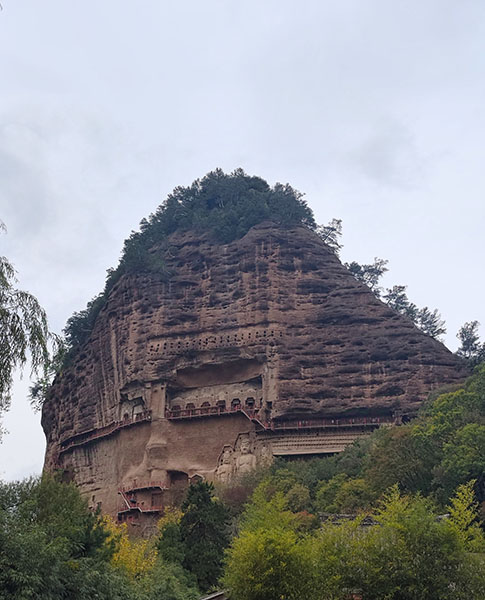
Maiji Mountain
Maiji Mountain scenic area, which covers 215 square kilometers, is located in Tianshui, Gansu province. The scenic area includes many tourist attractions, such as Maiji Mountain Grottoes, Immortal Cliff (Xianren Ya) and Stone Gate (Shi Men).
Maiji Mountain Grottoes, first constructed in the Eastern Jin Dynasty from 384 to 417, consists of 221 caves, 10,632 clay sculptures and stone carvings, and delicate frescoes covering 1,300 square meters.
Maiji Mountain Grottoes, as well as the Mogao Caves in Dunhuang, Gansu province, the Yungang Caves in Shanxi province, and the Longmen Grottoes in Henan province, are listed as the four most important grottoes in China.
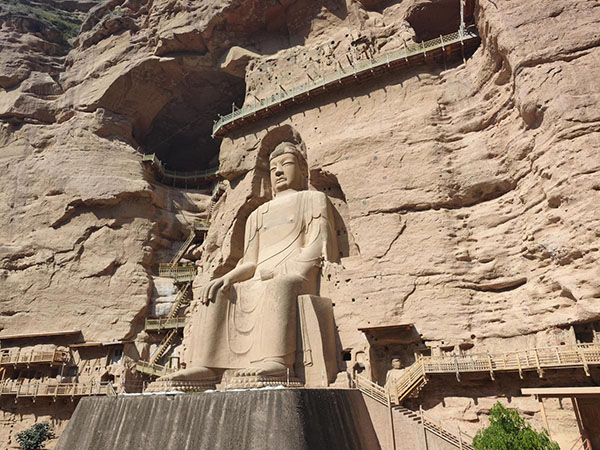
Bingling Temple World Heritage Tourist Area
Located in Northwest China's Gansu province, the Bingling Temple World Heritage Tourist Area covers 150 square kilometers. It is home to the Stone Grottoes of Bingling Temple (a component of the World Heritage of the Silk Road: the Routes Network of Chang'an-Tianshan Corridor), the Bingling Stone Forest, the Bingling Lake (the largest artificial freshwater lake in northwestern China), and the Yellow River Hydropower Expo Park.
As the largest stone grottoes in Gansu province, the Bingling Temple Grottoes are a world cultural heritage with a history stretching back more than 1,600 years, a national foremost protected cultural heritage site, and one of the six famous stone grottoes in China.
The temple boasts 216 extant grottoes, 815 stone statues, 1,000-square-meter murals, 56 stupas and 438 cultural relics. In particular, the earliest of China's well-preserved statue inscription dating back to 420 during the Western Qin State was discovered in the No 169 grotto.
With the grotto murals and stone statues of different historical periods, the Bingling Temple Grottoes are dubbed "the encyclopedia of stone grottoes" and have historical, artistic, and academic value arising from the development of stone grottoes and sculpture art in China.