


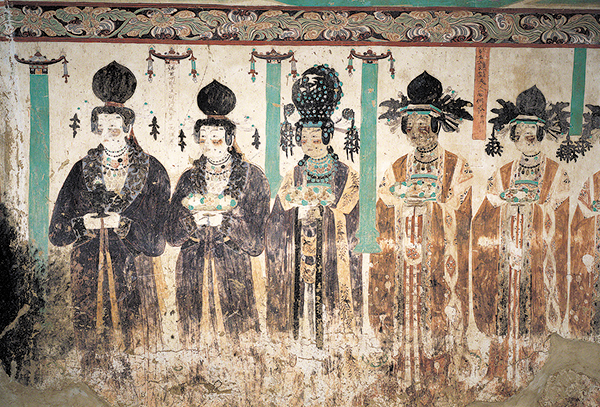
One theme that continually echoes through the world-renowned Mogao Caves in Dunhuang, Gansu province, is the passage of time. Tour guides often point out that the black elephant and black horse depicted in two frescoes — illustrating the mythical birth of Shakyamuni, the historical founder of Buddhism, and his departure from a life of luxury in pursuit of enlightenment — were originally painted white. Their darkened appearance today is the result of oxidation over a millennium.
The same chemical process affected the lead white pigment once applied to certain facial features to enhance structure and dimensionality — similar to how makeup is used today. As these white highlights darkened over time, some faces in the Dunhuang frescoes exude an eerie, haunting beauty.
However, the most powerful reminder of the progression of time lies not in the transformation of color but in the visible layering of history itself, as centuries of devotion and artistry accumulate one atop another, says Zhong Na, a senior tour guide who has visited the caves countless times over the past 20 years.
According to Zhong, though new caves were continually carved starting from the mid-4th century, it was common for each new generation of artists to add to the visions of those who came before — plastering over the works of their predecessors to paint their own sacred reflections of the Buddhist realm.
Known as chongceng bihua, or "multilayered frescoes", the phenomenon finds a striking parallel in the history of Western oil painting. Through techniques like X-ray fluorescence and infrared reflectography, conservators have discovered hidden compositions beneath the visible one — a practice known as pentimento (from the Italian pentirsi, meaning "to repent") in which artists reconsider their vision or repurpose a canvas. At times, these earlier images were painted over simply out of practicality, such as saving materials.
In Dunhuang, this practice has played a vital role in preserving the past. The top layers of murals, added by later generations, help protect the underlying artwork, slowing oxidation and discoloration. As a result, when the surface layer eventually deteriorates, the exposed lower layers often remain in relatively good condition. Even without the top layer falling away, the different strata can still be glimpsed along the edges, where broken portions reveal the cross-sections of the walls.
"In this sense, the Dunhuang frescoes are like a book — each page capturing a distinct era bound together by the thread of history," says Zhong. "It tells something about a cultural tradition that grounds the ancient Chinese civilization."
Interestingly, the same layering applies to the floors. In Cave 96 — home to the largest Buddha statue in Dunhuang — floors built during the Qing Dynasty (1644-1911) rest atop those from the Ming (1368-1644), which in turn overlay earlier layers from the Yuan (1271-1368), Xixia (Western Xia) (1038-1227) and Tang (618-907) dynasties, dating back to the cave's original construction in the late 7th century. "We've had to revise the recorded height of the cave multiple times with each discovery of a deeper floor beneath," Zhong admits.








