


Throughout history, religious worship has rarely existed in pure silence, and Dunhuang was no exception. At this cultural crossroads, traditional Chinese instruments blended with those introduced via the ancient Silk Road, played by celestial beings floating above realms of Buddhist bliss. Their music must have followed the rhythm of twirling dancers who, as part of the scene, spin gracefully on ornate round carpets — much like Sogdian performers at lavish banquets in Chang'an.
"The frescoes' historical value can never be overestimated given the fact that few Tang Dynasty paintings, and ever fewer pieces of architecture, have survived to this date," says Zhong.
Her point was amply illustrated by Liang Sicheng (1901-72), considered by many "the father of modern Chinese architecture", and his equally talented wife Lin Huiyin (1904-55), a writer, poet and arguably the first female architect in modern China.
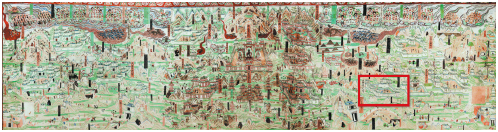
While poring over The Illustrated Catalogue of the Dunhuang Caves in 1937 — compiled by French Sinologist Paul Pelliot, who had visited Dunhuang in 1908 — Liang was captivated by a fresco titled Wutai Mountain Map.
Measuring 13 meters long and 3.6 meters wide, it was painted around the mid-10th century, roughly four decades after the fall of Tang Dynasty, to present a sweeping view of Wutai Mountain, a major pilgrimage site in Chinese Buddhism.
Whoever had created the bird's eye view had clearly marked and named 196 locations on the mural — including a certain Foguang Temple, which appeared to match one he had come across in archival materials shortly afterwards. Foguang literally translates to "the light of Buddha".
The couple wasted no time in journeying to Wutai Mountain, where, with the help of local monks, they succeeded in locating the main hall of the actual Foguang Temple. There, an ink inscription on a beam confirmed its dating to the Tang Dynasty.
"Until then, it was widely believed that no Tang Dynasty wooden structures had survived in China. The couple's discovery overturned that assumption — and they wouldn't have made it without that mural, painted on the western wall of Cave 61 in Dunhuang," Zhong says.





