


Birds of prey a fresh challenge for Beijing
Public awareness, rescue efforts increase as number of raptors grows










Fledgling efforts
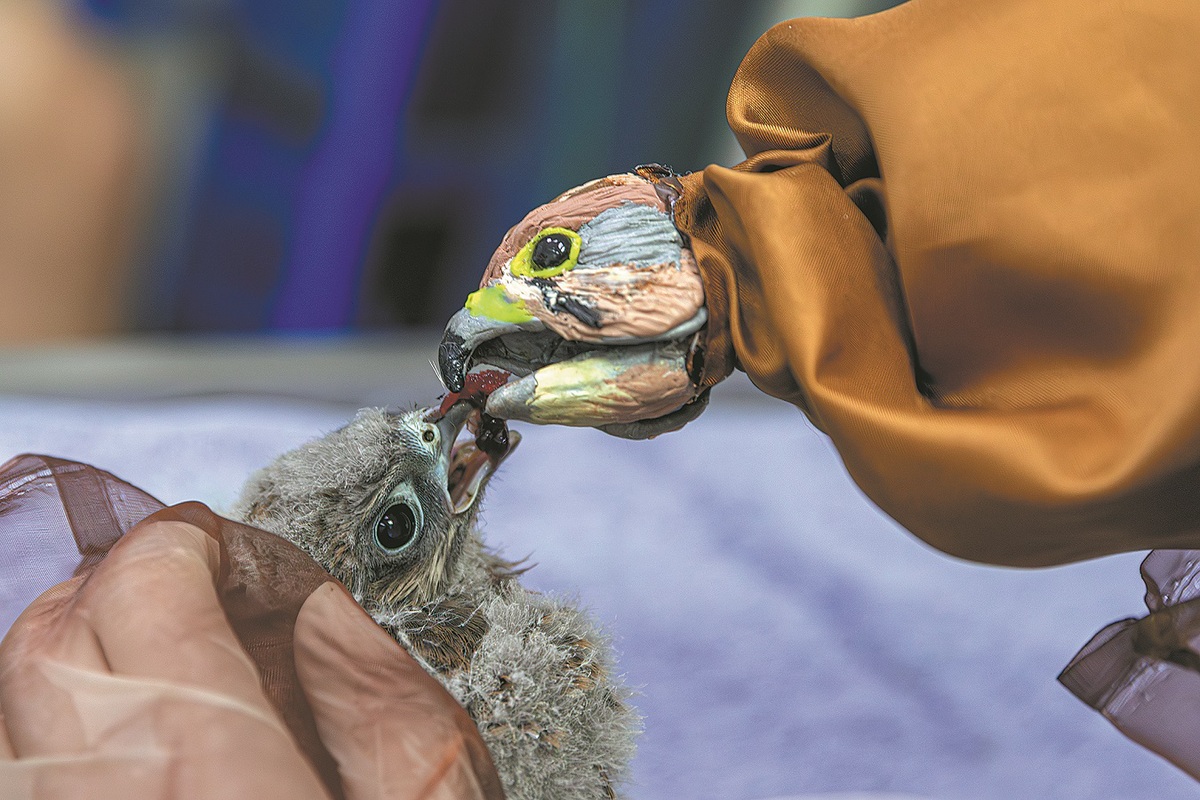
Baby birds that have fallen from their nests are also treated at the center. Zheng, the center manager, said raptors develop imprinting behavior at one to four weeks after hatching.
"To prevent the fledglings from developing incorrect imprinting behavior toward their human caregivers, our rehabilitator wears a hat covered with gauze and some decorations to hide her face and holds a puppet in the shape of a bird of prey to use its simulated beak to feed the fledglings, just like in the wild," said Zheng.
She added that during the process of raising baby raptors, the rehabilitators avoid unnecessary contact with them. As the baby raptors grow, they learn naturally from each other, practicing flying and gradually mastering hunting skills by relying on their instincts.
"We actually try to keep our contact with the animal to a minimum during the rescue process, which means that we do not expect additional affection from the raptors," Zheng said.
"The purpose of a rescue is to release it back into the wild, so we try as much as possible to avoid interacting with them and things like that."
With increasing public ecological awareness, the number of rescued birds accidentally harmed by poison has decreased, from an annual average of 10 between 2002 and 2005, to fewer than three in the past five years, center data showed.
The decline coincides with new legislative measures to protect animals and their habitats in recent years, Zheng said.
In May 2023, the revised Law on the Protection of Wildlife went into effect. The law prohibits the use of poisons, explosives, electric-shock or electronic devices for hunting and trapping wild animals.
Local authorities have also strengthened their protection efforts.
In April 2020, Beijing's wild animal conservation regulation, banned the human consumption of all terrestrial wildlife and certain aquatic wild animals that are on the Beijing wildlife conservation list. Trading the listed animals was also forbidden in markets.
Anyone who is found artificially breeding wild animals faces a fine of 20,000 yuan to 100,000 yuan ($3,074 to $15,350), according to the regulation, which took effect on June 1, 2020.





