Digital nomads' shifting landscapes
Two Hainan cities, emerging havens for the increasing group of remote workers, are also reaping economic benefits, Chen Bowen reports in Haikou.










Coastal hub
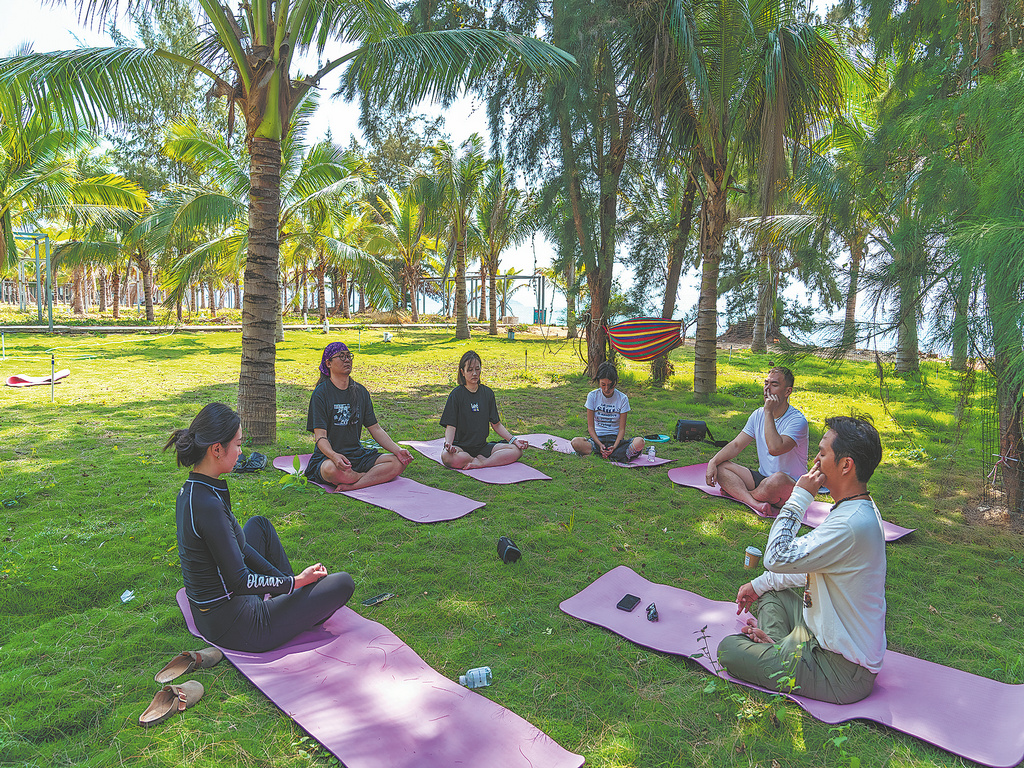
In Zhenhai village, located in Yazhou district of the coastal city of Sanya, another digital nomad community is making waves. The Sanya NCC Wave& Work Island Digital Nomad Community, the largest of its kind in China, has attracted over 200 nomads since its establishment in mid-December 2024. The community offers shared kitchens, libraries, gyms, swimming pools and offices, meeting the daily needs of its residents.
Li Xinya, 30, a community manager from Xi'an, Shaanxi province, frequently organizes activities to help newcomers connect with like-minded individuals.
"As long as you're not socially anxious and participate in community activities, it's easy to make new friends," Li says.
Li left his job in internet in Beijing a few years ago to explore a more flexible work-life balance and has since been involved in multiple digital nomad community projects.
Feng Ziqing, a designer from Foshan, Guangdong province, finds the oceanfront setting of the community inspiring.
"The quiet environment and proximity to the sea provide endless inspiration for my creations," she says.
Living in a six-person room, her monthly expenses, including food and accommodation, are around 2,000 yuan.
A 30-year-old finance professional from Wuhan called Laifu has visited the community twice within a month. He values the integration of work and leisure, as well as the intellectual exchanges among residents.
"Interesting souls, beautiful environment and well-equipped office spaces are crucial factors in digital nomad community life," he says.
Community events, such as cooking sessions, traditional local dance lessons, yoga practices and poetry workshops, foster deeper relationships among members. He hopes that future policies will support more flexible employment for digital nomads and more countries will offer visa-free entry to Chinese nationals, enabling him to "roam "more freely.
Yao Jianhua, a professor at Fudan University's School of Journalism, has been researching digital nomad communities for over two years. He sees these communities as transitional zones for young people facing employment challenges or career stagnation. "They offer a cost-effective alternative to metropolitan areas, allowing young people to experiment with online jobs while exploring their next career steps," Yao says.
However, managing shared spaces in digital nomad communities is not without its challenges. Li, the community manager, acknowledges that disputes over the use of public spaces, such as kitchens and quiet offices, can arise.
"Community governance must be self-regulated, not imposed," he says, emphasizing the importance of consensus-building and cross-authorization among residents to maintain order and harmony.
Beyond being a physical space, Li describes the Sanya nomad community as an experimental model for reshaping social interactions. "It fosters high-frequency idea exchanges, breaking traditional work-life patterns and transcending the 'information cocoon' of established social circles," he says, adding that this environment encourages ideological collisions and value integration, creating a unique blend of creativity and collaboration.
For many residents, the community represents a physical escape from the pressures of urban life and a spiritual journey of personal growth. "This new form of living is both a physical migration to escape involution and a spiritual journey of cognitive upgrading," Li explains.
As community members bring creative capital and innovative cultural tourism formats to local rural development, they also undergo self-reconstruction through cross-experiential exchanges. This dynamic reinforces a value loop of "talents returning to villages; community empowering individuals", creating a sustainable model for rural vitalization and personal fulfillment, he adds.
The term "digital nomad" was coined in a 1997 book by Tsugio Makimoto and David Manners, who predicted a future workforce of globe-trotting professionals. Today, this vision has become a reality, with Hainan Free Trade Port emerging at the forefront of this global movement. As digital nomad communities continue to grow, they are redefining how people balance work, life and travel in an increasingly interconnected world.
Contact the writer at chenbowen@chinadaily.com.cn