



Visits reaffirm commitment to ethnic areas









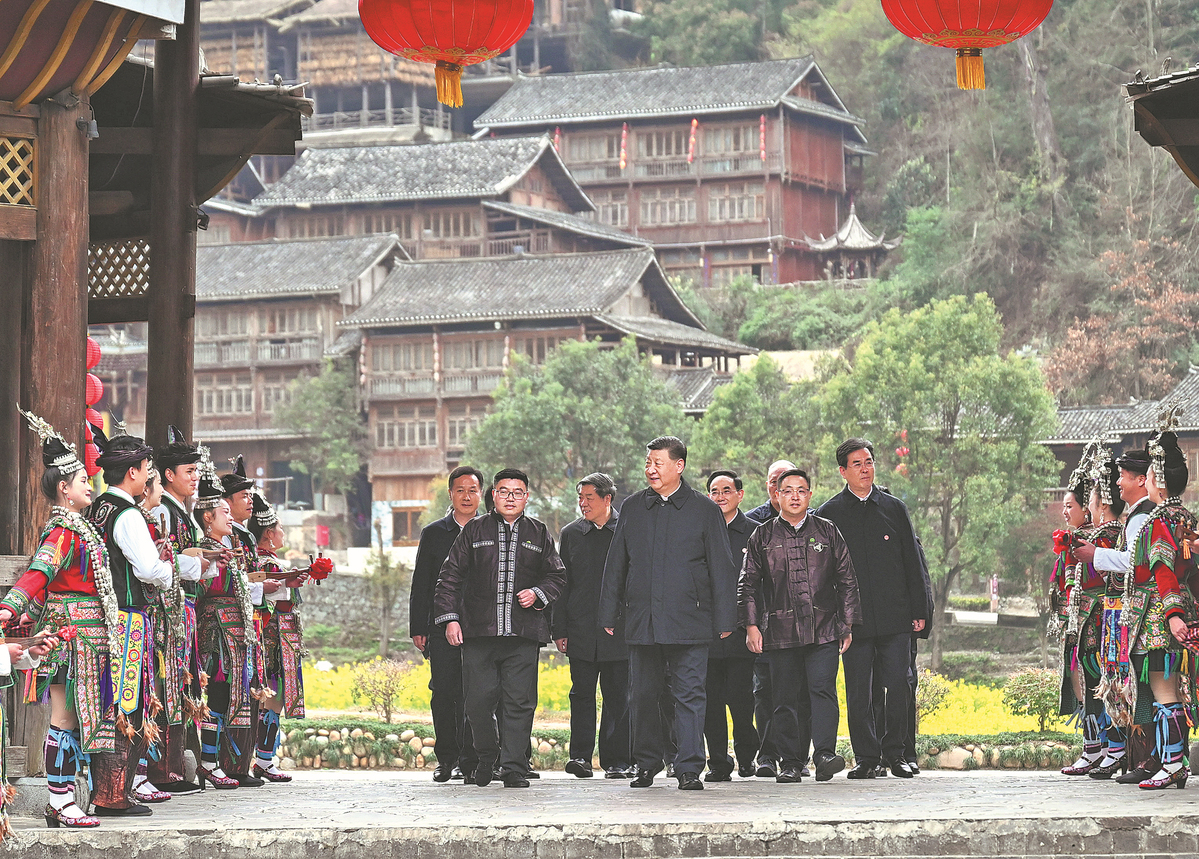
At the start of China's 14th Five-Year Plan period (2021-25), President Xi Jinping made a fact-finding trip to Guizhou province, where people of ethnic minority groups account for more than 36 percent of the population and which is home to the last nine counties removed from the country's poverty list in 2020.
Xi told the residents of a village in a Miao ethnic township that all 56 ethnic groups of China are part of the big family of the Chinese nation, and no ethnic group should be left behind in the country's building of a moderately prosperous society in all respects and in its drive toward modernization.
As the 14th Five-Year Plan nears completion and the country prepares for the next one, Xi once again chose Guizhou, along with Yunnan province, for his first inspection tour after the conclusion of the two sessions, the annual meetings of China's top legislative and political advisory bodies. The two provinces, both located in Southwest China, are home to diverse ethnic groups.
The tour brought Xi to a Dong ethnic village in Guizhou, where he sat with villagers to discuss all-around rural vitalization, and to the Old Town of Lijiang in Yunnan, where he inspected local distinctive industries, among other things.
Xu Xinji, first secretary of Zhao-xing Dong village, noted significant improvements in the village's infrastructure in recent years. "The newly built sewage treatment plant has improved the people's quality of life, and the newly constructed road has alleviated traffic congestion issues, making it easier for tourists to visit our village," he said.
Xu highlighted that Xi's encouragement to further advance rural vitalization in the process of Chinese modernization has greatly inspired the villagers and boosted their confidence.
"We will continue to develop our distinctive industries with Dong ethnic characteristics, such as the grand song of the Dong people and batik craftsmanship, in order to further increase villagers' income," he added.
Tourist magnet
Yuan Sha, an expert at the Chinese Academy of Social Sciences' Institute of Chinese Borderland Studies, noted that infrastructure in ethnic areas has improved significantly over the past 20 years.
"Building on this foundation, provincial-level regions in Southwest China, including Guizhou and Yunnan, which boast rich historical heritage and vibrant ethnic cultures, have achieved notable success in leveraging ethnic culture to boost tourism and promote economic development," he said, adding that this could be one reason that Xi chose these areas for his first fact-finding trip after the two sessions.
Li Guozhang, director of the cultural and tourism bureau of Li-jiang's Gucheng district, said that with a history of over 800 years, the Old Town in the district has become a bustling tourist destination in recent years. In 2024, the scenic area recorded 22.17 million tourist visits.
Noting that culture is an important pillar for driving high-quality development, Li said that in Li-jiang, where culture, scenery and customs are all attractive, the integrated development of culture and tourism has facilitated economic development, as the culture and tourism sectors contribute to half of Lijiang's economy.
"To promote the sustainable and healthy development of the culture and tourism industries, it is essential to prioritize protection and preserve the cultural roots of the Old Town," he said.
Shining example
In China, ethnic autonomous areas account for 64 percent of the country's total land area of over 9.6 million square kilometers. Of the nation's population of over 1.4 billion, more than 124 million belong to ethnic minority groups.
Since the 18th National Congress of the Communist Party of China in 2012, Xi has left his footprint in numerous ethnic autonomous areas — from the Qinghai-Tibet Plateau to the Tianshan Mountains and from the country's northern frontier to its southwestern border.
During a gathering to honor national role models for promoting ethnic unity and progress in 2019, Xi called for efforts to plan well for the development of ethnic minority groups and ethnic areas during the 14th Five-Year Plan period.
"The Chinese nation is a big family; everyone in the family deserves a good life," he said at the gathering.
Yuan, from the CASS institute, said that as 2025 is the final year of the 14th plan period and marks the transition from nationwide poverty alleviation to rural vitalization, economic development plays a crucial role for areas with large ethnic minority populations, so that they can keep pace with the country's overall development.
According to Yuan, ethnic areas in Southwest China have accumulated successful experiences in leveraging ethnic characteristics, promoting the integration of culture and tourism and driving prosperity.
"These experiences can offer important insights for other ethnic areas in China on how to empower high-quality development through ethnic culture tailored to local conditions," he said.



- 5.4-magnitude quake hits waters off China's Taiwan region: CENC
- Shanghai offers 'first cup of coffee' to May Day arrivals at airports
- China predicts over 344m inter-regional trips on first day of holiday
- Enjoy the May Day holiday
- Authorities warn of heavy rain, flood risks during holiday
- China launches immersive aerospace science center for kids, teenagers in Beijing





