



Futuristic buzzwords illustrate China's vision for people's well-being









BEIJING -- China's government work report this year features new entries like "embodied AI" and "6G," as well as recent buzzwords such as "AI Plus," sparking discussions on how these cutting-edge technologies will shape the country's future development.
The report, which charts China's course for 2025 and beyond, was submitted on Wednesday to the annual session of the national legislature for deliberation.
What do these new technological terms mean in practice? The answer extends beyond China's labs and factories to hospitals, nursing homes and schools, where innovations are rapidly being applied to enhance people's well-being.
The following are explanations about some of these concepts, their current applications in China, and the exciting possibilities they hold for the foreseeable future.
EMBODIED AI
"Embodied AI" is among the "industries of the future" that this year's government work report has pledged to support.
Experts define "embodied AI" as artificial intelligence equipped with a physical body, which allows it to better interact with the surroundings, often through sensors and robotic arms. It differs from AI systems that purely rely on data input and output, such as the chatbots on smartphones.
A typical example of "embodied AI" is intelligent humanoid robots, which are expected to replace humans in arduous and perilous tasks, and address the scarcity of workers in certain fields.
Researchers at Shanghai Jiao Tong University have developed a six-legged robotic dog to assist the visually impaired, addressing the shortage of guide dogs. Unlike real guide dogs, these robots can recognize traffic light signals, enhancing mobility and safety for users.
Experts believe a number of humanoid robot models will enter mass production this year in China, marking a significant milestone in the application of AI technology.
AI PLUS
Other forms of AI will also receive more attention, as the government work report highlights China's commitment to advancing its AI Plus (AI+) Initiative this year.
The country aims to promote AI's deep integration into various sectors, including urban management, medical service and education in addition to manufacturing.
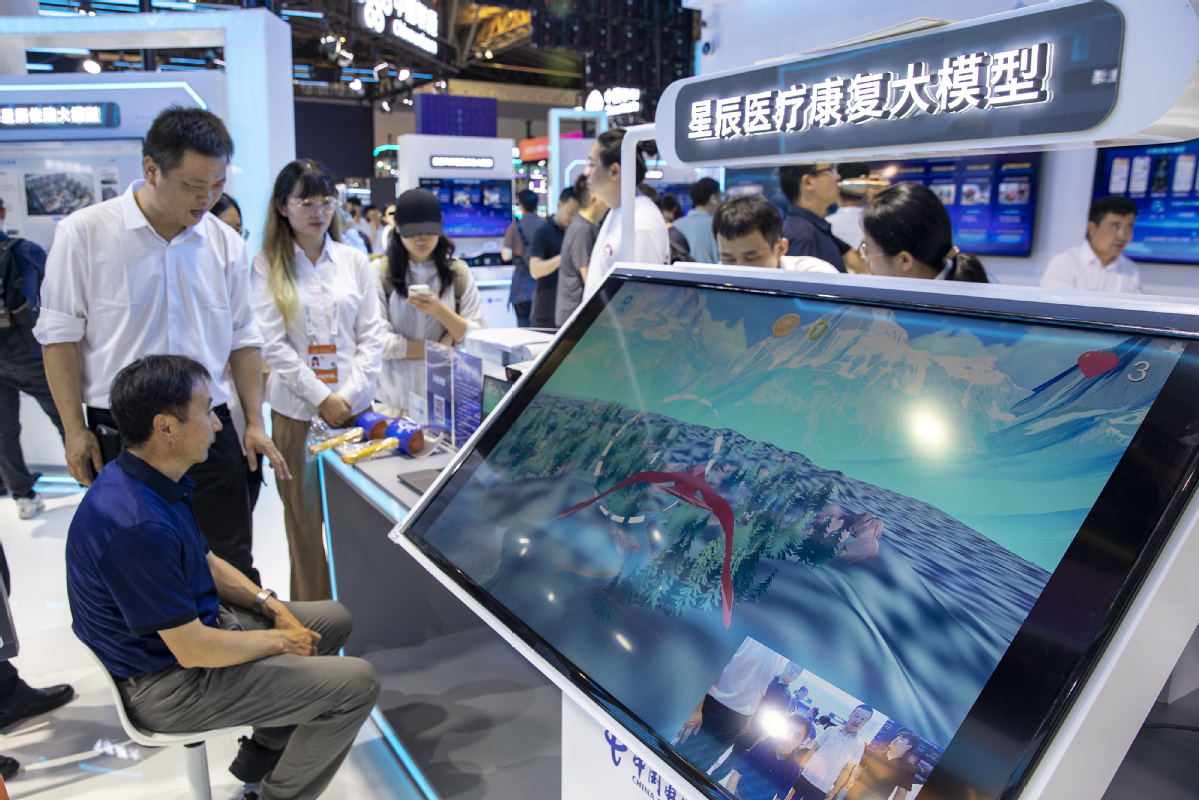
The "AI plus healthcare" is such a sector where AI technology is applied to improve accuracy and ease the burden on medical professionals. Many hospitals now use AI to analyze CT scan images and generate reports for doctors to review.
In February, China's first "AI pediatrician" began working at Beijing Children's Hospital. Powered by a large AI model, the system is trained on decades of medical records and expertise from over 300 leading pediatricians. It simulates human clinical reasoning to diagnose and treat rare pediatric diseases.
Epidemiologist Zhang Wenhong, a national political advisor, suggested that grassroots clinics increase their investment in AI to expand healthcare access and help bridge the expertise gap, particularly in regions with a shortage of professionals.
6G
For the first time, 6G technology was featured in the government work report this year, listed as one of the future industries China aims to foster.
The sixth generation of mobile communication technology represents the evolution beyond 5G, with most performance metrics expected to improve by 10 to 100 times. It is currently in the phase of standard research and formulation.
Industry insiders believe that 6G will not only involve more advanced wireless communication technologies but also deeply integrate cutting-edge innovations such as AI, cloud computing and edge computing.
Since the beginning of this year, several Chinese cities, including Beijing, Shanghai and Guangzhou, have proposed initiatives to accelerate the development of the 6G industry.
While the era of 6G has not yet begun, the widespread adoption of 5G has already provided a glimpse into a promising future.
With a lag time of less than a tenth of a second, 5G enables the remote operation of complex surgeries in regions facing a shortage of medical professionals.
In July last year, medical experts in East China's Shanghai worked with surgeons in Northwest China's Xinjiang Uygur autonomous region to successfully complete a lung tumor surgery for a middle-aged patient from Kashgar.


- Seven dead, 12 hurt as vehicle rolls over in Yunnan
- Purple sea of?catnip flowers?blooms in Shandong town
- 'Blue tears' turn Fuzhou's beaches fluorescent
- China-made marine-derived antitumor drug to begin combination therapy trials soon
- Wild apple trees create a poetic spring landscape in Xinjiang
- Tianjin town plays leading role in global instrument trade





