Passion for ice-and-snow sports fires up industrial fervor in northeast region









HARBIN — In the Baroque Museum in downtown Harbin, host city of the ongoing 9th Asian Winter Games, rows of ice skates lined up against a wall captivate the attention of winter tourists.
Liu Chang, collector of the skates, said the "relics", known as "Heilong Blades", were designed for speedskating and were manufactured by the Heilongjiang Ice Skate Factory back in the 1950s, making these some of the earliest domestically produced speedskating blades in China.
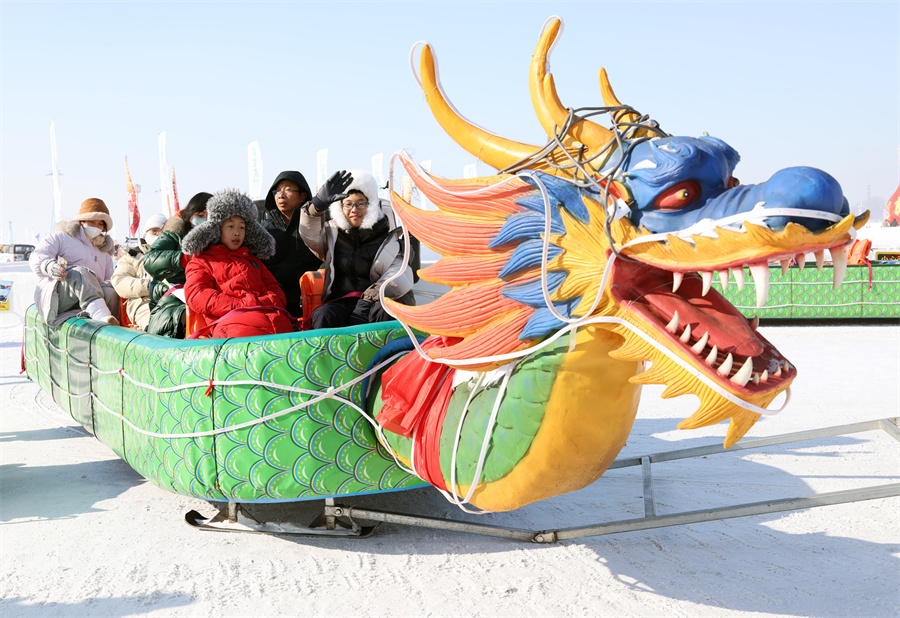
Harbin, capital of Northeast China's Heilongjiang province, is currently at the pinnacle of its ice and snow tourism season. The combined effects of the Games and China's broadened visa-free policies have led to a spike in tourists at this premium winter destination.
The city's landmark Harbin Ice-Snow World — the world's largest ice-and-snow theme park — had welcomed over 3 million person-visits so far this season as of Tuesday, setting a new attendance record just 52 days into its 26th edition.
Notably, the northeast was previously referred to as the country's "rust belt" after experiencing difficulties in terms of industrial transformation and development following its early fame as a major industrial base.
Liu said the skates displayed in the museum were collected to record the early stages of the city's transition from a heavy industry base to an ice-and-snow paradise.
Despite evident wear visible on the leather, the skates' blades still glisten brightly under the museum lights.
Liu said the nation's former heavy industry heartland saw the emergence of numerous steelmakers back in the day, among which was the predecessor of the Heilongjiang Ice Skate Factory, namely — Heilongjiang Hardware Factory.
"Responding to the national call of developing winter sports, engineers at the factory began trial production of the skates in 1954," Liu said.
In 1959, Harbin hosted the first National Winter Games of China, which triggered a surge in local ice-and-snow sports. As a result, "Heilong Blades" became highly sought-after commodities, and when the city hosted the 3rd Asian Winter Games in 1996, the popularity of the locally made skates soared.
However, the market environment underwent significant changes in the late 1990s, resulting in many local firms, including the Heilongjiang Ice Skate Factory, enduring the pain of transition. The factory ended up closing its doors in 2003.
Yet, the story of "Heilong Blades" didn't end there. Heilongjiang later managed to accelerate its industrial transformation, and its ice-and-snow economy — nurtured by the lasting winter sports culture — gained momentum, thus injecting vitality into ice sports equipment manufacturing.
In June 2015, Qiqihar Heilong International Ice and Snow Equipment Co Ltd was established, breathing new life into the production of "Heilong Blades".
Li Mingyang, head of the company's technology quality department, said by capitalizing on the booming ice sports and tourism markets, the company has grown into one of China's largest manufacturers of ice-and-snow equipment.
The company currently holds eight patents for ice sports products, while its robotic production line is capable of churning out up to 3 million pairs of skates annually, which are sold worldwide.
Li said the company has focused its latest research efforts on developing ultralight, high-strength alloys for ice skates. They have successfully broken through material technology barriers, allowing the company to enhance the performance of its ice sports equipment.
"We are upgrading a speed skating blade model featuring five-layer full-carbon materials. This upgrade will reduce weight and better support performance," he added.
The ice-and-snow sector has been identified as both a key economic driver and a vital means of promoting public fitness in China. The primary goal of the Beijing 2022 Winter Olympics was to "engage 300 million people in ice-and-snow sports" in China and promote leapfrog development of winter sports in the country.
China aims to boost its ice-and-snow economy, targeting an economic scale of 1.2 trillion yuan ($167 billion) by 2027 and 1.5 trillion yuan by 2030, according to guidelines released by the State Council last year.
With the hosting of the 9th Asian Winter Games and the flourishing of winter tourism, Heilongjiang is effectively transforming its ice-and-snow resources into economic opportunities — boosting the growth prospects of the cultural tourism, sports and equipment manufacturing sectors in the province.
More than 500 ice-and-snow events are planned to be held this winter in Heilongjiang, which is expecting to see an influx of visitors during the cold season.
Heilongjiang's industry and information technology department estimates that the province's ice-and-snow sector generated revenue of 5.47 billion yuan in 2024, a 7.9 percent year-on-year increase.
Ma Tao, dean of the Business School at Harbin Institute of Technology, said China's ice-and-snow economy is expected to break new ground and unleash more vitality with the integration of high-end industries such as equipment manufacturing, new materials and new energy, thereby creating new forms of consumption.
Xinhua