High definition









MA XUEJING/CHINA DAILY
The two sessions will demonstrate China's ability to respond to a changing global environment with strategic foresight
China's two sessions, the annual meetings of the National People's Congress and the Chinese People's Political Consultative Conference, usually held at the beginning of March, set the course for national policymaking in the coming year.
The NPC, with more than 2,900 members, is the largest legislative body in the world. The CPPCC is an advisory body in which the main groups that make up China's vast society provide their insights into the country's development priorities for the coming year.
The world has increasingly recognized the importance of these meetings, paying close attention to the discussions and outcomes. First, the two sessions offer a valuable window for foreign observers to better understand how China's political institutions function and how policies are formulated. Biases against China's political system are all too common, often leading to a failure to appreciate the roles of its institutions as defined by the country's Constitution.
Second, the annual Government Work Report delivered by the Chinese premier to the NPC provides a comprehensive synthesis of the country's economic, social and political developments over the past year and outlines the policy priorities that will guide the country in the months to come.
This year, the third session of the 14th NPC and the third session of the 14th CPPCC will take place at a crucial moment for both domestic and international reasons.
Since the 19th National Congress of the CPC in 2017, China has accelerated its transition from quantitative growth to high-quality development. This significant shift is not only reshaping Chinese society but also affecting the world, as the actions of a nearly $19 trillion economy have global repercussions. High-quality development prioritizes technological advancement, environmental sustainability and domestic consumption as key drivers of the economy. This year marks the end of the 14th Five-Year Plan (2021-25), a strategic blueprint aimed at fostering high-quality development.
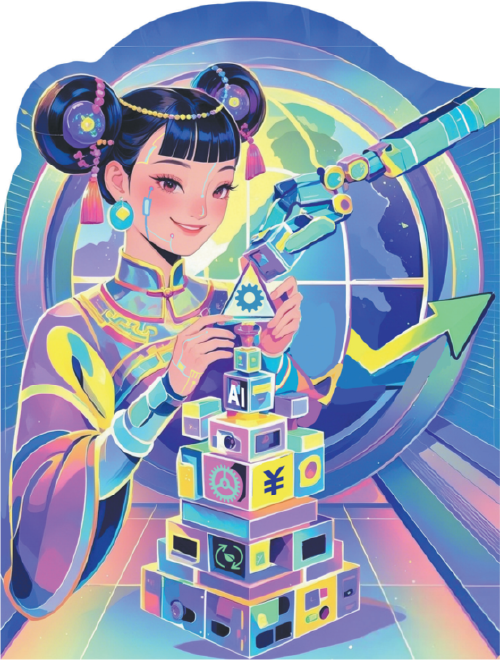
One topic that will undoubtedly be featured in discussions at the two sessions is the DeepSeek story. This breakthrough serves as a clear demonstration of China's growing capabilities in artificial intelligence and stands as a symbol of the country's push toward high-quality development. DeepSeek's success highlights China's ability to innovate at a world-class level, reinforcing its position as a major player in cutting-edge technology.
If China can replicate such achievements across a wide range of fields — including semiconductors, biotechnology and quantum computing — it will not only enhance its own economic and technological strength but also shape the future of global innovation. The ability to lead in these sectors would position China at the forefront of modernity, influencing industries, setting new standards, and competing with the most advanced economies. In this context, DeepSeek is more than just a milestone; it is a glimpse into China's broader ambitions for technological leadership in the 21st century.
Beyond domestic concerns, this year's two sessions will also serve as a forum for discussing China's foreign policy strategy, particularly in light of the return of Donald Trump to the US presidency. The world is watching closely to see how US-China relations will evolve.
During Trump's first term, US-China relations were marked by trade tensions, technological restrictions and geopolitical frictions. His administration imposed tariffs on Chinese goods, sought to curb China's technological advancements, and deepened military cooperation with allies in the "Indo-Pacific" region. While his successor Joe Biden largely maintained a firm stance on China, his approach was more multilateral and predictable.
It is an understatement to say that Trump's return to the White House introduces new uncertainties. His rhetoric on trade, security, and industrial policy suggests a potential continuation, or even escalation, of economic and technological competition between the world's two largest economies. After 10 days back in the White House, he announced that the US would impose an additional 10 percent tariff hike on all Chinese goods. On his first trip abroad as US secretary of state, Marco Rubio visited Panama and called for immediate action to counter so-called Chinese influence on the canal. The two sessions will provide an opportunity for Chinese policymakers to assess the early signals from the new US administration and to reach a consensus on how to respond.
The two sessions focus on stability and long-term planning, ensuring that external shocks, whether from economic disruptions or geopolitical shifts, do not derail the national goals.
This year, more than ever, China will seek to project confidence in its development trajectory while also preparing for potential headwinds from external factors. The Government Work Report will provide signals on how China plans to balance its economic reforms, technological ambitions and foreign policy adjustments in response to global uncertainties. Investors and business leaders worldwide will be eager to know China's growth target and the measures that will be taken to further stimulate the economy.
The 2025 two sessions will take place at a significant moment for China, both domestically and internationally. As the country advances its high-quality development agenda, discussions will center on technological innovation, economic resilience and sustainable growth. At the same time, Trump's return to the US presidency adds a layer of complexity to China's external relations, making this year's meetings particularly significant.
For foreign observers, the two sessions offer a glimpse into China's policymaking process, helping them to decode the country's priorities, challenges, and strategies for the year ahead. The outcomes of these discussions will not only shape China's future but will also have far-reaching implications for the world economy. The international system needs stability and predictability. The two sessions can signal that China remains a steadfast anchor.

The author is founder of the China-Europe-America Global Initiative. The author contributed this article to China Watch, a think tank powered by China Daily. The views do not necessarily reflect those of China Daily.
Contact the editor at editor@chinawatch.cn.