


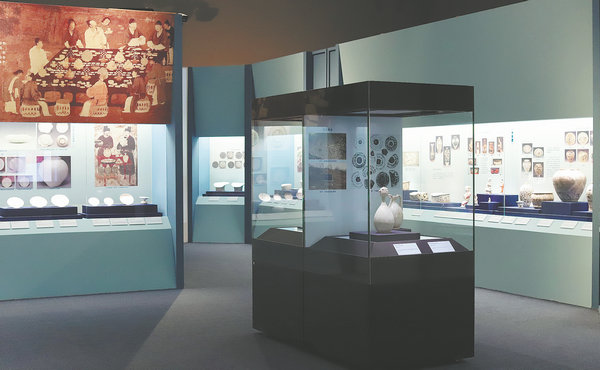
A tribute to this glamorous chapter in Chinese ceramic history can now be seen at Pure and Infinite, an exhibition at the Hebei Museum in Shijiazhuang, Hebei province, which runs until April 13.
It has been organized in collaboration with the National Museum of China and puts on display examples of white ware from the collections of both museums, as well as from other cultural institutions.
The exhibits include artifacts from the sites of historical kilns, some of which no longer exist, and work by contemporary artists that reflect the conservation of the white ceramic tradition, like Su's Paper series.
"The exhibition is a display of more than 300 pieces of the varying types of white porcelain from different kilns from across the country, from past to present," says Wang Yueqian, the exhibition's curator and a researcher at the National Museum of China.
"These sophisticated ceramics are radiant for their diversity and cultural content, and have inspired modern potters to explore new possibilities in the field. The kiln fire never dies, but erupts with innovative spirit," he adds.
Most ceramics before the 6th century were celadon, which is known for its pale blue-green glaze, and according to Wang, the earliest examples of white porcelain emerged during the final years of the Southern and Northern Dynasties (420-581).
The technique achieved maturity during the Sui Dynasty (581-618), as testified by the well-polished pieces found in an early 7th-century tomb near Xi'an, Shaanxi province.
"The Tang Dynasty (618-907) saw a situation of rivalry in which the production of celadon in the south and white ceramics in the north went neck and neck. White ware kilns were largely found in the north and led to the rise of types named after their distinguished kilns," Wang says.





