A million years of human history in Kenyan majesty
From ancient stone tools to volcanic landscapes, explore the beautiful natural and cultural heritage that defines the Olorgesailie site









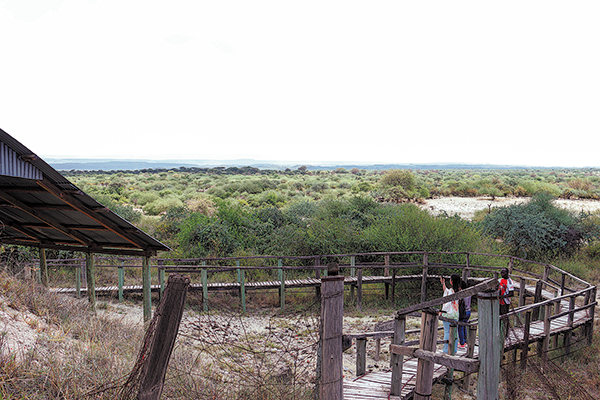
Located 90 kilometers southwest of Kenya's capital Nairobi lies the Olorgesailie Prehistoric Site, dubbed the world's "factory of stone tools".This title stems from the large concentration of ancient tools, specifically hand axes, unearthed at the site, which date back millions of years.
Spanning an area of 50 hectares in the Great Rift Valley, between the extinct volcanoes of Mount Olorgesailie and Mount Oldonyo Esakut, the site is a memorable experience, rich in historical significance, and draws archaeologists, paleontologists, geologists, and visitors with a passion for human evolution.
Olorgesailie is a trove of in situ prehistoric materials, including hand axes, armor stones, flakes, and bones from extinct species of hippopotamus and elephant, deposited more than a million years ago.
Robert Opuka from the National Museums of Kenya based at Olorgesailie says the site has been revealing prehistoric materials since 1919, when British geologist John Walter Gregory discovered hand axes near Mount Olorgesailie while exploring for minerals in East Africa.
In the 1940s, British-Kenyan paleoanthropologists Louis and Mary Leakey conducted the first excavations at the main site following Gregory's notes, unearthing more hand axes. Later, in the 1960s, South African archaeologist Glynn Isaac expanded research through further excavations and geological studies as part of his dissertation.
Opuka says the artifacts found at Olorgesailie are associated with Homo erectus, an early human ancestor, based on sedimentary dating.
"Isaac carried out a lot of archaeological work around understanding the behavior of Homo erectus and the surrounding environment. He also produced a lot of documentation in regard to Homo erectus in Olorgesailie, Turkana, and the Omo River in Ethiopia," he said.
After Isaac's death in 1985, the site remained largely dormant until the late 1980s, when Richard Potts, director of the Human Origins Program at the Smithsonian Institution in California, took up the work, Opuka says.