


Chinese expertise helps restore damaged monument in Nepal
Conservationists from Hebei spend years in Kathmandu to rebuild iconic structures damaged by earthquake










Great responsibility
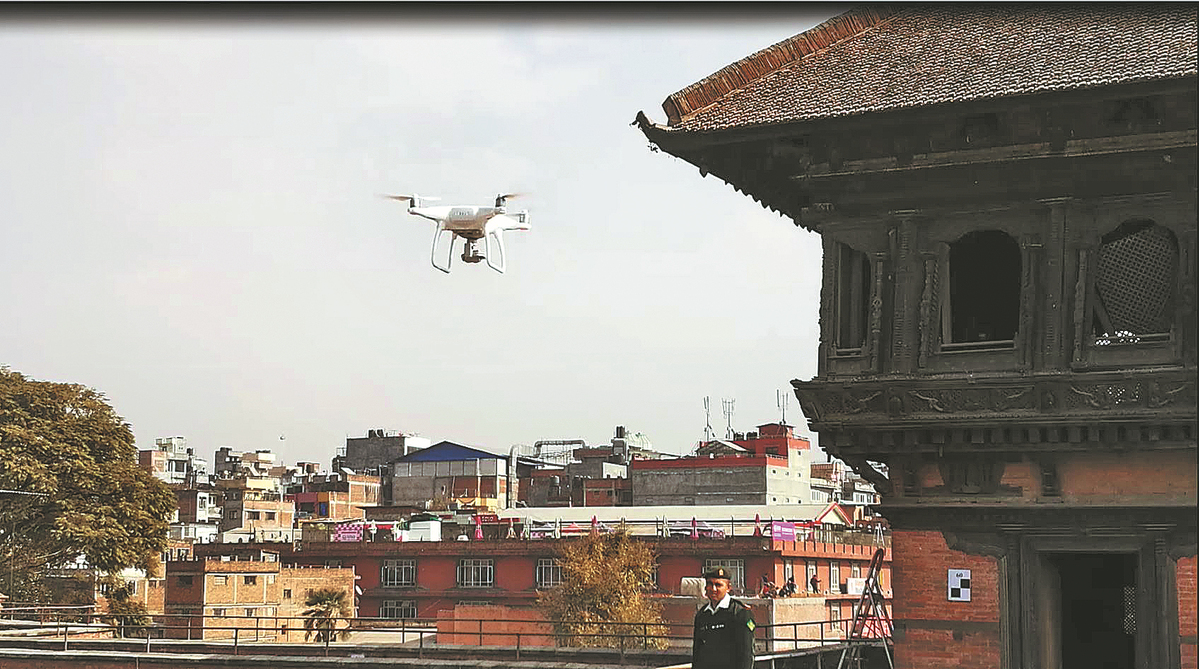
Sun was the person in charge of surveying and designing the restoration process of the nine-storied Basantapur Tower and its auxiliary buildings at the Durbar Square in Kathmandu.
"It was a great honor to participate in the restoration project, not only because it's an important cultural heritage site, but also because me and my team members established a deep friendship with the Nepalese people," Sun said.
On April 25, 2015, the Basantapur Tower and its surrounding buildings — a tower at each corner of a Lohan Chowk yard at the Durbar Square — were seriously damaged by an 8.1-magnitude earthquake that devastated the Himalayan nation.
The top three layers of the tower at the southwest corner — the Basantapur Tower — and the sixth layer of the tower at the northeast corner collapsed completely. The walls of the complex buildings were left leaning in places and cracked, Sun said.
"I have been working on maintenance of ancient buildings for more than three decades. Seeing such important cultural relics with a long history being destroyed by an earthquake like that was very upsetting," Sun said, adding that she also felt a great sense of responsibility for restoring it to its original state.
The Basantapur Tower and its auxiliary buildings were designated as part of the Kathmandu Valley that was inscribed on the World Heritage List in 1979.
Built between the 17th and 18th centuries, the complex consists of a four-story square courtyard called Lohan Chowk and four towers located at the four corners.
It was an important part of the Hanuman Dhoka Palace, which served as the royal palace of the Malla Dynasty (1328-1768) and the Shah Dynasty (1768-2008) in Nepal, according to Liu Zhongwei, head of the Hebei Institute of Cultural Heritage and Ancient Architecture Preservation.





