Trump to start tariffs on China, Canada and Mexico on Feb 1









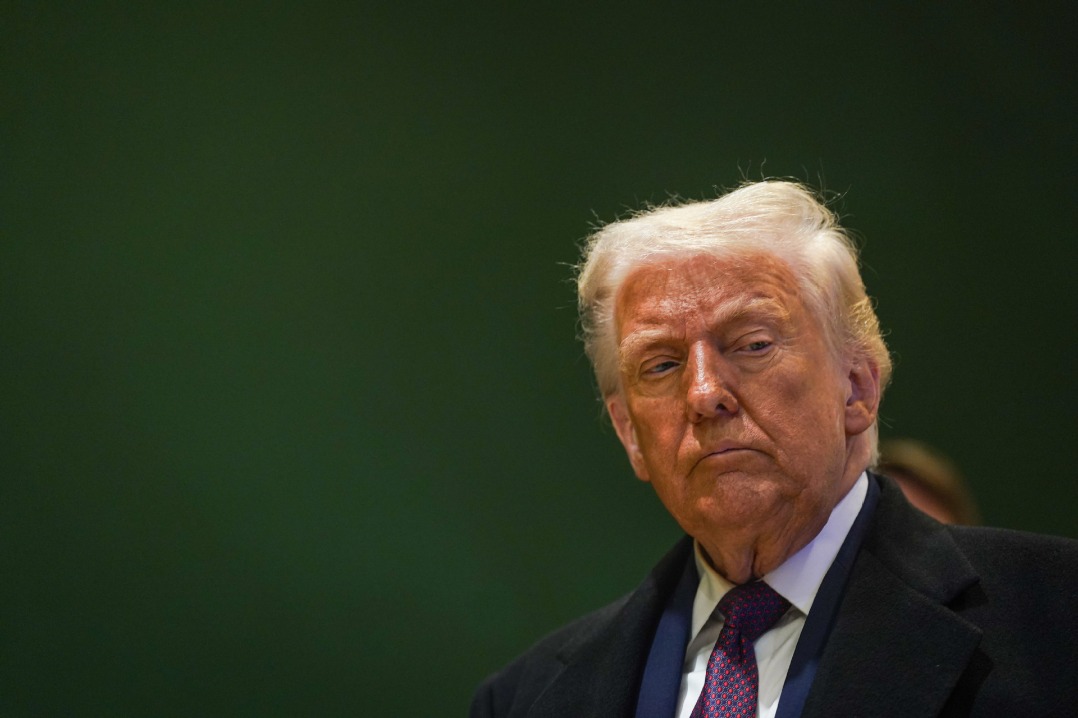
US President Donald Trump will go ahead with tariffs of 10 percent on Chinese goods and 25 percent on imports from Canada and Mexico, effective Feb 1.
Experts said the move, which comes while trade between the United States and China remains robust, could result in significant changes in global trade.
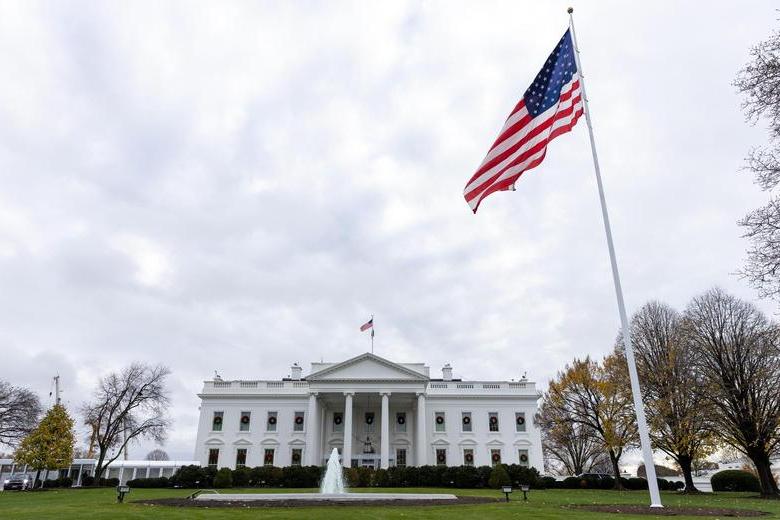
"I can confirm that, tomorrow, the February 1 deadline President Trump put into place with a statement several weeks ago continues," White House press secretary Karoline Leavitt said Friday.
Trump told reporters in the White House Oval Office on Thursday he would go ahead with tariffs on Mexico, Canada and China to address the large number of undocumented migrants and fentanyl coming into the country. He also aims to boost American manufacturing.
"We're going to be putting tariffs on steel, aluminum, and ultimately copper," he said at a news briefing Friday. "Copper will take a little longer, but it will happen quickly.
"We're going to build a tariff wall to bring pharmaceuticals back to America. The way to do that is by putting up a wall — a tariff wall," he added.
Thomas Fullerton, an American economist and economics professor at the University of Texas at El Paso says that there are several reasons that Trump touts tariffs as a policy that will help US consumers, manufacturers and businesses when numerous studies and economists have found it could raise costs.
"The president and a subset of his advisers seem to believe that the global intra-industrial structure of the US economy is less dependent on production sharing than is actually the case," Fullerton told China Daily.
"Companies from Germany, Japan, South Korea, Taiwan, Canada, France and other high-income countries also depend on intra-industrial ties to remain competitive, but the advisers to whom the president is listening seem to believe that the most wealthy economy can play by a different set of rules."
Data showed US seaports handled the equivalent of 451,000 40-foot containers of goods from China in December alone, a year-over-year increase of 14.5 percent, according to trade data supplier Descartes Systems Group.
Overall trade between the US and China accelerated in the last month of the year, as companies imported goods early to get ahead of tariff threats. For 2024, according to US government data, the country imported more than $401 billion worth of goods from China while exporting slightly less than $131 billion worth.
Imports of machinery, bedding, plastic toys and other products from China rose 15 percent in 2024 from 2023, according to Descartes. Some firms stockpiled goods.
Frederic Neumann, chief Asia economist at HSBC in Hong Kong, told Reuters there had been an "uptick in the exports of final goods from China to the US, as importers aim to front-run possible tariffs on consumer items".
Many companies decided to import goods "earlier" than usual to not just avoid the threat of tariffs but to avoid any strikes at ports, Jonathan Gold, president of supply chain and customs policy at the National Retail Federation, told China Daily.
While trade between the US and China was brisk last year, since 2018, the original round of tariffs imposed on China by the Trump administration and those kept and extended by President Joe Biden's administration have altered the relationship.
The Peterson Institute for International Economics (PIIE) in Washington DC concluded that in 2018, "two-way commerce between China and the US was $659 billion".
"Canada was second, with two-way commerce of $618 billion, and Mexico was third with $610 billion. But in 2024 … Mexico was first with $848 billion in two-way commerce, Canada was second with $764 billion, and China was third with $578 billion."
Fullerton said that a better way for the US to address competition with Asian countries would have been to join the Comprehensive and Progressive Agreement for Trans-Pacific Partnership.
In 2016, the Trans-Pacific Partnership was a proposed free trade agreement between 12 countries in Asia. While it was signed in 2016, the US never ratified it.
Trump's tariffs are, in part, to encourage Americans to shop at home more. He also wants manufacturers to relocate back to the US or produce more here.
Fullerton adds: "As trade barriers, 'tariffs' can also cause domestic industries to become less competitive."
Mary Lovely, professor emeritus of economics at Syracuse University and a senior fellow at PIIE told China Daily that tariffs will hurt US consumers' wallets and "take a larger share of income from poorer households than richer households".
Before the tariffs were enacted, many of the goods arriving in the US from Mexico and China were allowed to cross the border tariff free, under the United States-Mexico-Canada Agreement of 2020 — an agreement negotiated by Trump to replace the North American Free Trade Agreement, or NAFTA.
Both countries are heavily reliant on their trade relationship with the US. Mexico sends about 80 percent of its exports to the US.
Canada sends around 75 percent of all its goods and services and exports to the US, its largest trading partner. At least $2.5 billion worth of goods is traded with Canada per day, creating an $800 billion-a-year trade relationship.
And while the US is the world's largest oil producer, it mixes its home-grown lighter crude oil with heavier oil from Canada to make gasoline and diesel. The United States imported almost 4.6 million barrels of oil daily from Canada in October, and 563,000 barrels from Mexico, according to The Associated Press.
At least 60 percent of that oil is imported from Canada, and about 7 percent from Mexico.
When asked on Friday if the Feb 1 tariffs would apply to Canadian oil, Trump said: "I'm probably going to reduce the tariff a little bit on that. We think we're going to bring it down to 10 percent for the oil."
In 2023, US trade of both goods and services with Canada and Mexico was worth than $1.8 trillion, compared with $643 billion with China, Reuters reported.
All three key trading partners have repeatedly said that they wanted to avoid conflict over tariffs and could hit back with their own levies.
President Claudia Sheinbaum of Mexico told reporters Friday that Mexico wanted to avoid tariffs but "are prepared for any scenario".
Ding Xuexiang, vice-premier of China, told the World Economic Forum in Davos, Switzerland, that Beijing also was looking for a "win-win" solution to trade tensions.
Canadian Prime Minister Justin Trudeau told an advisory council on Canada-US relations on Friday that Ottawa will bring a "forceful but reasonable" reaction to tariffs imposed by the US.
- US Fed keeps interest rates unchanged at 4.25-4.5 percent as inflation picks up
- Tesla suing EU over tariffs on China-made EVs
- Tesla, BMW join Chinese EV makers in challenging EU tariffs
- US not to impose tariffs as Colombia agrees to accept deportees: White House
- Trump imposes 25-pct tariffs on Colombia after 2 US deportation flights denied landing