"The more species there are, the healthier the environment will be"










Zhai Weiwei, 40, a plant science writer based in Nanjing, the capital of Jiangsu province, was talking with Xin Wen.
Fascinated by plants from a young age, I switched careers to become a dedicated plant science communicator from an electronic countermeasure engineer. Though I didn't follow a traditional academic path in botany, my passion for plants has been a constant.
After quitting my engineering job in 2019, I went to the Xishuangbanna Tropical Botanical Garden in Yunnan province and listened to lectures on botanical research for half a year.
I love plants and birds. Whenever I see rare plants, I take photos. While I adore the aesthetic beauty of plants and birds, I find myself drawn more deeply to their intrinsic nature.
I remember one early December trip to Beijing when I saw a string of bright and eye-catching small yellow fruits of a parasitic plant on the outskirts of the capital city. They were visible from afar, standing in sharp contrast to the dreary wintry scene of the northern forests.
The plant, called Loranthus tanakae, is a species under the Loranthaceae family of the Loranthus genus. It grows a cluster of green leaves in the summer, mostly hidden within the lush canopy of trees, hardly noticeable. Only when the wind blows does it rustle gently.
It is not until the winter, when the leaves of big trees have fallen, that the plants emerge from the nooks and crannies.
The leaves of Loranthus tanakae disappear in winter, leaving only the bright yellow small fruits occupying the surrounding trees such as oaks, hazels, elms and pears, plundering their water and nutrients to survive.
Next to the Loranthus tanakae was another member of its species, the Viscum coloratum. While the fruits of the Loranthus tanakae are yellow, the Viscum coloratum's fruits come in two colors, red and yellow.
Although both plants live off the stems of certain trees, they each have their own stems and leaves, allowing them to perform photosynthesis to some extent and not rely entirely on their host. They prefer to grow in the upper parts of large trees. The Viscum coloratum remains evergreen throughout the year.
I read research published by the journal Flora in July 2021, indicating that the color of the two types of plants' fruits is not directly related to the type of host. Instead, it is somewhat related to the geographical locations where the plants are grown.
According to the study, in Northeast China, the proportion of red fruits in the extreme north is apparently high, exceeding 70 percent, whereas in some southern areas of the country's northeastern regions, the proportion of yellow fruits takes the majority.
During cold winters, plants employ various strategies to endure freezing temperatures. They relocate essential nutrients from their leaves to their roots, where they are better protected.
Additionally, plants increase the concentration of their cell sap to prevent freezing. Deciduous plants, those that shed their leaves seasonally, further conserve energy and water by dropping their foliage.
Some parasitic plants are generally thought to be detrimental to nature. But in my view, parasitic plants are part of nature.
Their existence is justified and they are the result of evolution. When they couldn't compete with autotrophic plants, they chose a different path.
There is no good or bad for the parasitic plants. Only if they impact our lives negatively, then it will be a problem.
For nature, the more species there are in a place, the more stable the climate and structure will be. It resembles a food chain, with three or four species. If one species collapses, the whole chain could fall apart. But in an ecosystem, like a network, the more species there are, the healthier the overall environment will be.
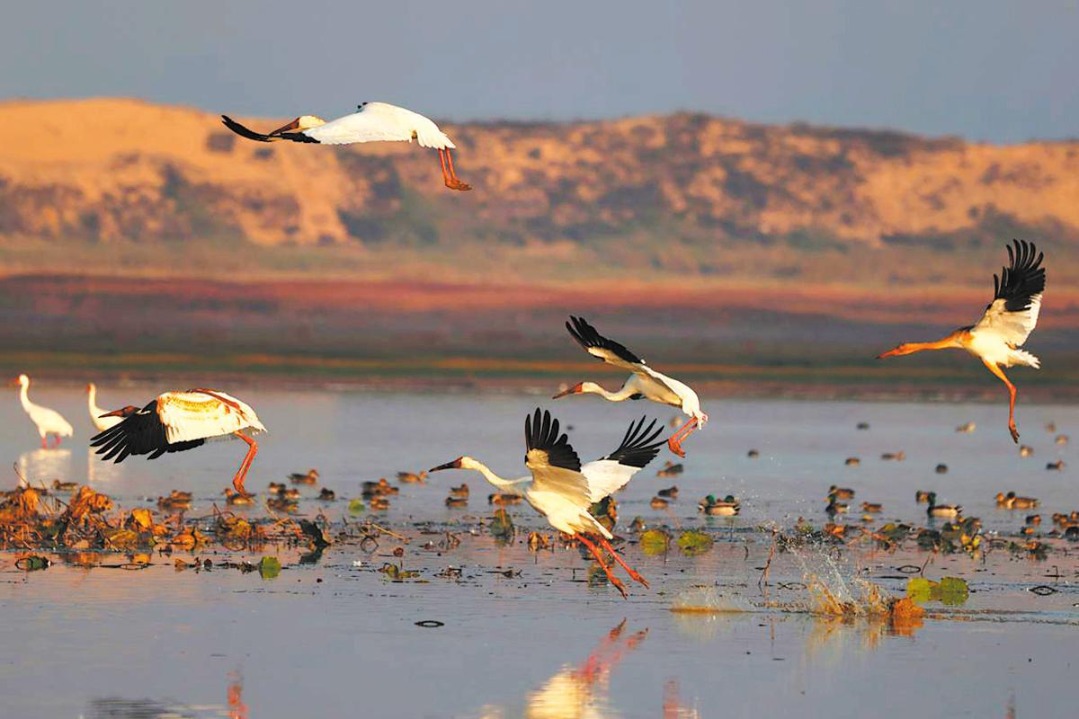
Overwintering birds, or small rodents, can find the colorful fruits of parasitic plants as one of the few food sources available in the cold winter. Birds can also help the dispersal of the parasitic plants' seeds to propagate.
In the future, I hope more people, not just children, will be interested in appreciating the beauty of plants and eager to learn more about them.





- Over 7.3 million people recorded as registered organ donation volunteers in China
- China says Nipah outbreak poses limited risk
- PLA's aerobatic jets arrive in Singapore to take part in air show
- China's garbage sorting drive still has a long way to go in many cities
- Former Chengdu official Bao Hui under investigation
- Bouncy fish ball captures the attention of Guangdong deputies