


Journey of oriental civilization launched in Beijing










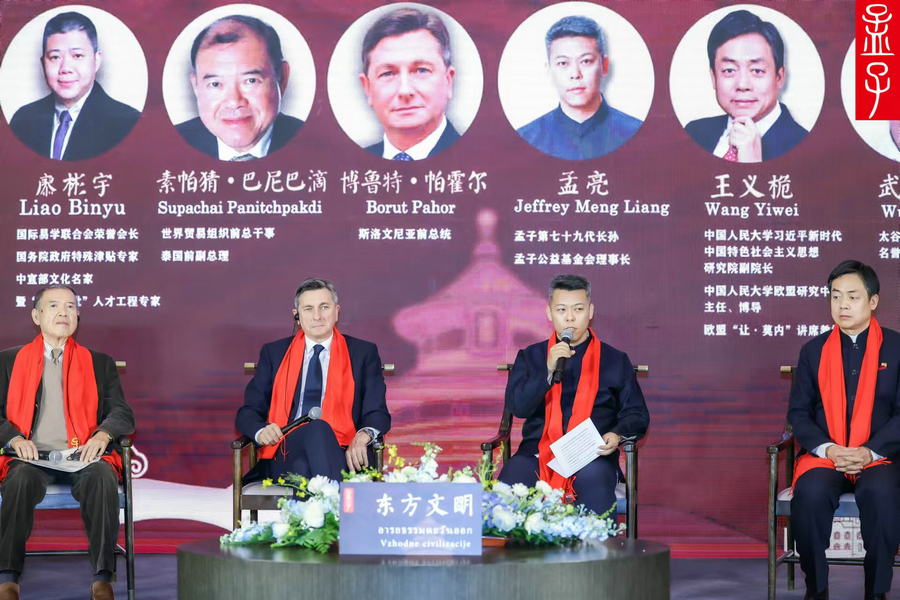
Alongside the launch event, Meng engaged in a dialogue centering on traditional Chinese medicine (TCM), I-Ching, and the wisdom of Mencius, with several Supachai Panitchpakdi, former director-general of the World Trade Organization, Borut Pahor, former president of Slovenia, and other notable figures from home and abroad.
Meng argued that in international cultural exchanges, TCM embodies a gentle, balanced, and enduring health concept, offering a complementary, alternative solution to Western medicine.
He also believed that the dialectical thinking embodied in I-Ching, or The Book of Changes, resonates with Western philosophy, providing global thinkers and scholars with new dimensions of thought and a source of inspiration.
Meng also emphasized that adopting beliefs worldwide, such as the inherent goodness of human nature and prioritizing righteousness and benevolence over profit and personal gain, as advocated by the ancient Chinese philosopher Mencius (c. 371-289 BC), could lead to a better and more harmonious world.
"We have to learn to be able to live with the difference but also to be able to make use of the vast commonalities that exist among different cultures around the world," Panichpakdi said, arguing that such is in line with the aim of the forums and dialogues organized by the Mencius Foundation.
Panichpakdi said seeking a balance between opposites and respecting nature are two fundamental principles in traditional Chinese culture, which TCM, I-Ching, and Confucianism epitomize. These can be of reference value for contemporary world leaders to cope with climate change and disputes.
Pahor pointed out that historically, TCM began to be understood by the West in the 17th and 18th centuries through merchants and cultural exchanges and had a significant impact on the West in the 20th century. He also noted that Westerners have come to realize that the adoption of TCM can be an asset created by civilizational dialogues.
Pahor believed that the integration of traditional wisdom and modern innovation, regardless of East or West, would help all humanity to advance together. He advised that both the East and the West need to rediscover the wisdom of balance and harmony in Chinese traditional culture, which can help the fragmented modern world reintegrate.





