Warm shelters built for all in Xizang's quake zone









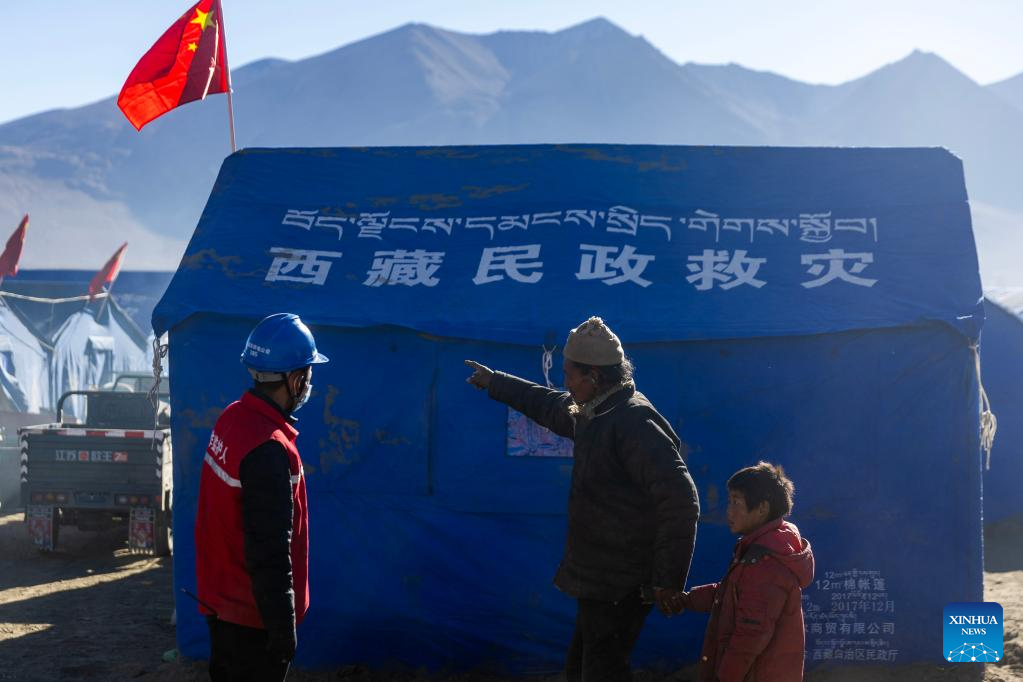
LHASA -- On Sunday morning, at a newly-built resettlement site in the earthquake-struck county of Dinggye, Southwest China's Xizang autonomous region, children were doing their homework inside warm makeshift houses, undisturbed by occasional jolts of aftershocks and the chilling winds howling through the Himalayas.
In neighboring Dingri county, Tsering Pingtso, Party chief of Gurum village, told Xinhua that he no longer worries about his villagers, as all of 107 people in the quake-hit village had moved from tents to makeshift houses by Friday, three days after the earthquake.
On Jan 7, a 6.8 magnitude earthquake hit Dingri, home to the northern base camp of the world's highest peak, Mount Qomolangma, leaving 126 people dead and hundreds injured.
"Now, four to five people share a board house, each with an area of 18 square meters and supplied with electricity, folding beds, tables and stoves. The villagers can now live comfortably during the winter cold," said the village official.
The quake zone, situated at an altitude of more than 4,000 meters above the sea level, is experiencing its coldest time of the year. Keeping quake victims warm is the top priority of the on-site quake-relief work.
After the conclusion of the search for victims, the focus of rescue efforts has shifted to relocation of affected villagers and post-disaster reconstruction, local authorities said.
Within days, 224 relocation sites have been set up in affected areas, accommodating 47,500 people, while 12,730 tents have been erected and 12,043 heating facilities have been installed.
Local authorities and rescue teams have been busy erecting more makeshift houses, allowing displaced residents to move from tents to more earthquake-resistant and warm housing.
The swift decisions made by China's top leadership to mobilize all resources to save lives and support post-disaster recovery are driving the effective relief efforts.
"Each household is allocated with two board houses, plus their previous tents," said Mima Tsering, chief of Gojag township.
People live in the makeshift houses, while the tents are for storing essential supplies and food, he said, adding there are stoves in the houses and people use cow dung and sheep dung they collected as fuel, which is the usual local practice.
Although fast-built, these makeshift houses have good sealing and thermal insulation performance. They also boast certain disaster-proof functions to protect people from earthquakes, fires, wind and rain.
By Saturday afternoon, all the resettlement sites in the epicenter area had been connected to stable power supply. Many settlements in the counties of Dingri and Dinggye have been covered by the telecom network, allowing villagers to watch Internet TV.
As Gurum village achieved full Wi-Fi coverage, children were excited and asked if they could watch a movie.
At the resettlement sites, Xinhua reporters saw the food supplied had changed. It used to be mainly emergency supplies of instant noodles and bread, but now people have rice, flour, cooking oil, beef, mutton and vegetables.
It is not easy to ensure hot meals on the high plateau. Tao Mingjun, Party chief of the Dinggye county, said they have done their best to supply food that caters to the habits of the local people, providing salt, tea, beef and mutton. They also provide cooking utensils suitable for plateau regions, which can overcome the problems of low air pressure and low boiling point of water.
According to the State Grid Xizang Electric Power Co Ltd, after connecting the resettlement sites to power facilities, they are laying power lines to public facilities such as medical sites.
After the earthquake, the central authorities quickly allocated 42,000 pieces of relief materials such as tents, quilts and folding beds. Local authorities dispatched 73,000 pieces of electric blankets, heating stoves, quilts, clothes and blankets, among others. Enterprises, foundations, and philanthropists also provided 350,000 pieces of relief materials to the quake zone.
"No one shall be left out to suffer from hunger and cold here. We'll work meticulously to make sure of that," said Tashi Dondrup, head of Dingri county.





- Intl students showcasing global business acumen in Shanghai
- CPC expels former senior official of Guangxi
- Shanghai university unveils sustainable, efficient water treatment system
- Fire at auto business park in Jiangsu claims one life
- Magnitude 6.0 earthquake strikes Akqi county in Xinjiang
- Shenzhou XXI team to carry out first spacewalk