Washington's tariff policy will increase its domestic taxes









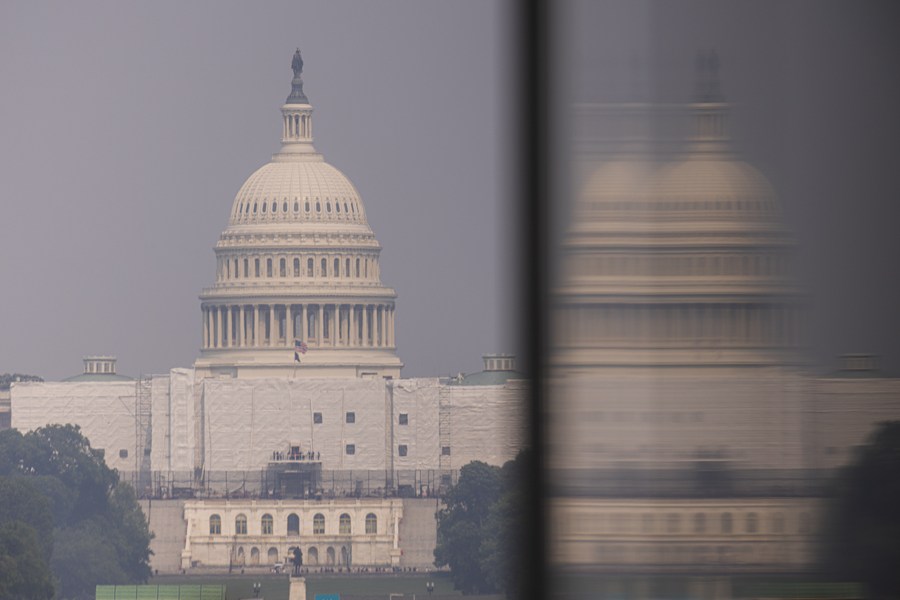
Every week, the United States seems to unveil new plans for a colossal tariff scheme, which could reshape global trade dynamics in the quest to "Make America Great Again".
US President-elect Donald Trump said in November he planned tariffs of 25 percent on all imports from Canada and Mexico and 10 percent on all imports from China on day one of his new administration.
The US has already imposed a 25 percent tariff on a vast range of Chinese goods, dating from Trump's first presidential term in office. US president Joe Biden imposed a new 100 percent US tariff on all Chinese electric vehicles, a 25 percent tariff on lithium-ion EV batteries, and a 50 percent tariff on photovoltaic solar cells. A 50 percent tariff on semiconductors made in China has gone into effect since the start of this year.
Subsequent discussions on all these extant and proposed tariff measures have been dominated by an examination of the grave threat they pose to healthy, desirable levels of global trade.
There is, however, another less-headlined, crucial change embodied in all this prodigious tariff planning. If even half of the tariffs being proposed or threatened are implemented, the US is set to experience the most radical reform of its taxation system seen in decades — all unfolding behind an extraordinary political smoke screen. It is instructive to consider how this has happened.
Here is the Oxford online dictionary's definition of a tax: "A compulsory contribution to state revenue, levied by the government on workers' income and business profits, or added to the cost of some goods, services and transactions."
A curious aspect of the US taxation system is the comparatively low fiscal importance of consumption or sales taxes. Unlike most developed jurisdictions, the US has no modern valued added tax or goods and service tax that applies to consumption — only old-style retail sales taxes. Major changes to this outdated system have long been stoutly resisted. However, things now look set to change dramatically.
Consider this figure from a recent CNN report: the US today is massively reliant on the annual import of more than $3 trillion in consumer goods — above all from China — to sustain its preferred lifestyle. As they arrive in the US, new, frontloaded consumption taxes are thus about to be imposed at greatly increased levels on a vast range of crucial, imported consumer items.
But wait — Trump says that is not what is about to unfold (and perhaps water is not wet). He claims that China and other countries will pay "trillions and trillions of dollars into the United States Treasury" under his burgeoning tariff regime.
According to Douglas Irwin, an economics professor at Dartmouth College quoted in the CBS report, this is a "very misleading way to say what is going on". It is US consumers who will pay these imposts. This is a federal tax whereby money is transferred "from consumers to the federal government".
A recent study by the nonpartisan Congressional Budget Office, requested by the Senate Budget Committee, confined itself to examining a 10 percent across-the-board tariff lift combined with a 60 percent additional tariff on all goods coming from China — notably less than an entire sequence of Trump tariffs threatened so far.
The consequences arising from introducing this limited spectrum of new tariffs, according to the CBO, include a 1 percent increase in inflation by 2026, an average increased cost to every US family of $1,560, and significant price increases of consumer and capital goods.
The CBO also estimated that the tariffs studied would shrink the US economy by $165 billion by 2034 raising around $3 trillion in fresh revenue over the same period. Somewhat more gloomy estimates from the Tax Foundation confirm these figures.
According to the US Treasury, the country's national debt in 2024 was $35.46 trillion or 123 percent of GDP. Many commentators expect the debt level to rise, partly to allow the new Trump administration to reduce taxation levels that apply to the super-wealthy (many of whom have spent heavily to ensure Trump's election).
Treasury funds raised by the projected imposition of greatly increased de facto consumption taxation on over 300 million US citizens are also, according to this argument, set to be deployed to assist in this same tax relief project.
An initial tariff-based, sales tax reform scheme was road-tested by the first Trump administration. Now the US looks set to experience a full-blown version of this covert, revolutionary reform of consumption taxation.
Many leading US media outlets seem to have averted their gaze as this fiscal "pea and thimble trick "unfolded before their eyes. It helped, too, that the Biden administration had already proved that it "loved tariffs" almost as much as Trump. Have the US' primary political parties and the mainstream media conspired against the voters? It is undoubtedly hard to recall a comparable example in the developed world where primary taxation reform has been achieved by relying to such a degree on collective, influential stealth.
The author is an adjunct professor in the faculty of law, Hong Kong University.