



Animating tradition









Unfinished, the animated finale of Black Myth: Wukong, resonates with audiences worldwide.
The first Chinese AAA game, Black Myth: Wukong, inspired by the classic novel Journey to the West, has become a global sensation since its release in August this year. Every aspect of the game — from its music and songs to its animations — has been in the spotlight, including Unfinished, the ending clip of chapter six, and its director Yang Tingmu.
"I've watched several reaction videos from international fans, and I was surprised to see that many of them were moved to tears," said Yang, founder of Fantasier Animation.
For him, the ability of something so inherently Chinese to resonate with global audiences lies in the uniqueness of the animation.
"When you truly incorporate your emotions and cultural identity as a Chinese person, this sentiment can reach foreigners too. Even if they aren't familiar with the story of Journey to the West or the visual style we used, they can sense that the product is cohesive in every aspect and feel emotionally connected to it," he explained.
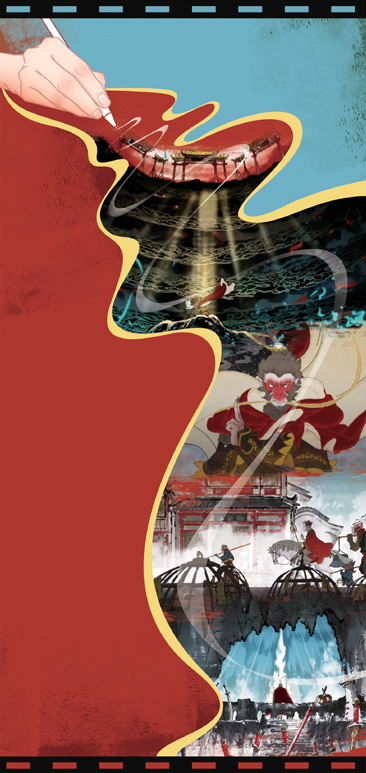
Yang credits the success of the clip and its reflection of Chinese culture to a collaborative effort: the dialogue is taken from the original novel, the music is inspired by the theme song of the 1986 TV adaptation of Journey to the West, and the character Wukong is influenced by its Peking Opera portrayal.
However, the unique animation of the Chinese lianhuanhua (palm-sized comic books) is solely the work of Yang and his team. They initially explored various painting styles, including traditional Chinese water and ink, before ultimately choosing the lianhuanhua aesthetic.
"Lianhuanhua-style illustrations are familiar to most Chinese people, but no one has seen them animated before," Yang noted. "This blend of familiarity and novelty creates a unique effect."
Yang conducted extensive research, drawing inspiration primarily from traditional baimiao, or ink line drawing. One of his main sources was the work of Li Gonglin (1049-1106), a Northern Song Dynasty painter renowned for this technique.
"My goal is to restore the ancient essence of Journey to the West," Yang explained. "I wanted to steer clear of contemporary animation techniques, and Li Gonglin's style was exactly what I needed."
Yang was also deeply inspired by the murals in Dunhuang, Gansu province, which he studied to capture intricate details, like the folds in clothing. Another major influence was the artist Dai Dunbang, who created an entire set of artworks based on Journey to the West.
"I have several of Dai's painting albums and would carefully study how he uses specific symbols and images in his work," Yang said.
Even with thorough research and preparation, the project remained challenging for Yang and his team, as they were not only reviving a traditional style but also pioneering a new approach: animating lianhuanhua.















