Renewals, trade-ins unlock investment, consumption
Households in China have combined total of more than 3 billion major home appliances and over 300 million automobiles










Faced with a cloudy external environment, particularly in terms of the global trade landscape, by channeling resources toward initiatives that can directly boost domestic demand, the government can create a more stable foundation for economic development, Wen added.
In a production workshop of Wison Group, a Zhoushan-based offshore engineering company in Zhejiang province, a new batch of fully automated production lines has been put into operation to undertake the manufacturing of modules for floating liquefied natural gas facilities.
"In the first half of this year, we invested 540 million yuan to purchase new machinery and equipment, which is more than five times the amount compared to the same period last year," said Xu Tianfeng, the company's chief financial officer. "After the equipment update, we have been able to accept a wider range of high-tech manufacturing tasks, which has greatly broadened our company's business horizons."
To address the financing needs of enterprises undertaking equipment upgrades, the People's Bank of China, the country's central bank, has, in coordination with relevant departments, established a 500 billion yuan re-lending facility for technological innovation and technical transformation, with an interest rate of 1.75 percent.
The re-lending facility, which channels low-cost funds to banks for on-lending to eligible enterprises, is a crucial tool to empower businesses to invest in advanced technologies and the equipment they need to enhance their competitiveness and drive sustainable growth, said Peng Lifeng, deputy head of the bank's financial market department.
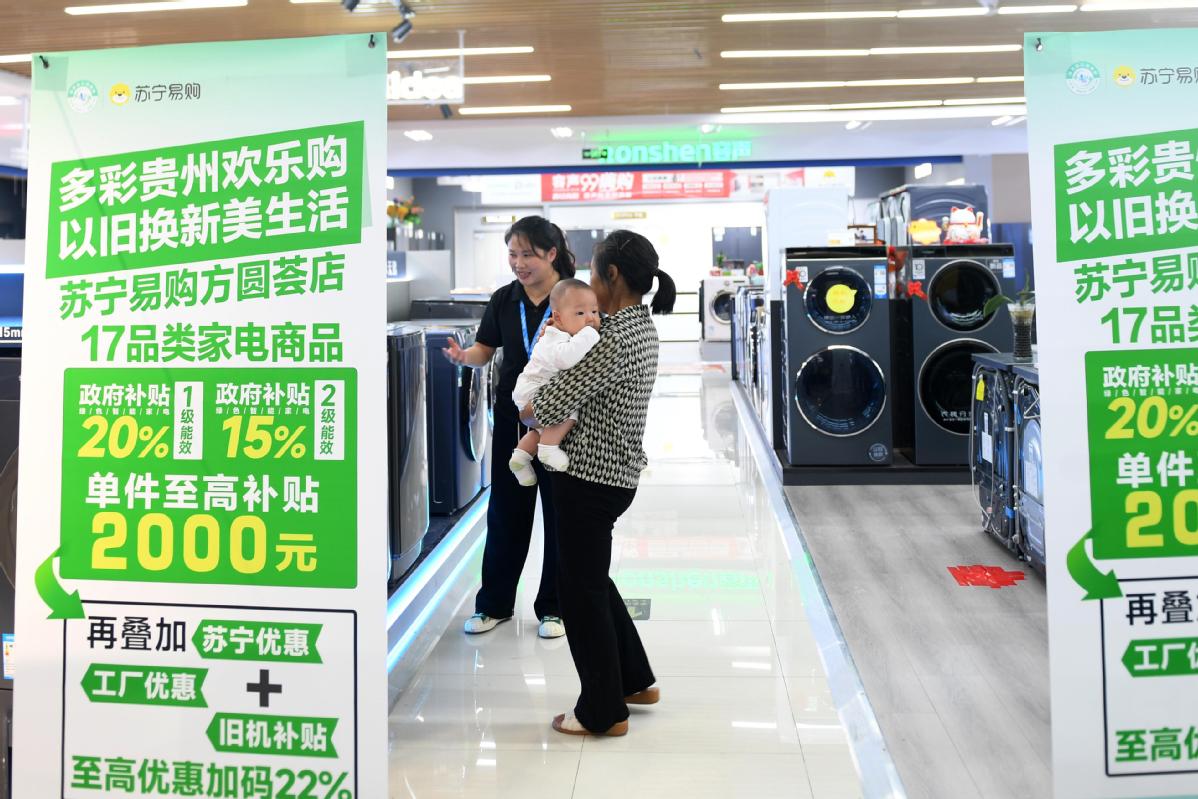
In addition to the large-scale equipment renewal, the trade-in policies, which offer incentives for consumers to replace their existing goods with newer models, have stimulated demand and facilitated the upgrading of consumer durables, according to officials and experts.
Currently, China's households hold more than 3 billion major home appliances and over 300 million automobiles, signaling vast potential for upgrades and replacements, according to the commission.
The rollout of "trade-in" policies across various regions has led to a significant increase in the sales of key consumer products, as shown by recent data.
The China Automobile Dealers Association reported that nationwide passenger vehicle retail sales reached over 2 million units in September, a substantial 9 percent increase from the previous month. Notably, new energy vehicle retail sales soared to more than 1.1 million units, a 9 percent jump compared to August.
Data from the National Bureau of Statistics showed that the retail sales of household appliances and audio-visual equipment registered a 20.5 percent year-on-year increase in September, accelerating 17.1 percentage points from the previous month.
The implementation of trade-in policies for consumer goods has also indirectly driven investment growth and improved profitability across related industries, said Wen Hua, deputy director-general of the commission's department of resource conservation and environmental protection.
In the first eight months of the year, investment in the consumer goods manufacturing industry increased by 14.9 percent year-on-year. In August, the value-added output of the consumer goods manufacturing industry grew by 4.2 percent year-on-year, with the growth rate accelerating compared to July, Wen said.
The trade-in programs create a win-win scenario, benefiting both enterprises and households, said Xu Hongcai, deputy director of the China Association of Policy Science's Economic Policy Committee.
"These targeted initiatives not only spur sales for manufacturers and retailers, but also enable consumers to access more advanced and efficient products, ultimately contributing to the improvement of living standards," Xu said.
In Hangzhou's Shangcheng district, the first trade-in model apartment for age-friendly home renovations in Zhejiang province has been unveiled. The apartment features renovations focused on improving safety for using the restroom and bathing, indoor mobility, smart monitoring, and the installation of assistive equipment.
"As a central urban area of Hangzhou, Shangcheng district has a high concentration of elderly residents, with 249,000 elderly people aged 60 and above, accounting for 27.6 percent of the total population," said Ping Yuan, deputy director of the district's civil affairs bureau.
Ping said that by including a range of age-friendly products and materials as part of the "trade-in "subsidy program, the goal is to integrate these adaptive solutions into the living spaces of the elderly, enhancing their safety and convenience.
Industry insiders believe that the increased participation of e-commerce platforms and the innovation of e-commerce services have made the trade-in channels more accessible and the experience more seamless, which can effectively enhance consumers' willingness to make purchases and further unlock the potential of domestic demand.
Chinese e-commerce giant JD.com has joined forces with over 100 home appliance and furniture brands, committing 3 billion yuan to fund trade-in subsidies and service upgrades. Using air conditioners as an example, JD.com has streamlined the process from the previous two or three visits to a one-stop service that includes both delivery and installation.
Another major e-commerce platform Tmall has cumulatively invested over 700 million yuan this year to increase the subsidies and expand the coverage of its trade-in program.
Tmall has also upgraded its "last-mile" service experience, offering nationwide one-visit delivery and installation for large products such as air conditioners, refrigerators, washing machines, and TVs.
According to the China Galaxy Securities Research Institute, the current round of trade-in policies is expected to drive the replacement of approximately 60 million home appliances, leading to nearly 100 billion yuan in total home appliance consumption.