



Tianlai's entry can draw more 'pathfinders'









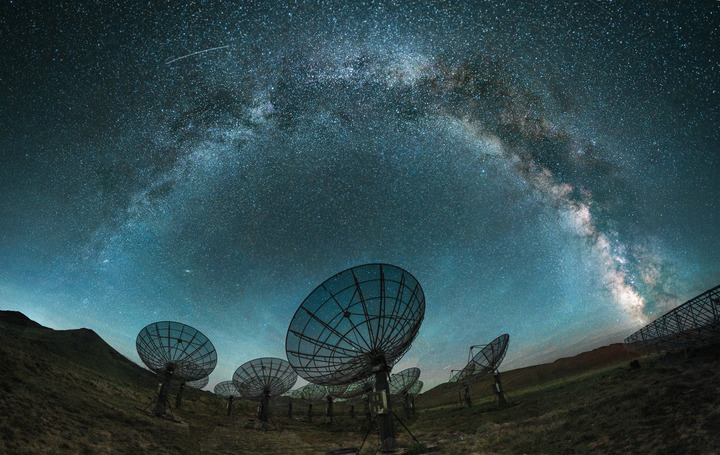
China's Tianlai Experiment, a scientific project aimed at detecting dark energy using a radio telescope array, has been granted the "pathfinder" status by the Square Kilometer Array (SKA) Observatory, an intergovernmental radio telescope project. The move enhances the whole organization's ability to further uncover secrets of the universe and grant relevant researchers across the world new opportunities.
When completed, the SKA will be the largest radio telescope array in the world, with its official members spread across China, South Africa, the United Kingdom, Australia and six other nations. While its goal is to explore the universe, its different members have different advantages. There's the Australian Square Kilometre Array Pathfinder, which is a synthesis array consisting of 36 dish antennas, each 12 meters in diameter, spread out in two dimensions with baselines up to 6 km long that make it highly sensitive to radio waves with frequencies in the range of 700 to 1,800 MHz.
The Murchison Widefield Array, made of 4,096 spider-like antennas, is tuned to receive signals of frequencies ranging from 70 to 300MHz, ideal for discovering the formation of galaxies and nebulas.
China's Tianlai adds a new dimension to the common endeavor. Tianlai, which means "heavenly sounds", is good at searching for the 21-centimeter signals emitted by hydrogen atoms, which have gradually shifted to longer wavelengths, in a process called "redshift", with the expansion of the universe. By observing how the expansion rate of the universe changes over time, scientists will further analyze the abundance and dark energy properties, which, believably, make up 70 percent of the universe and drive its expansion but cannot be observed directly. Besides, China also has the Wukong dark matter explorer satellite, which together with Tianlai grants the nation leadership in dark matter detection.
That's China's contribution to the world and also the significance of SKA, which allows different participants to exert their potential to deepen knowledge about everything. With Tianlai being granted the status, more observatories over the world will hopefully join the family of "pathfinders" in the future for a common endeavor.





