'New style' wave combines the past and modern









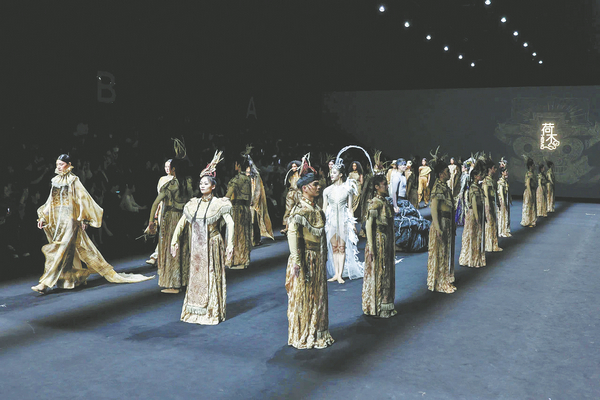
In fabric creation, Goldlion 3388 employs techniques such as jacquard weaving, burn-out printing, and three-dimensional embroidery to give clothing a unique visual expression.
In addition to advocating sustainable design, the new Chinese-style brand Tuyue is particularly meticulous in exploring the authenticity of culture. Yang Yingying, the founder of Tuyue, says: "By consulting various sources and striving to acquire as much knowledge background as possible, we then contemplate how to apply it — whether through inheritance or innovation."
Apart from fashion shows, the Oriental. Neo Chinese-Style Show Exhibition kicked off at the West Bund, along with a forum that invites experts and designers to discuss the future of this style.
According to Zhang Wei, vice-president of Pop Fashion, one of the largest clothing design information platforms in China, industry data indicates that from January to October 2023, the number of posts related to new Chinese style on lifestyle-sharing platform Xiaohongshu increased by 110 percent compared to the same period in 2022.
While xinzhongshi has emerged as a crucial symbol in the Chinese fashion industry, the subsequent topics that arise need be addressed.
Zhang suggests that a key challenge lies in breaking the homogenization of this style.
"China's textiles offer a vast realm for exploration. Our textile craftsmanship is exceptionally refined, encompassing intangible cultural heritage that provides a rich tapestry of materials and cultural backgrounds," Zhang says. "However, it also confronts challenges. Preserving the original craftsmanship of intangible cultural heritage materials often gives rise to concerns such as cost and production cycles. However, China's modern textile technology is already among the most advanced in the world, so we are certain to find a solution."
Chai Fangjun, chairman of Dingtian Fashion Textile Technology, echoed that his company is actively engaged in tackling the problem.
"Homogenization arises from the difficulty in personalizing fabrics. Balancing small batches, diverse varieties, personalization, and large-scale production poses a paradox," says Chai.
Chai's company started digitalization in 2009 and has achieved the ability to quickly create original samples. Currently, the company boasts 150,000 digital assets that can address the majority of questions from personalized designers and support color swaps based on these 150,000 samples.
heqi@chinadaily.com.cn