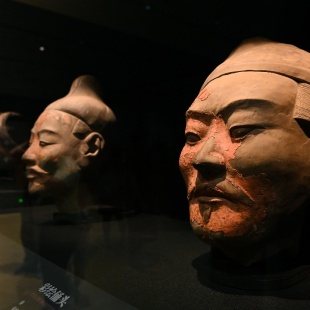



First emperor still fascinates with his treasures
Exhibition showcases priceless artifacts from mausoleum of Qinshihuang, report Wang Ru in Beijing and Qin Feng in Xi'an.










Unity drive
One of the biggest contributions of Emperor Qinshihuang, people generally believe, is that he established a central dynasty that united China and implemented a series of policies to consolidate unification, like the unity of words, currency and measurements according to historical literature, which then has a long-lasting influence on later dynasties in China. That can be evidenced by some unearthed artifacts.
A bronze bobweight on display has two engraved edicts of unifying measurements — one from 221 BC, the year Emperor Qinshihuang established the Qin Dynasty, and the other from 209 BC, the first year of his son's reign.
"The bobweight is about 256 grams. It was unearthed from the Siguan Site between the inner and outer walls in the west of the mausoleum. We believe it was a standard measurement to be promoted across the dynasty," says Ye.
"Unification of such things actually laid a solid foundation for the unification of China since the Qin Dynasty."
Qin implemented a rigorous management system inherited from the Spring and Autumn Period (770-476 BC). This system mandated that craftspeople engrave their names on the artifacts they produced, holding them accountable for the quality throughout their lifetimes.
Concrete evidence of the system is a bronze halberd from Terracotta Warrior No 1 Pit, which bears inscriptions confirming it was made in 242 BC by craftsman Cheng. Official Zhe and his assistant Yi from Sigong, an institute that governed weapon-making, were responsible for its quality and the production was supervised by counselor-in-chief Lyu Buwei (292-235 BC).
"Emperor Qinshihuang established a united dynasty with multiple ethnic groups and consolidated his unification with a series of political systems. Such a great cause required efficient management. This system just reflects the accuracy and efficiency of his governing," says Ye.